
Expanding your food delivery business to a new city is not a marketing decision — it is an operational one. Most operators who try and fail do so not because their food is wrong or their brand is weak, but because they move before their systems can carry the weight of two markets at once.
At Deonde we provide the technology backbone for over 300 delivery businesses across more than 24 countries.
We have seen exactly what causes a new city launch to fail, and more importantly, we know exactly what makes it succeed. Expanding today requires a sharp, data-first approach. You cannot just guess where people want food; you have to know.
The North American online food delivery market hit $38 billion in 2024 and is on track to reach $105.8 billion by 2033, according to IMARC Group. That growth is real, but it is not evenly distributed across cities. Some markets are saturated.
Others are dramatically underserved. Knowing which is which — and knowing whether your own backend can handle the jump — is what separates operators who scale cleanly from those who burn cash trying.
This guide is written for the four types of operators who ask us this question most often: food delivery startup founders who have found product-market fit in one city, restaurant owners who want to reach customers in new markets without opening full brick-and-mortar locations, multi-location operators managing delivery across several outlets, and entrepreneurs building delivery-first brands from scratch.
The roadmap applies to all four — though the cost assumptions and tech requirements vary, which we will address specifically.
5 Signs Your Food Delivery Business Is Ready to Expand to a New City
Before spending a dollar on a new market, run through this checklist honestly.
- Your current city’s delivery zones are consistently maxed out. If you are regularly declining orders or watching delivery times creep past 45 minutes during peak hours, you have hit capacity — not demand. That is the right signal.
- You have a documented, repeatable operations process. If your kitchen relies on one chef who “just knows” how things work, expansion will unravel quickly. A new city needs a process, not a person.
- Your unit economics are profitable at the order level, not just on paper. Restaurant operators on third-party platforms typically pay 15–30% commission per order. If your margins only look good in a spreadsheet and not after platform fees, figure that out before adding a second city’s overhead.
- You have at least 90 days of operating cash in reserve. A new city will not be profitable in the first 60–90 days. That is normal. What kills operators is running out of cash waiting for it to work.
- Your technology can support multi-location operations without you manually managing each one. This one is the most overlooked and we will spend significant time on it below.
If you can confirm all five, you are genuinely ready. If three or four are true, the gap is usually operational — not market-related — and is worth fixing before moving.
How to Choose the Right City to Expand Into (This Is Where Most Operators Go Wrong)
Almost every article about restaurant expansion tells you to “research your target market.” That is obvious advice that does not tell you what to actually look at. Here is the framework we recommend.
Look at delivery demand density, not just population size. A city of 400,000 people with high delivery order frequency is a better target than a city of 900,000 where 70% of residents eat at home with groceries. Delivery app rankings by market — DoorDash publishes quarterly data on its most active markets — give you a concrete starting point. In 2024, the top markets by delivery order volume in the US were New York, Los Angeles, Chicago, Houston, and Phoenix. But the highest-growth emerging markets were mid-size metros: Nashville, Austin, Charlotte, and Columbus, where delivery infrastructure is expanding but competition is less entrenched.
Find the cuisine gap, not just a market. The smartest expansion move is entering a city where your specific cuisine is in demand but underrepresented at the delivery level. If you run a halal chicken concept and the city’s halal delivery options are limited to two restaurants, that gap is more valuable than a large city with 60 competitors in your category.
Assess your delivery radius cost. A city with a dense downtown and walkable neighborhoods has a tighter, more efficient delivery radius. A sprawling suburban market with spread-out order locations will drive up your per-order driver cost significantly. Before choosing a city, map out what a 3-mile and 5-mile delivery radius looks like in terms of addressable households.
Check the competitive dynamic on third-party platforms. Search your cuisine category on DoorDash and Uber Eats in the target city.
If the first page is dominated by national chains with 10,000+ reviews, building organic visibility there will take 12–18 months. If you see a mix of local operators with 200–400 reviews, you can compete within 60–90 days.
Proximity to your current market matters more than you think.Toast’s expansion research notes that word-of-mouth from your existing market travels most effectively to cities within a 3–4 hour drive.
Slutty Vegan, the Atlanta-based plant-based burger brand, used Atlanta’s reputation and social media following to generate demand in Birmingham and Charlotte before opening there — a pre-sell strategy that cut their launch marketing spend significantly.
Two Expansion Models: What Your Budget Actually Gets You
This is the number most articles avoid giving you directly. Based on current US operator data, here is what each expansion model costs.
Cloud kitchen in a new city: $30,000–$80,000
This covers commercial kitchen lease (shared spaces in most cities run $1,500–$4,000/month), kitchen equipment if the facility is not already equipped, initial food inventory, basic local marketing, and platform onboarding fees. Franklin Junction — the ghost kitchen technology company named to Fast Company’s Most Innovative Companies list — demonstrated this model at scale when it partnered with Denny’s in January 2024 to launch virtual restaurant concepts across at least 250 Denny’s locations, adding a new revenue stream without a single new physical location.
Cloud kitchens can reach break-even within 6–10 months and generate profit margins of 20–25% once volume is established. A single cloud kitchen location generating $30,000 in monthly revenue can net $4,500–$7,500 in profit per month. That is the upside. The downside is brand invisibility — without a physical presence, trust-building takes longer and relies entirely on your digital presence and review volume.
Traditional brick-and-mortar delivery location: $185,000+ in year one
This includes lease, fit-out, front-of-house setup, staff, permits, and working capital. The 66% cost difference between this model and a cloud kitchen is not abstract — it is $100,000+ in capital that would otherwise fund driver recruitment, local marketing, and tech infrastructure in the new city.
Use the first 6 months to validate demand, build your review base, and establish driver relationships before committing to a permanent location. This same lean infrastructure is often utilized by founders who start a food delivery startup to keep initial capital expenditure low.
This is exactly the lower-risk approach that makes cloud kitchen expansion so attractive for delivery-first brands.
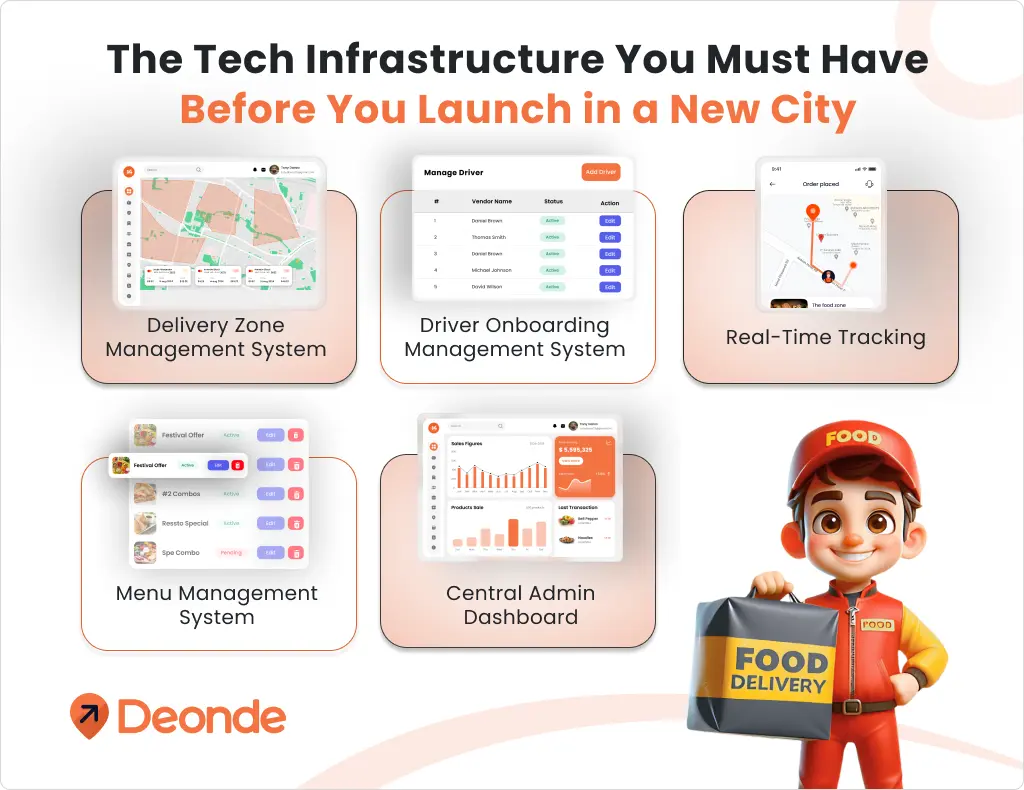
The Tech Infrastructure You Must Have Before You Launch in a New City
This is the section most expansion guides skip entirely, and it is the one that causes the most operational failures.
When you operate in one city, gaps in your technology are manageable — you can make a phone call, walk into the kitchen, or manually intervene. When you operate in two cities simultaneously, those gaps become outages. Here is what your platform must be able to do before you go multi-city.
- Separate delivery zone management per location. Your delivery zone configuration in City A should not affect your City B radius. This sounds obvious but is a real operational problem for businesses running on basic ordering systems that do not support multi-location zone logic.
- Driver onboarding and management that works in a new market from day one. You need to be able to recruit, onboard, and dispatch drivers in the new city without creating a parallel manual process. A proper driver management system lets you configure driver pools per city, track earnings, handle settlements, and monitor performance from a single admin dashboard — not a separate spreadsheet per location.
- Real-time tracking visible to the customer, not just the dispatch team. Customers in a new city have no existing trust in your brand. Every delivered order is a trust-building moment. An order that arrives with no tracking visibility and no ETA communication is a negative review waiting to happen.
- Menu management that can vary by location. Your new city may have different supplier costs, different regulations around certain ingredients, or simply different demand patterns. You need to be able to push a different menu — or a different pricing tier — to your new location without affecting your original market.
- A central admin dashboard that gives you performance visibility across both cities. If you are checking two separate systems to understand your combined daily order volume, average delivery time, and driver utilization — you are already behind. Multi-location restaurant management should consolidate all of this into one view.
If your current platform cannot do all of the above, fix that before you expand. Adding a second city to a broken tech stack does not dilute the problem — it doubles it.
Building Brand Trust in a City Where Nobody Knows You
This is the strategic gap that separates operators who launch and struggle from those who launch to a waitlist.
Start building a presence 60 days before you take your first order. Create a city-specific Instagram account or geo-tag your content to the new market. Partner with 2–3 local micro-influencers (10,000–50,000 followers) in the food space to post before your launch. Their audiences are in the city. Yours are not — yet.
Use a pre-launch offer to collect early customers. A “launch week” promotion — first 200 orders get 30% off — does two things: it generates initial review volume quickly, and it gives you a real test of your operations under demand conditions in the new city. 200 orders in the first 5 days tells you everything about your kitchen throughput, driver coverage, and delivery time accuracy.
Seed your third-party platform listings before you go live. On DoorDash and Uber Eats, new listings start with zero reviews. Ask your most loyal customers from your existing city who may have friends or contacts in the new market to leave early reviews. A new listing with 15–20 reviews on day one performs significantly better in platform search than one with zero, regardless of food quality.
Partner with a local business for cross-promotion. A well-known local coffee shop, gym, or retailer in your target neighborhood will have an audience that trusts them. A co-promotion — “Free delivery on your first order from [Your Brand] — partnered with [Local Business]” — borrows that trust at a fraction of the cost of paid advertising.
Managing Multi-City Delivery Operations Without Losing Your Mind
Once you live in two cities, the operational challenge shifts from launch to consistency. The brands that scale successfully across cities are the ones that treat hyperlocal delivery as a system problem, not a management problem.
Standardize your packaging and food quality protocols before launch, not after. Every driver in City B who picks up an order should be packaging it the same way your City A drivers do. Build a driver onboarding document that covers packaging standards, handoff protocol, customer communication expectations, and what to do when an order has an issue. This takes 2 hours to create and saves you 20 hours a month in customer complaint resolution.
Set city-specific delivery time benchmarks, not one universal standard. A 28-minute average delivery time in a dense urban market like Chicago may actually be harder to achieve than 35 minutes in a suburban Atlanta delivery zone. Benchmarking against your own city’s geography rather than a generic industry number gives you an accurate picture of performance. We have seen operators penalize their drivers in a new market for not hitting times that were physically impossible given the route density — a fast way to lose your driver pool in a new city.
Optimize routes before drivers start, not after. Delivery route optimization in a new city requires learning the road patterns, traffic peaks, and parking constraints that your original city did not have. Build at least 2 weeks of route data before drawing conclusions about your delivery cost per order in the new market.
Why Owning Your Delivery Platform Matters More at Multi-City Scale
This is a conversation that changes significantly when you go from one city to two.
At one location, paying 15–30% commission to DoorDash or Uber Eats on every order is painful but manageable. At two locations with combined monthly revenue of $80,000–$120,000, that commission line becomes $12,000–$36,000 per month leaving the business. At that scale, building and owning your direct ordering channel — your own app, your own website ordering, your own driver fleet — stops being a “nice to have” and becomes a margin decision.
Operators using a white label food delivery platform can accept direct orders through their own branded app and website, pay zero commission per order, and retain full customer data across both cities. That customer data — order history, preferences, delivery address, reorder frequency — is what powers the loyalty programs, push notifications, and personalized promotions that third-party platforms will never share with you.
The practical approach for most expanding operators: maintain your third-party platform presence for discovery (it still drives new customer acquisition effectively), and actively migrate your repeat customers to your own platform for reorders. A repeat customer ordering directly through your own channel instead of DoorDash saves you $4–$9 per order on a $30 ticket. At 1,000 repeat orders a month across two cities, that is $4,000–$9,000 back into your margins every month.
That is the financial case for owning your platform before you expand — and it gets stronger, not weaker, with every new city you add. Explore how on-demand delivery software built for multi-market operations can support this from day one.
Conclusion: Launching Smarter, Not Harder
Expanding a food delivery business into a new city does not have to be a blind gamble. The era of winning a market by spending the most money on advertising is completely over.
At deonde, we know that the companies winning in 2026 are the ones acting like smart tech companies. By mapping your city block by block, using rock-solid white-label software, building tiny micro-hubs, and locking in loyal customers with subscriptions, you can enter any new market with absolute confidence.
You keep your costs low, your deliveries fast, and your customers happy. This is how you don’t just survive your first year in a new city—this is how you take it over.
FAQ
Q1. How do I know if my food delivery business is ready to expand to a new city?
Ans: The clearest signals are: consistent profitability in your current market, delivery zones that are regularly at capacity, a documented operations process that does not depend on one person, 90 days of operating cash reserves, and a technology platform that supports multi-location management. Meeting all five indicates readiness. Meeting three or four usually means there is an operational fix needed first.
Q2. What city should I expand my food delivery business to?
Ans: Focus on three factors: delivery demand density relative to existing competition in your cuisine category, proximity to your current market (within 3–4 hours tends to support organic word-of-mouth), and the cost-efficiency of the delivery radius given the city’s geography. Mid-size metros — Nashville, Charlotte, Columbus, Austin — are showing the strongest growth in delivery demand with less competitive entrenchment than major metros.
Q3. How much does it cost to expand a food delivery business to a new city?
Ans: A cloud kitchen entry costs $30,000–$80,000 and can reach break-even within 6–10 months. A traditional brick-and-mortar delivery location in a new city typically requires $185,000+ in the first year. For most operators making their first city expansion, the cloud kitchen model significantly reduces risk while validating the new market.
Q4. How do I build brand trust in a new city where I have no existing customers?
Ans: Start 60 days before launch: partner with 2–3 local micro-influencers, run a pre-launch promotion to collect early orders and generate reviews, seed your third-party platform listings through your existing customer network, and co-promote with a trusted local business for early audience borrowing.
Q5. Should I use third-party delivery apps or my own platform when expanding to a new city?
Ans: Use both — but with a clear strategy. Third-party platforms drive discovery and new customer acquisition in the new city. Your own ordering platform retains repeat customers commission-free and gives you ownership of customer data across all your cities. The goal is to acquire customers through platforms and migrate loyal reorder customers to your own channel over time.
Q6. How do I manage delivery operations across two cities without building separate teams for each?
Ans: The answer is centralised technology, not centralised headcount. A single admin dashboard that covers delivery zones, driver management, menu configuration, analytics, and customer data for both cities lets a lean operations team manage multi-city delivery without duplicating roles. Define your standards, document your processes, and let the platform enforce consistency.