The “get-anything-delivered” industry has completely changed how we shop and eat.
Postmates was a major force in this revolution, building a brand around ultimate convenience.
Before its acquisition by Uber Eats, it held approximately 8% of the U.S. food delivery market, placing it as the fourth-largest service at the time.
But what was the Postmates business model that powered this service?
The company’s journey reveals a difficult path, marked by fierce competition and high costs.
This all led to a turning point: its acquisition by Uber.
This blog examines the mechanics of its model, its revenue generation, and what its story signifies for the future of on-demand logistics. Let’s dive into the strategy behind the billion-dollar sale.
What is Postmates?
Craving anything from a late-night burger to a last-minute charging cable? Just Postmate it!
Postmates versatile delivery mobile app lets you get almost anything delivered to your doorstep in just a few taps. Founded in 2011 and headquartered in San Francisco, Postmates is a pioneer of the “anything-on-demand” delivery model in the USA.
While other apps focused only on food, Postmates started as a logistics provider for everything—groceries, alcohol, electronics, and personal items. In 2020, Postmates was acquired by Uber for $2.65 Billion, but it still operates as a standalone brand with a massive user base.
And that’s not all. Postmates has grand plans to dominate the hyper-local delivery space by leveraging Uber’s massive driver network. In 2026, Postmates integrated AI-driven logistics to ensure even faster deliveries across 3,500+ cities in the US.
Today, Postmates operates as part of Uber’s delivery infrastructure, leveraging the company’s resources and technology to continue serving millions of customers.
How does Postmates Work?
Postmates operates as an aggregator marketplace platform, connecting users to some of the best hyper-local vendors and merchants. Let’s walk you through its primary workflows:
- Customers Place Orders: Users login to the Postmates app, find their nearby favorite restaurants or stores, customize items, and pay using desired payment methods.
- Order Fulfillment: Merchants accept the order, prepare it, and assign it to nearby delivery partners.
- Delivering Orders: Partners (The Fleet) accept the request, pick up the parcel, and deliver it to the customer’s address within the estimated delivery time.
What is the Postmates Business Model?
At its core, the Postmates business model is a three-sided marketplace, also known as an “aggregator” model.
The platform doesn’t cook food, own stores, or employ drivers. Instead, it acts as a high-tech logistics “middle-man” that creates value by connecting three distinct groups:
- Customers (The Demand): People who want food, groceries, alcohol, or convenience items delivered to their doorstep.
- Merchants (The Supply): Restaurants, grocery stores, and retailers (over 600,000+ partners) who want to sell their products to a larger audience without building their own delivery fleet.
- Delivery Partners: Independent gig workers (the “Postmates”) who use their own cars or bikes to transport goods from the merchant to the customer in exchange for a fee.
Since its acquisition by Uber, this entire ecosystem has been integrated into the larger Uber Eats platform. While the Postmates brand still faces customers, the technology, driver fleet, and merchant network are now one and the same.
Postmates Business Model: Explained
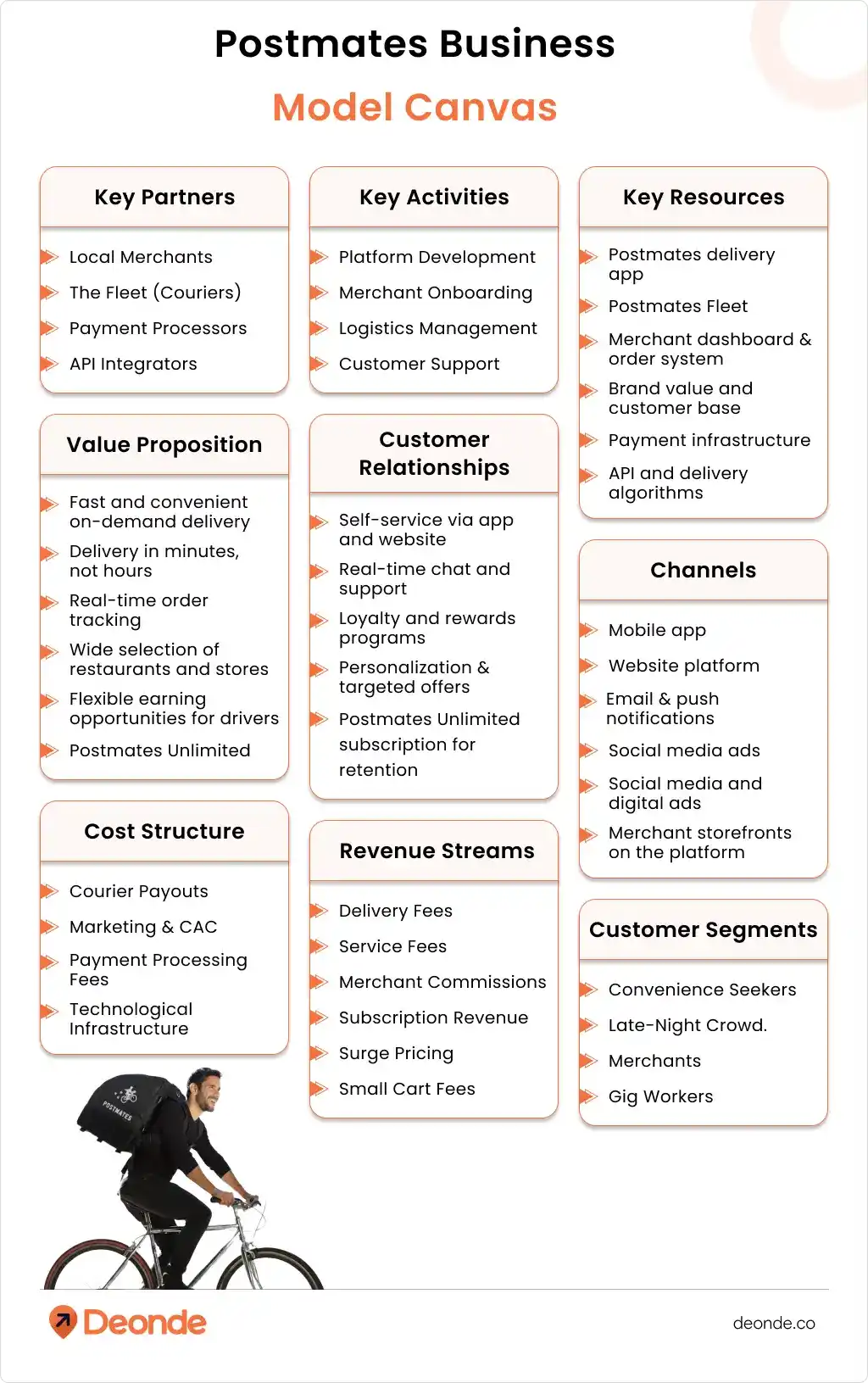
The Platform Architecture
Postmates operates as a technology-driven marketplace that aggregates supply (merchants and products) with demand (customers) and connects them through a network of independent delivery partners. This asset-light model allows Postmates to scale rapidly without bearing the costs of owning inventory, storefronts, or delivery vehicles.
Value Proposition for Each Stakeholder
For Customers:
- Convenience and Speed: Access to thousands of merchants with 60-minute delivery guarantees in selected areas
- Variety: Ability to order from restaurants, grocers, pharmacies, electronics retailers, and specialty shops through a single app
- Real-time Transparency: Live tracking of orders from merchant to doorstep
- Competitive Pricing: Transparent pricing with the ability to compare delivery fees and promotional offers
- Flexible Ordering: Support for multiple dietary restrictions, special requests, and customizations
For Merchants:
- Market Expansion: Access to Postmates customer base without building their own delivery infrastructure
- Operational Efficiency: Tools to manage online orders, track deliveries, and gather customer insights
- Revenue Growth: Ability to reach customers beyond their physical location
- Data Analytics: Access to customer ordering patterns and preferences to optimize menus and inventory
- Brand Visibility: Exposure on the Postmates platform alongside category-specific recommendations
For Delivery Partners:
- Flexible Work: Set your own schedule and choose which orders to accept
- Earning Potential: Earn per delivery with opportunities for performance bonuses and tips
- Independence: Work as an independent contractor without long-term commitments
- Support Services: Insurance coverage, 24/7 customer support, and access to the Postmates community
- Multiple Earning Streams: Ability to earn from delivery fees, tips, and platform bonuses
Key Business Partnerships
Merchant Partnerships: Postmates partners with a diverse range of merchants, from small local restaurants to major retail chains like CVS, Walgreens, and Target. This vertical diversity allows Postmates to serve as a one-stop delivery platform for various customer needs.
Financial Service Providers: Partnerships with payment processors ensure secure transactions and multiple payment options, including credit cards, digital wallets, and in-app payment solutions.
Logistics and Technology Partners: Postmates integrates with mapping services, traffic prediction systems, and logistics optimization platforms to enhance delivery efficiency and accuracy.
Corporate Partnerships: Postmates has established relationships with enterprise clients for corporate food and goods delivery, opening new revenue channels beyond consumer delivery.
Postmates Revenue Model: How Postmates Makes Money
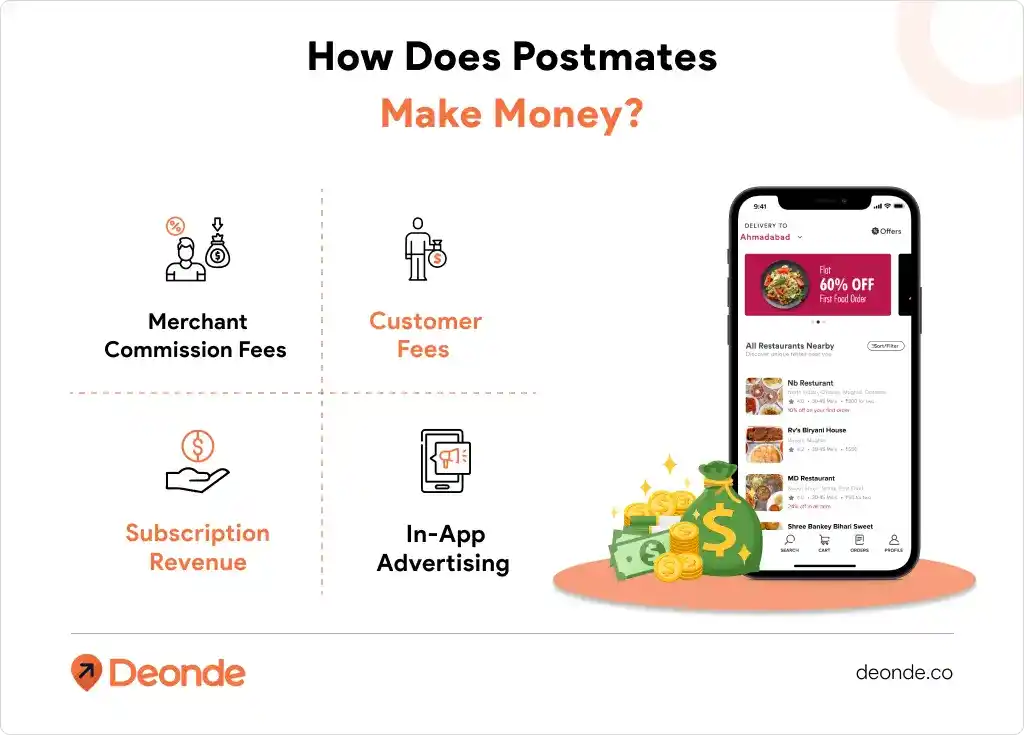
Postmates generates revenue through multiple streams, creating a diversified and resilient business model:
1. Delivery Fees
Postmates charges customers delivery fees for each order placed. These fees are dynamic and vary based on multiple factors:
- Distance: The distance between the merchant location and the customer’s delivery address
- Order Complexity: The number of items and pickup locations involved in the order
- Geographic Area: Urban areas may have different pricing than suburban or rural areas
- Time of Order: Orders placed during off-peak hours may have lower delivery fees
These delivery fees are one of Postmates most consistent and reliable revenue sources, as they’re charged on nearly every transaction on the platform.
2. Service Fees
Beyond delivery fees, Postmates charges service fees on customer orders. These fees are separate from delivery charges and are applied as a percentage of the order value or as a flat fee. Service fees cover operational costs such as:
- Customer service and support
- Platform maintenance and technology infrastructure
- Payment processing and fraud prevention
- Risk management and insurance
Service fees typically range from 10-15% of the order subtotal and are added to every customer transaction, making this a significant revenue stream alongside delivery fees.
3. Merchant Commissions
Postmates earns commission on successful orders placed through its platform. Merchants pay Postmates a percentage of each order’s value. The commission structure includes:
- Standard Commission: Typically 15-30% of the order value depending on the merchant category and agreement terms
- Tiered Pricing: Different commission rates for different merchant tiers based on partnership level
- Category-Based Rates: Commission rates may vary between restaurants, groceries, retail, and pharmacies
For example, if a customer places a $100 order at a restaurant partner, Postmates might earn $20-25 in merchant commission. This incentivizes Postmates to increase order volume and expand its merchant network.
4. Uber One (Subscription)
Postmates has transitioned to “Uber One,” a unified subscription service that provides customers with premium benefits across both Postmates and Uber Eats:
- Fee Waiver: Unlimited $0 Delivery Fee on eligible food and grocery orders.
- Exclusive Discounts: Up to 5% off on eligible orders and reduced service fees.
- Ride Perks: Members earn Uber Cash back on eligible rides.
- Priority Service: Access to top-rated drivers and premium support.
The subscription model creates predictable recurring revenue while increasing customer lifetime value. It locks customers into the ecosystem for both transport and delivery, generating higher total engagement than standalone users.
5. Blitz and Surge Pricing
Postmates implements dynamic pricing strategies during peak demand periods:
- Surge Pricing: During high-demand hours (lunch rush, dinner rush, late night), delivery fees increase to incentivize more delivery partners to work and reflect supply-demand imbalances
- Blitz Pricing: Special promotional pricing designed to encourage orders during typically slow periods or to drive volume during strategic business objectives
- Peak Hour Multipliers: Delivery fees may be multiplied by 1.5x-2x or higher during extremely busy times
These dynamic pricing strategies maximize revenue during peak periods while helping to balance supply and demand on the platform.
6. Advertising Revenue
Postmates monetizes its platform through merchant advertising and promotional opportunities:
- Promoted Listings: Merchants can pay for prominent placement in search results and category pages to increase visibility
- Sponsored Merchant Ads: Featured merchant cards, promotional banners, and spotlight placements throughout the app interface
- Targeted Advertising: Brands and merchants can purchase targeted advertising to reach specific customer segments based on ordering history, location, and preferences
- Promotional Partnerships: Co-marketing opportunities with consumer brands featured on the platform
This advertising model has become increasingly important as merchants compete for visibility on the platform, similar to sponsored advertising on e-commerce and search platforms. As Postmates user base grows, advertising inventory becomes more valuable to merchants seeking customer acquisition.
Why Was the Postmates Model So Unprofitable?
If Postmates has four different revenue streams, why was it famous for losing money?
The answer is simple: its costs were astronomically high. The on-demand delivery business is a game of high volume and razor-thin margins.
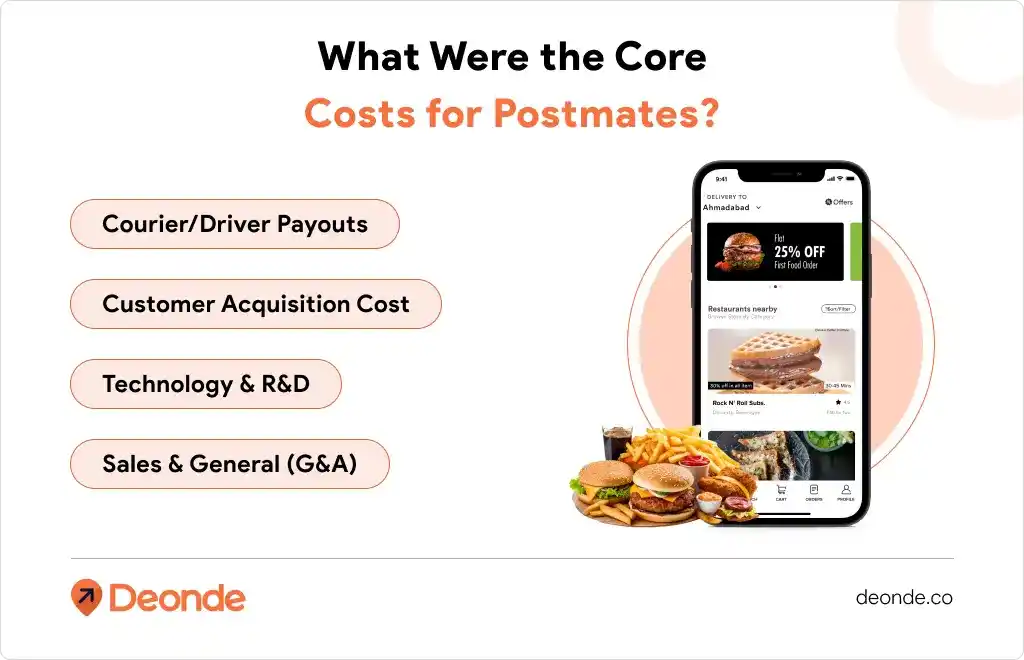
What Were the Core Costs for Postmates?
1. Courier/Driver Payouts
This is the single biggest expense. For every order, a large portion of the fees collected goes directly to the driver to pay for their time and vehicle use.
Additionally, delivery economics historically struggle with efficient “batching” (delivering multiple orders in one trip), which severely impacts per-unit margins.
2. Customer Acquisition Cost (CAC)
This was the “cash-burning” war. To compete with DoorDash and Grubhub, Postmates had to spend billions on marketing. This included TV commercials, online ads, and endless “20% off your next 5 orders” promotions. They were literally paying customers to use their service in a desperate “land-grab” for market share.
3. Technology & R&D
The cost of building and maintaining a sophisticated app that can handle millions of orders, track thousands of drivers in real-time, and process payments securely is enormous.
4. Sales & General (G&A)
This includes the salaries of the sales teams signing up restaurants, the customer support staff handling complaints, and all other corporate overhead.
This combination of thin margins and brutal competition meant Postmates was in a race to “scale or die.”
Why Did Uber Buy Postmates?
This brings us to the real story. In July 2020, Uber announced that it would acquire Postmates in an all-stock deal valued at $2.65 billion.
Uber didn’t buy Postmates for its profits. It bought Postmates for its strategic assets to win the all-out war against the #1 market leader, DoorDash.
Here is the true, authoritative breakdown of that acquisition.
Reason 1: Market Consolidation
- The Context: The U.S. food delivery market was a four-way battle: DoorDash (~45% market share), Uber Eats (~23%), Grubhub (~23%), and Postmates (~8%) before the acquisition.
- The Play: Uber had just tried to buy Grubhub, but the deal fell apart (Grubhub sold to Europe’s Just Eat Takeaway). Blocked from buying #3, Uber immediately pivoted and bought #4.
- The Result: This deal instantly removed a key competitor and gave the new “Uber + Postmates” entity a combined ~30-37% market share, making it a much stronger #2 to fight DoorDash.
Reason 2: Geographic Dominance (The “LA” Factor)
- The Context: Market share wasn’t evenly spread. DoorDash was dominant in the suburbs, but Postmates was a powerhouse in key, high-value urban markets.
- The Play: Postmates was the market leader in cities like Los Angeles, Miami, and Phoenix.
- The Result: Uber didn’t just buy a “brand”; it bought a massive, loyal customer base in some of the most lucrative and important delivery markets in the country, areas where Uber Eats was comparatively weaker.
Reason 3: The “Deliver-Anything” Vision (The Future)
- The Context: Most competitors, including Uber Eats at the time, were hyper-focused on restaurant food.
- The Play: Postmates was the original “deliver-anything” pioneer. Its brand was built on delivering groceries, alcohol, convenience items, and even retail goods.
- The Result: This was vital for Uber’s future. Uber’s CEO, Dara Khosrowshahi, didn’t want to be a “food delivery app“; he wanted Uber to be the “operating system for your city.” Acquiring Postmates’ merchant partnerships and “deliver-anything” logistics was a massive shortcut to achieving that vision.
(Note: Uber later aggressively expanded into grocery and convenience delivery, a strategy directly influenced by Postmates’ original model.)
How Modern Entrepreneurs Avoid the “Postmates Trap”
The lesson from Postmates is simple: building your technology from scratch is a slow, expensive trap. Today, you have a massive advantage: you can eliminate this “Technology & R&D” cost.
The smart, profitable path is using a Readymade, White-Label On-Demand Solution.
This is a complete, pre-built, and proven platform (customer app, driver app, admin panel) that you brand as your own. Here’s why it’s the logical choice:
- Launch in 7 Days, Not 2 Years. Get your fully branded app live in as little as a week. While your competition is still coding, you will be on the market taking orders.
- Be Profitable from Day One. Instead of spending millions on R&D, you pay a simple, low-cost subscription. This turns your biggest financial risk into a small, predictable monthly expense.
- Focus 100% on Growth. Because the technology is already handled, you can dedicate all your energy to what actually makes you money:
- Signing up merchants.
- Marketing to customers.
- Running smooth operations.
- Lower CAC Requirement: Using a white-label platform allows you to focus on hyper-local SEO relevance rather than national ad wars, resulting in a significantly lower Customer Acquisition Cost (CAC).
In short, Postmates was trapped by its high-tech costs. You can succeed by utilizing an affordable, ready-made platform and focusing on profitability from the outset.
Conclusion
The Postmates story is a clear lesson in the realities of the on-demand market.
Being a pioneer with a popular idea is not always enough to guarantee long-term profit.
The “Postmates trap” was its immense operational and technology costs, which made it unsustainable as a standalone company.
For modern founders, success lies in efficient execution, not just owning the code. Don’t let the cost of building an app consume your capital before you’ve even made a sale.
Today, new entrepreneurs can achieve the same goal—launching a delivery service—without the billion-dollar tech spend.
Start your own profitable on-demand platform from day one. Explore the powerful, ready-to-launch solutions at deonde.