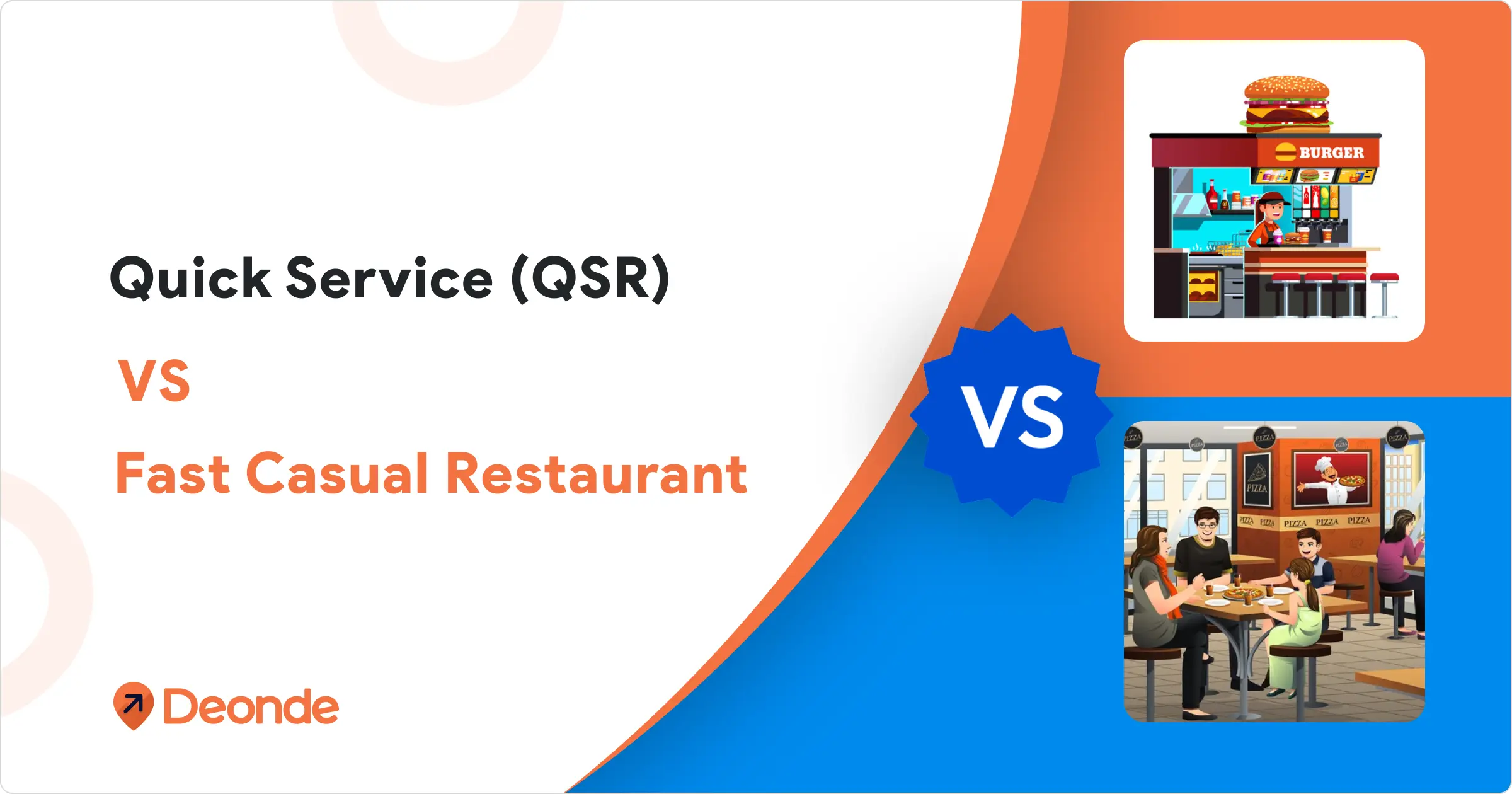
You’re standing at a crossroads, restaurant concept in hand, and two paths stretch before you: QSR or fast casual? This decision shapes everything from your profit margins to who walks through your door.
Let’s be real – choosing between quick service restaurants and fast casual concepts isn’t just about speed versus quality anymore. The lines have blurred, and your success hinges on matching the right model to your vision.
I’ve watched entrepreneurs pour their savings into the wrong restaurant model simply because they never clearly understood the fundamental differences. Whether you’re expanding your restaurant portfolio or launching your first concept, this guide breaks down exactly what separates QSR vs. fast casual restaurants.
So what actually determines which model will maximize your investment? The answer might surprise you…
Understanding the Key Differences Between QSR and Fast Casual
Defining QSR: Speed, Price Points and Business Model
Quick Service Restaurants (QSRs) are all about efficiency. Think McDonald’s, Burger King, and Wendy’s – these places prioritize getting food in your hands fast. Their entire operation revolves around speed, with streamlined menus and systematic cooking processes designed to deliver your meal in minutes, perfect for integrating with online ordering systems.
The price point? Typically under $8 per person. This affordability is a major selling point for customers who need a quick bite without breaking the bank.
The business model focuses on high volume and rapid turnover. Most QSRs operate with:
- Drive-thru windows (often generating 70% of sales)
- Simplified menu options
- Standardized operations that can be replicated easily
- Lower labor costs (fewer staff per location)
- Heavy reliance on part-time workers
Defining Fast Casual: Quality, Experience and Price Structure
Fast casual restaurants like Chipotle, Panera Bread, and Shake Shack occupy that sweet spot between QSRs and full-service restaurants. They’re serving up higher-quality ingredients and menu items that feel more “premium” than traditional fast food, often supported by contactless digital menus.
Customers pay more (usually $10-15 per person) but get fresher food that’s often prepared in front of them. Many fast casuals pride themselves on better ingredients – think organic, locally-sourced, or antibiotic-free options.
The business model typically includes:
- Made-to-order preparation
- More customization options
- Higher food costs but better margins
- Smaller footprints than full-service restaurants
- More emphasis on atmosphere and design
Service Style Comparison: Counter Service vs. Enhanced Dining Experience
In QSRs, the transaction is purely transactional. Order at the counter or drive-thru, get your food in a bag, and you’re on your way. Minimal interaction, maximum efficiency.
Fast casual takes a different approach:
|
QSR |
Fast Casual |
|
Order at the counter/drive-thru |
Order at the counter, often with guided options |
|
Pre-made or quickly assembled |
Prepared after ordering, often visible prep |
|
Packaging designed for portability |
Real plates/baskets are sometimes used |
|
Limited customization |
Extensive customization encouraged |
|
Get in, get out mentality |
Encourages lingering |
Fast casual spaces are designed to be more inviting. They want you to stay, maybe even open your laptop and hang out for a while, enhancing the experience with tools like restaurant marketing software.
Target Customer Demographics for Each Model
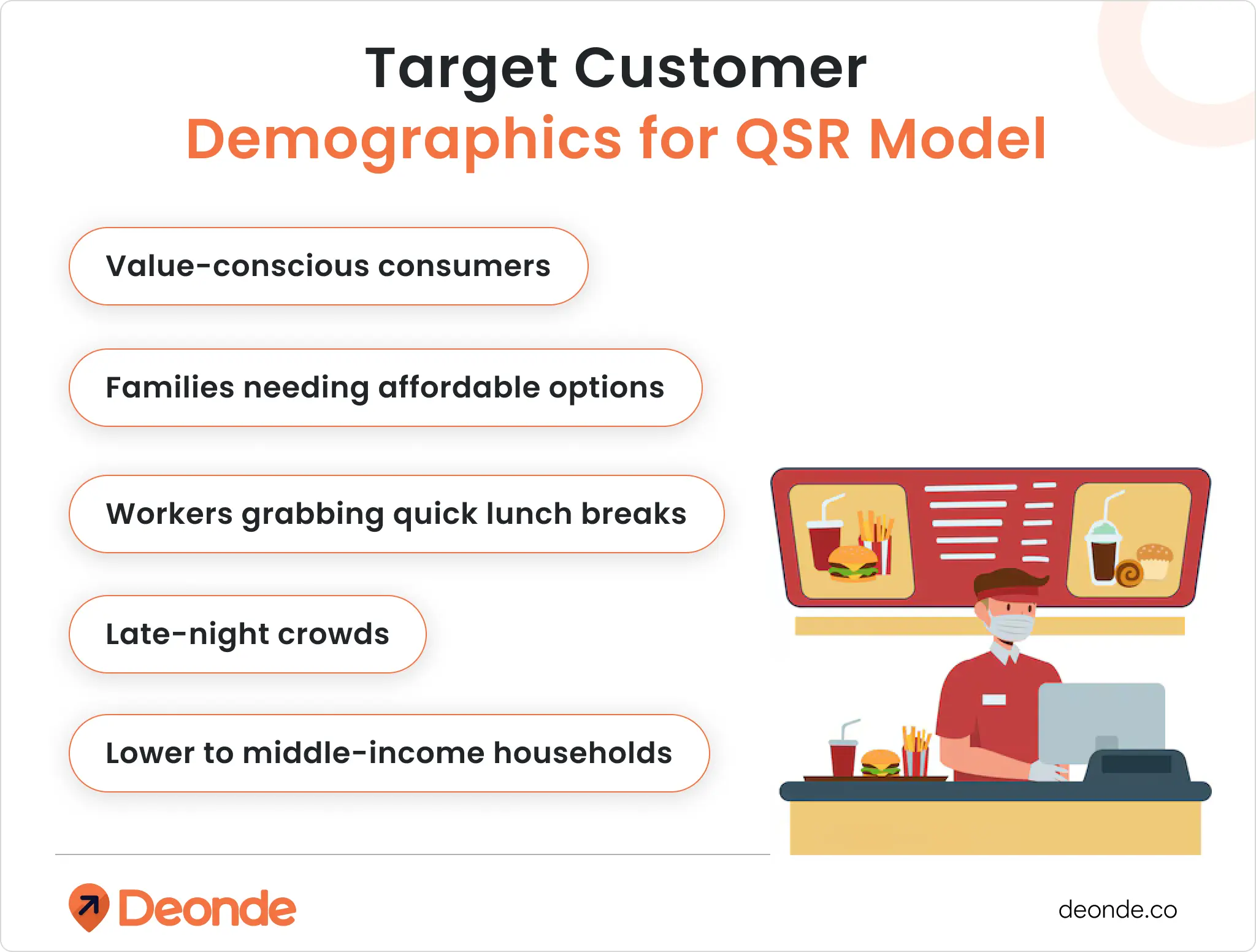
QSRs cast a wide net, but their core customers are:
- Value-conscious consumers
- Families needing affordable options
- Workers grabbing quick lunch breaks
- Late-night crowds
- Lower to middle-income households
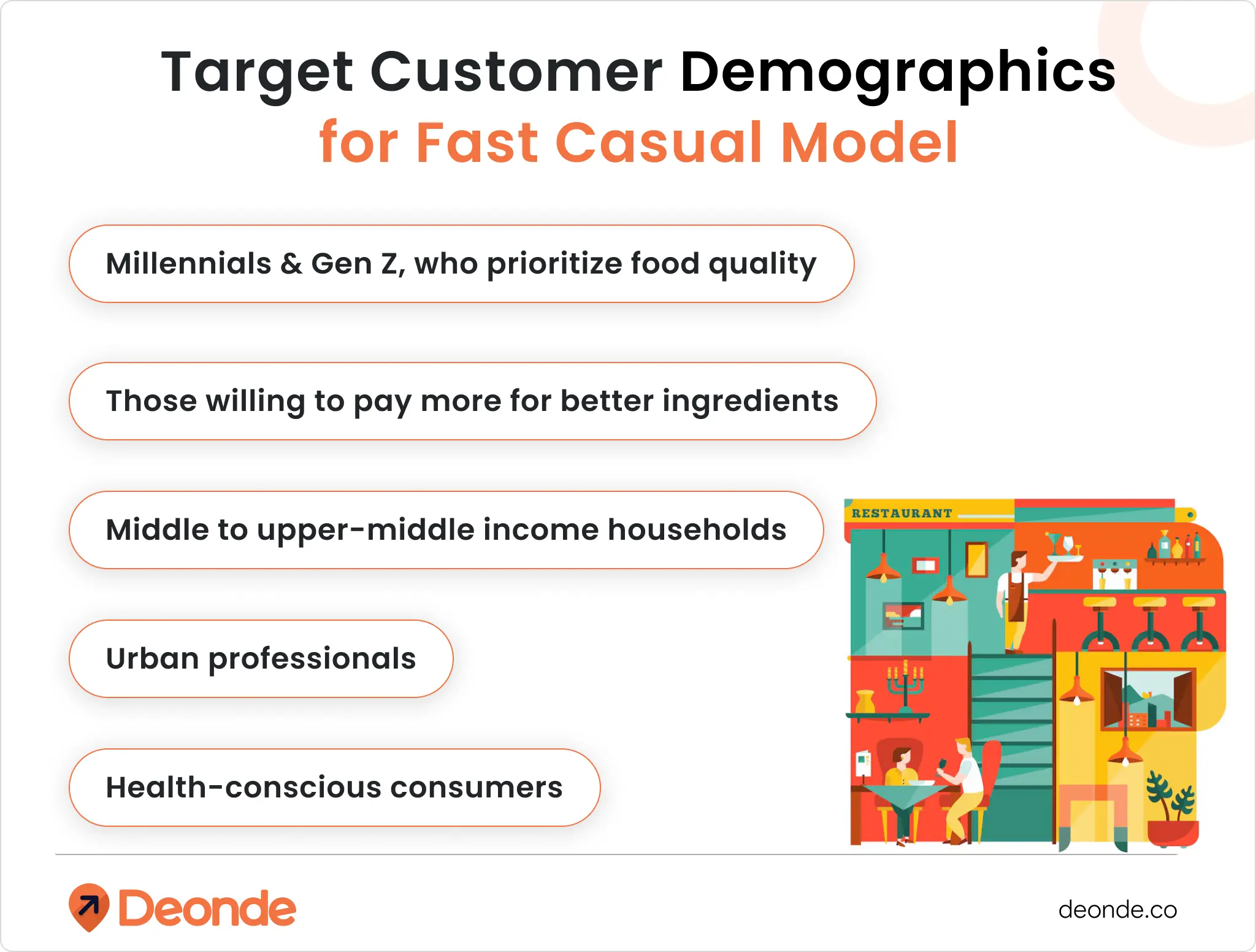
Fast casual attracts a different crowd:
- Urban professionals
- Millennials and Gen Z, who prioritize food quality
- Health-conscious consumers
- Middle to upper-middle income households
- Those willing to pay more for better ingredients
The fast casual customer typically has more disposable income and prioritizes the experience alongside the food itself. They’re not just buying a meal—they’re buying into a lifestyle and set of values that these restaurants embody, often reinforced through loyalty points.
Financial Considerations: Investment and Returns
A. Initial Capital Requirements Compared
The money talk. Let’s jump right in.
QSRs typically need $250,000 to $1 million to get started. That’s the franchise fee, equipment, signage, and your first inventory order.
Fast casual? You’re looking at $750,000 to $2.5 million. Why the jump? Higher-quality finishes, better kitchen equipment, and more sophisticated POS systems.
Here’s what you’re paying for:
|
Expense |
QSR |
Fast Casual |
|
Franchise Fee |
$25,000-$50,000 |
$35,000-$75,000 |
|
Equipment |
$75,000-$300,000 |
$150,000-$500,000 |
|
Build-out |
$100,000-$300,000 |
$350,000-$1,000,000 |
|
Initial Inventory |
$20,000-$30,000 |
$30,000-$60,000 |
B. Typical Operating Costs and Margins
The numbers that keep you up at night.
QSRs typically run 20-25% food costs with 6-9% profit margins. You’re moving volume, not premium items.
Fast casual flips this with 28-32% food costs but squeezes out 8-12% profit margins. Better ingredients cost more but command higher prices.
Labor? QSRs spend about 25-30% on payroll while fast casual hits 30-35%. Those extra-skilled kitchen staff don’t come cheap.
C. Real Estate and Location Requirements
QSRs can thrive in 1,200-2,500 sq ft spaces. Drive-thrus are gold – adding 40-70% to your revenue potential.
Fast casual demands 2,000-4,000 sq ft with emphasis on dining experience. You’re paying premium for those Instagram-worthy interiors.
Location differences? QSRs work in strip malls and high-traffic corners. Fast casual needs more affluent neighborhoods where folks don’t mind spending $15 instead of $7 for lunch.
D. Staffing Needs and Labor Costs
QSRs run lean – 15-25 employees total with minimal kitchen experience required.
Fast casual needs 20-35 staff members including more skilled kitchen personnel. Your cooks actually need to know how to, well, cook.
Training costs more in fast casual too – $2,000 per employee versus $1,200 in QSR.
E. Average ROI Timelines
The million-dollar question: when do you break even?
QSRs typically see breakeven in 18-36 months. Well-run operations return initial investment in 3-5 years.
Fast casual? Longer runway of 24-48 months to breakeven, with 4-7 years to recoup initial investment.
The tradeoff is clear: QSRs offer faster returns with lower ceilings. Fast casual takes longer but can build stronger, more valuable businesses long-term.
Operational Complexities and Daily Management
Kitchen Equipment and Space Requirements
QSRs and fast casual restaurants might as well be from different planets when it comes to their kitchens.
QSRs keep it simple. They’re designed for speed, with specialized equipment like high-capacity fryers, rapid-cook ovens, and assembly-line setups. The space is compact and efficient – typically 1,500-3,000 square feet total with the kitchen taking up about 30%.
Fast casual spots need more room to breathe. Their kitchens accommodate made-to-order cooking with equipment like exhibition cooking stations, higher-end grills, and versatile cooking platforms. They generally run 2,500-4,000 square feet with kitchens claiming 40-50% of that space.
Food Preparation: Made-to-Order vs. Prepared in Advance
The fundamental difference? Time versus customization.
QSRs are all about speed. Food is often pre-made, held in warming units, and assembled when ordered. Think burger patties cooked in batches, waiting for their bun. This system sacrifices some freshness but delivers that 90-second order time customers expect.
Fast casual flips the script. Food is prepared when you order it. The chicken hits the grill after you’ve placed your order, not before. Yes, it takes longer (usually 5-10 minutes), but customers get fresher food tailored exactly to their preferences, often managed through driver apps for delivery.
Inventory Management Differences
QSRs run tight ships. They use just-in-time ordering systems with frequent, smaller deliveries. Their limited menu means fewer ingredients to track, and most items come pre-portioned or prepared.
Fast casual inventory is trickier. With broader menus and fresher ingredients, they deal with:
- More frequent deliveries of perishables
- Higher-quality (and often costlier) ingredients
- More complex prep requiring skilled kitchen staff
- Lower shelf life for fresh components
Technology Integration and POS Systems
Both models are tech-heavy, but with different priorities.
QSRs need lightning-fast POS systems optimized for speed and drive-thru operations. They’re pioneering self-service kiosks, mobile ordering, and kitchen display systems that minimize order times.
Fast casual restaurants use tech to enhance the customer experience. Their POS systems handle more complex orders with numerous modifications, tableside ordering tablets, and loyalty programs that track detailed preference data, often supported by third-party integrations.
The tech stack differences reflect their core business models – QSRs prioritize throughput while fast casual prioritizes personalization.
Menu Development and Food Quality Expectations
Price Point Considerations and Menu Engineering
The gap between QSR and fast casual starts with your price point. QSRs typically keep prices under $8 per person, while fast casual stretches into the $8-15 range. This isn’t just about what you charge – it shapes your entire menu strategy.
For QSRs, profit margins come from volume. Your menu needs to be:
- Quick to prepare (under 3 minutes)
- Easy to standardize
- Built around high-margin items like sodas and fries
Fast casual concepts have more breathing room. With higher check averages, you can experiment with premium ingredients without scaring off customers. Your menu engineering focuses on:
|
QSR Approach |
Fast Casual Approach |
|
Value meals |
Signature dishes |
|
Limited-time offers |
Seasonal rotations |
|
Combo pricing |
À la carte with premium add-ons |
Ingredient Quality Expectations from Customers
Let’s get real – customer expectations have dramatically shifted. Even QSR customers are increasingly label-conscious, but fast casual diners practically demand transparency.
QSR customers accept conventional ingredients but increasingly expect:
- No artificial colors or flavors
- Some healthier options
- Consistent quality
Fast casual diners typically expect:
- Locally sourced when possible
- Organic or natural options
- Transparency about sourcing
- Higher-quality proteins
Menu Diversity Requirements
QSRs thrive on focused menus – typically 25-40 items that deliver consistent results across thousands of locations. McDonald’s succeeds not by offering everything, but by nailing their core items every single time.
Fast casual concepts need variety but shouldn’t go overboard. Aim for 40-60 thoughtfully curated options that highlight your concept’s unique selling point. Chipotle masters this balance with minimal ingredients recombined into countless customizable options.
Customization Options and Flexibility
Customization isn’t optional anymore – it’s expected. But how you approach it differs dramatically between models.
QSRs need streamlined customization:
- Limited modifications (“hold the pickles”)
- Self-service drink stations
- Standardized add-ons
Fast casual thrives on visible customization:
- Build-your-own concepts (bowls, salads, pizzas)
- Multiple preparation methods
- Extensive sauce/topping options
- Dietary accommodation (gluten-free, vegan)
Your choice between QSR and fast casual ultimately comes down to your vision for customer experience. Will they grab and go, or linger and customize?
Growth Potential and Scalability
A. Franchising Opportunities in Both Models
The restaurant game has two heavy hitters when it comes to scalability: QSRs and fast casual concepts. McDonald’s didn’t become a global empire by accident.
QSRs typically offer more straightforward franchising models. Their standardized operations make them easier to replicate across locations. Think about it – a Burger King in Seattle runs almost identically to one in Miami. That’s by design.
Fast casual? They’re catching up. Chipotle and Panera have shown these concepts can scale too, but they often require more training and operational finesse. The upside? Higher profit margins per location when executed correctly.
Here’s how they stack up:
|
Aspect |
QSR Franchising |
Fast Casual Franchising |
|
Initial Investment |
$500K-2M |
$750K-3M+ |
|
Training Complexity |
Moderate |
Higher |
|
Operational Control |
Highly standardized |
More flexibility |
|
Typical ROI Timeline |
3-5 years |
4-7 years |
B. Multi-Unit Expansion Challenges
Growing pains hit different depending on which lane you choose.
QSRs face supply chain challenges when expanding rapidly. When Wendy’s pushes into new territories, they need those square patties delivered consistently everywhere.
Fast casual spots struggle more with maintaining quality and experience. Shake Shack had to pump the brakes on expansion when they realized their special sauce – that high-touch customer experience – was getting diluted.
The labor equation changes dramatically too. Running 10 Taco Bells requires a different management approach than 10 Mod Pizzas. The fast casual model demands more skilled labor per location, making multi-unit expansion more complex.
C. Brand Development Considerations
Your brand identity lives or dies by the model you choose.
QSRs bank on consistency and ubiquity. The golden arches mean the same thing everywhere. That sameness is actually their superpower.
Fast casual concepts thrive on personality and local connection. Sweetgreen adapts to local ingredients while maintaining its core ethos. This flexibility lets them tap into community vibes that many QSRs miss.
Digital branding plays differently too. Fast casual spots typically generate more social media engagement per location, while QSRs dominate mass marketing channels.
D. Market Saturation Risks and Opportunities
The elephant in the room? Market saturation.
QSR territories are increasingly crowded in developed markets. Good luck finding a major intersection without a fast food joint already claimed. Your opportunity might lie in international markets where American QSR concepts still have room to run.
Fast casual has more domestic runway left. Secondary markets are still underserved by quality fast casual options. Plus, these concepts can often thrive in specialized locations (office complexes, university areas) where traditional QSRs might struggle.
The smart move? Look at population trends. Growing suburbs and gentrifying urban areas typically welcome fast casual first, while highway-adjacent locations and rural areas favor QSRs.
Aligning Your Personal Vision with the Right Model
A. Assessing Your Culinary Passion and Food Philosophy
Your food philosophy matters more than you might think. QSR operations thrive on consistency and speed – think standardized menus that rarely change. If you wake up dreaming about new recipes and creative plating, you’ll feel stifled in this model.
Fast casual gives you more creative wiggle room. You can experiment with seasonal ingredients, rotate menu items, and put your personal stamp on dishes. Ask yourself: Do you care more about food as an art form or food as a reliable product?
Some questions to ask yourself:
- Do you get excited about culinary innovation?
- Are you passionate about ingredient quality?
- Would you rather perfect five menu items or experiment with fifty?
B. Evaluating Your Management Style and Skill Set
QSRs demand military-like precision. You’ll need to be comfortable with strict protocols, time management systems, and maintaining unwavering standards.
Fast casual requires more finesse with staff. Your team needs deeper training since they’re not just assembling pre-made components but often preparing food with more complex techniques.
Your natural leadership style matters here:
- Are you process-oriented or people-oriented?
- Do you prefer clear-cut rules or flexible guidelines?
- Are you skilled at training staff for consistent execution or inspiring culinary creativity?
C. Considering Your Work-Life Balance Goals
I’m not sugarcoating this – restaurant ownership is demanding regardless of model. But there are differences.
QSRs often operate on tighter margins, meaning owners typically work longer hours to maintain profitability. The upside? Operations are highly systematized, so eventually you can step back if your systems are solid.
Fast casual concepts typically command higher prices but require more ongoing attention to food quality and customer experience. The trade-off is worth considering based on your life priorities.
|
Model |
Owner Hours |
Systematization |
Delegation Potential |
|
QSR |
Longer initially |
Highly systematic |
Higher |
|
Fast Casual |
More consistent |
More nuanced |
Moderate |
D. Matching Your Financial Resources with Business Ambitions
Starting capital shapes your options dramatically.
QSRs typically require higher upfront investment (especially franchises) but offer proven systems and potentially faster returns. You’re buying a turnkey operation that’s designed to make money from day one.
Fast casual concepts can sometimes be launched with lower initial investment but may take longer to reach profitability as you build your brand and refine your concept.
Your risk tolerance matters too. QSRs have lower concept risk but higher competition. Fast casual gives you differentiation potential but higher concept risk.
E. Identifying Your Target Customer and Community Needs
The final piece is honestly assessing your local market. Drive around your target neighborhood and watch people’s habits.
Are they grabbing coffee and breakfast sandwiches on their morning commute? A QSR might thrive. Are they looking for healthy lunch options in an area dominated by burger joints? Fast casual might fill that gap.
The model that fits your community is often the one that will succeed, regardless of your personal preference. Sometimes the best business decision is serving what people actually want, not what you think they should want.
Conclusion
Choosing between QSR and fast casual restaurant models requires careful consideration of your financial resources, operational capabilities, culinary vision, and long-term goals.
QSRs offer lower startup costs and streamlined operations ideal for entrepreneurs seeking rapid expansion, while fast casual concepts demand higher initial investment but potentially deliver stronger profit margins and customer loyalty through elevated food quality and dining experiences.
The most successful restaurant ventures ultimately stem from authentic alignment between business model and personal vision. Whether you prioritize efficiency and volume like QSRs or quality and experience like fast casual establishments, your passion and commitment to your chosen path will prove essential.
Take time to honestly assess your resources, skills, and aspirations before embarking on your restaurant journey – the right model for you is the one that not only promises financial success but also brings you fulfillment in the daily execution of your vision.