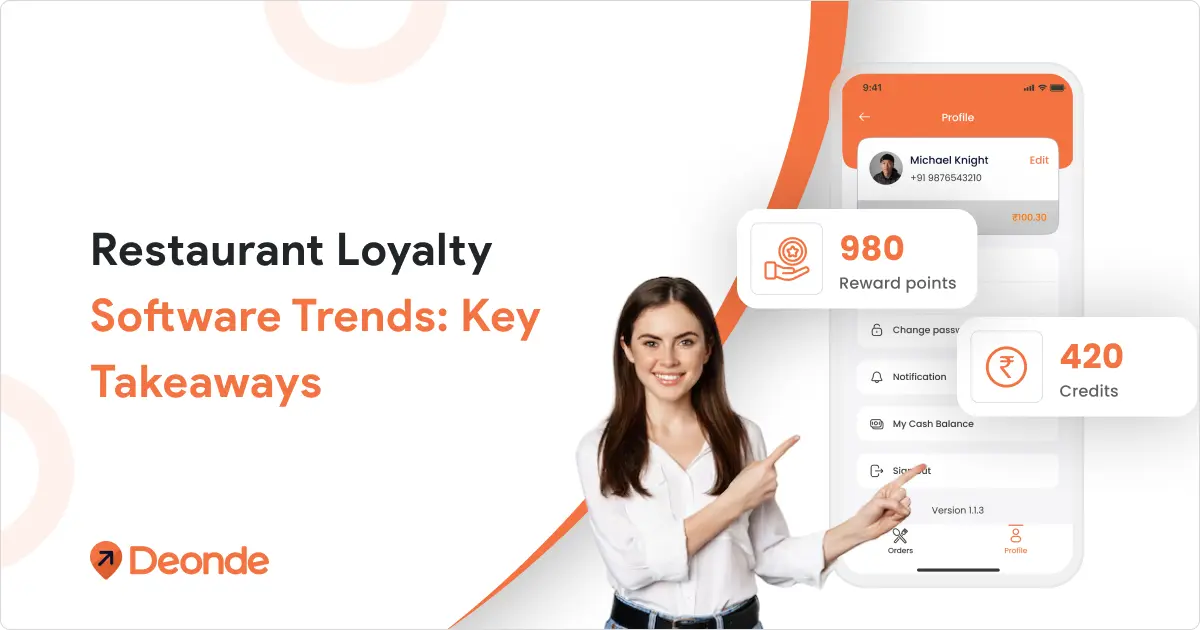
Loyalty software is a digital platform that tracks customer behavior, personalizes rewards, and integrates across POS, app, and delivery channels to increase repeat orders and customer lifetime value.
In 2026, loyalty software moved beyond points and discounts. It became a more advanced system for customer retention.
For years, loyalty programs had one main job: reward a purchase with a discount. In 2026, that is no longer enough.
Most restaurant brands already have a rewards program, so the real difference is no longer whether you have one. It is how well it works.
Here is what changed in 2026 and what it means for restaurant loyalty software, whether you run a single café or a delivery brand across multiple countries.
Quick takeaways:
- Personalization based on real order data is replacing generic, one-size-fits-all discounts.
- Gamified, visible progress toward a reward drives more repeat orders than a static points balance.
- Loyalty identity has to follow customers across web, app, WhatsApp, and in-store — app-only programs are losing ground, especially in the US and UK.
- Success is measured by repeat orders and redemption, not how many people signed up.
- What works in India, the US, and the UK isn’t identical, and restaurant loyalty software needs to flex accordingly.
What Changed in Loyalty Programs in 2026
Loyalty in 2026 looks nothing like it did three years ago. The shift is structural, not cosmetic.
The definition of success changed. 59% of loyalty professionals now prioritize improving Customer Lifetime Value (CLV). This is up from 36% in 2021.
More teams now focus on lowering churn and proving ROI. That shows loyalty is becoming a business growth tool, not just a marketing feature.
“Generating more orders” as a standalone goal sits at only 8%. Scale alone no longer defines loyalty success. Retention efficiency and financial impact do.
Points-only programs are losing impact. When every brand offers the same earn-and-burn model, points stop standing out.
Gamification is now a major growth driver. Brands use it to improve engagement, reduce churn, and increase customer lifetime value.
Personalization moved from strategy deck to engineering requirement. 59.7% of respondents identify personalization as their top investment area in 2026.
But there is a problem. Many brands want personalization, but their systems cannot deliver it in real time.
For restaurants, loyalty software must do more than issue points. It must connect to POS data, unify customer profiles, support behavior-based rewards, and report results.
Old Loyalty vs. 2026 Loyalty
Use this to check whether your current program still fits 2026.
| What loyalty looked like before | What loyalty looks like in 2026 |
| Points for every purchase, with the same reward for everyone | Personalized offers based on order history, frequency, and preferences |
| App-only enrollment | Enrollment through app, website, WhatsApp, QR code, or POS |
| Manual campaigns sent only sometimes | Automated triggers like win-back messages, birthday rewards, and cart recovery |
| Success measured by sign-ups | Success measured by repeat order rate, redemption rate, and revenue per member |
| Static tiers and slow points ladders | Gamified milestones, streaks, and near-instant rewards |
| Rewards tied to a single ordering channel | Rewards that follow the customer across every channel they use |
Nothing in the “before” column is wrong exactly — it’s just no longer sufficient on its own.
Why Restaurant Loyalty Software Matters Now
Restaurant loyalty software matters more in 2026 than it has in years.
Loyalty members visit roughly 2.5 times more often than non-members. A single loyalty member generates approximately $1,500 in annual revenue compared to $600 for a non-member.
In the US, 39% of restaurant visits now come from loyalty members. This is roughly double the share in 2019. Globally, loyalty programs now drive approximately two-thirds of restaurant delivery decisions.
The budget shift tells the real story. In 2026, 61% of limited-service and 52% of full-service operators are actively investing in loyalty and rewards technology. Nearly half of restaurant marketing budgets now flow to retention and CRM.
What this looks like changes by business model:
- Independent restaurants and cafés use loyalty to build repeat guests. Birthday rewards, visit-based stamps, and simple recognition work well here.
- QSRs and multi-location chains need consistency. Customers should see the same balance and rewards across every outlet.
- Cloud kitchens do not have a storefront, so loyalty has to build customer recognition through data.
- Grocery, quick commerce, and delivery brands use loyalty to build repeat buying habits. The goal is not one large order, but regular reorders.
For more structural examples, see Restaurant Loyalty Programs: Inspirations & Examples in 2026.
Global Markets: Why US and UK Loyalty Expectations
In markets like the USA and UK, customers increasingly expect loyalty programs that work without a separate app.
This shift is driven by three clear factors:
1. SMS and WhatsApp-based loyalty: Customers can join and engage with loyalty programs through text messages or WhatsApp, without downloading any app. A customer texts a code, earns points, and receives personalized offers directly on their phone.
2. Payment-linked rewards: Credit and debit cards automatically track purchases and apply rewards. The customer does nothing extra — the loyalty happens in the background.
3. Unified profiles across touchpoints: A customer who orders online, visits in-store, and pays through a delivery app is recognized as the same person across all channels. No separate loyalty card, no separate app, no friction.
In the US, Starbucks Rewards alone drives over 50% of sales through loyalty members. In the UK, strong data privacy regulations push brands toward transparent, value-first loyalty experiences.
For restaurants serving these markets, loyalty software must support phone-number-based enrollment, real-time point updates across channels, and integration with local payment methods — all without requiring customers to download yet another app.
How Indian Restaurants Can Use Loyalty Without Heavy Discounting
Indian restaurants often rely on deep discounts to attract customers. But heavy discounting erodes margins and attracts deal-seekers rather than loyal guests.
The 2026 loyalty trends offer a better path: use behavioral triggers and personalized engagement to improve repeat ordering without sacrificing profitability.
Practical loyalty strategies for Indian restaurants:
- UPI-linked loyalty — tie loyalty to UPI payments. When a customer pays via Google Pay, PhonePe, or Paytm, automatically track their purchases and reward frequency.
- WhatsApp-based engagement — send personalized menu suggestions, order reminders, and exclusive previews through WhatsApp. No app download required.
- Behavioral rewards — reward customers for trying new menu items, ordering during off-peak hours, or increasing their order value — not just for spending more.
- Local festival campaigns — create seasonal loyalty challenges around Diwali, Holi, or regional festivals that drive engagement without blanket discounts.
The goal is to make loyalty feel like a natural part of the ordering experience, not a separate system customers have to manage.
Real Use Cases: Loyalty for Different Restaurant Business Models
Quick-Service Restaurants (QSRs)
QSRs benefit from high-frequency, low-margin transactions. Loyalty software can increase visit frequency by 15-25% through micro-rewards and streak incentives.
Example: A burger chain offers a free side after three visits. The customer visits weekly instead of bi-weekly. The reward costs $2 but generates $30 in incremental revenue.
Cloud Kitchens
A cloud kitchen sees that a customer orders biryani every Friday. It sends a relevant offer on Thursday instead of a generic discount.
Example: A cloud kitchen notices a customer orders biryani every Friday. The loyalty system sends a targeted offer for a new biryani variant on Thursday evening — not a generic 10% discount.
Multi-Brand Delivery Platforms
Platforms that host multiple restaurant brands need loyalty that works across all partners. The platform earns commission while restaurants build direct customer relationships.
Example: A delivery platform offers cross-brand rewards: order from three different restaurants this month and earn a platform-wide credit. The customer discovers new restaurants while the platform increases overall order frequency.
Subscription-Based Food Delivery
Businesses like milk delivery or meal plans benefit from loyalty that reinforces subscription habits. The goal is reducing churn in recurring orders.
Example: A milk delivery service offers a free week after three months of uninterrupted subscription. The customer feels rewarded for loyalty without receiving discounts that devalue the service.
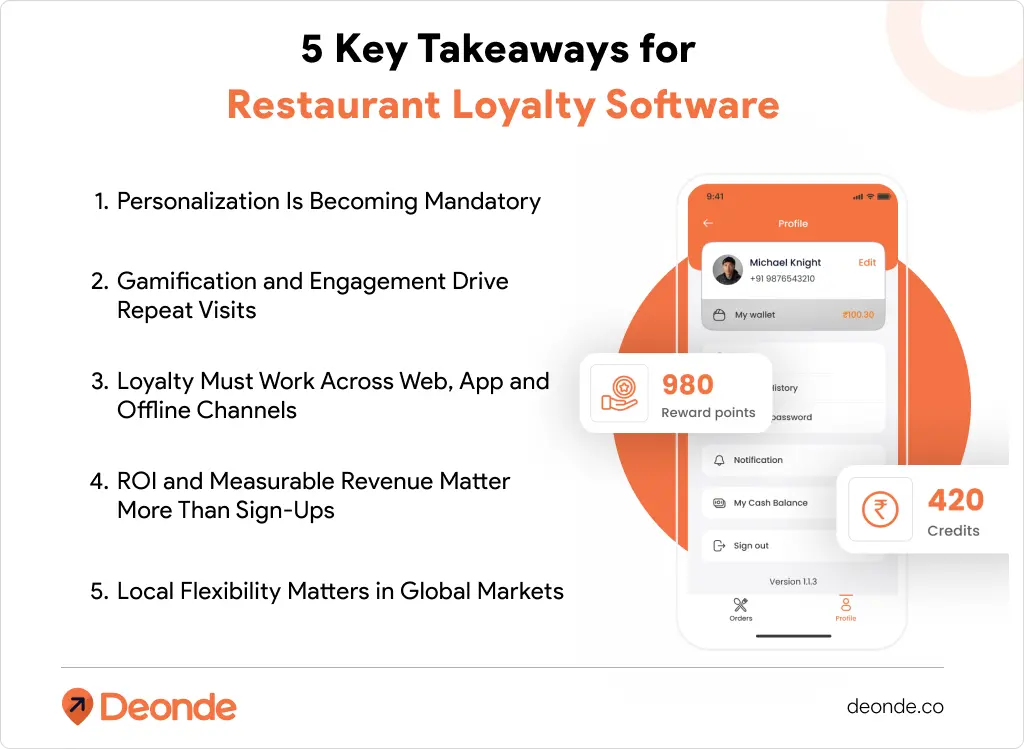
5 Key Takeaways for Restaurant Loyalty Software in 2026
As we look at the shifting landscape of diner behavior, it is clear that traditional punch cards and basic point systems are no longer enough.
To stay competitive and protect profit margins, restaurants need to upgrade their tech stack. Based on the 2026 Loyalty Program Trends, here are the five most important takeaways for your loyalty software strategy.
Takeaway 1: Personalization Is Becoming Mandatory
Generic discounts no longer work as well. According to research on AI-driven loyalty, customers in personalized programs spend up to 37% more and convert at a much higher rate.
Why? Because your customers want to feel seen. If your restaurant loyalty software knows a customer orders a pepperoni pizza every Friday night, it should automatically send them a relevant Friday evening perk—not a random Tuesday morning breakfast discount.
Actionable Tips for Your Restaurant:
- Connect your data: Ensure your loyalty program is directly tied to your POS and order data so you can track purchase history, frequency, and timing.
- Aim for recognition, not surveillance: Personalization has a ceiling. Use your data to show customers you appreciate their habits, but don’t overwhelm them with messages that make it feel like you’re tracking their every move.
Takeaway 2: Gamification and Engagement Drive Repeat Visits
People like to see visible progress. Studies show that over 80% of consumers are more likely to keep engaging with a brand if they can actually see how close they are to a reward. Progress bars like “Only 2 orders away from a free dessert!” consistently outperform boring, hidden point balances.
Gamified challenges—like sorting customers into tiers and giving them personalized order goals—can more than double order frequency for those users.
Actionable Tips for Your Restaurant:
- Make rewards instant: Delayed points update is a massive source of frustration. Ensure your system updates immediately after a purchase.
- Match your order cycle: Set gamification loops that make sense for your business. A daily coffee shop can run tight, weekly streaks, while a sit-down steakhouse should focus on monthly milestones. Use automated push notifications to keep the momentum going!
Takeaway 3: Loyalty Must Work Across Web, App, and Offline Channels
In 2026, forcing a customer to download a dedicated loyalty app is actually a barrier to entry.
Most people simply won’t give a single restaurant a permanent spot on their phone’s home screen.
Instead, the industry is shifting toward frictionless, app-less enrollment using QR codes and digital wallet passes (like Apple or Google Wallet). Furthermore, it is incredibly frustrating for a customer to earn points online, only to find out they can’t redeem them at an in-store kiosk because the systems don’t talk to each other.
Actionable Tips for Your Restaurant:
- Go omnichannel: Your customer’s loyalty identity (who they are, what they’ve ordered, and their points) must travel seamlessly across your website, WhatsApp ordering, in-store POS, and self-serve kiosks.
- Remove the friction: Ensure the customer never has to guess which channel “counts” toward their rewards.
Takeaway 4: ROI and Measurable Revenue Matter More Than Sign-Ups
Simply saying “we have a loyalty program” is no longer a flex. The real metric of success has shifted from total enrollments to actual revenue generated.
Right now, an estimated $10 billion in loyalty points go unspent every year in the US alone. A program might boast thousands of sign-ups, but if those members never come back to redeem their points, you are losing money on the software.
Actionable Tips for Your Restaurant:
- Ditch the vanity metrics: Stop obsessing over total sign-ups.
- Track what pays the bills: Judge the success of your restaurant loyalty software by tracking your repeat order rate, reward redemption rate, and win-back recovery rate (how many lapsed customers actually return after a campaign). Measure the actual revenue generated per loyalty member versus non-members.
Takeaway 5: Local Flexibility Matters in Global Markets
A loyalty structure that thrives in New York will likely fall flat in Mumbai or London. The global loyalty market is massive, but consumer expectations are completely different depending on the region.
For example, India leans heavily into UPI payments and prefers instant discounts over hoarding points. The US loves credit-card-linked rewards and mobile-app dominance. Meanwhile, the UK demands strict data privacy transparency, and the Middle East is driving a massive boom in localized, mobile-first QSR experiences.
Actionable Tips for Your Restaurant:
- Demand flexible software: Whether you are a multi-national chain or a local independent café, do not lock yourself into a rigid vendor.
- Adapt to the market: Ensure your software supports localized communication, multi-currency earn-and-burn rules, and the specific payment and cultural preferences of the neighborhood you operate in.
How Deonde Helps Restaurants Apply These Trends
Platforms built specifically for restaurants are also making these shifts easier to execute without a heavy tech lift. For instance, Reelo is a restaurant CRM and loyalty platform used by 32,000+ restaurants that combines personalized offers, WhatsApp-based engagement, and cross-channel loyalty tracking into one system, so operators don’t have to stitch together separate tools for POS data, campaigns, and rewards.
Every takeaway above points to the same underlying requirement: loyalty can’t be a bolted-on discount-code generator. It has to be connected to how customers actually order.
Deonde’s restaurant loyalty program runs on the same platform that handles a restaurant’s ordering, delivery, and customer data, which is what makes personalization and cross-channel rewards possible in the first place, instead of bolting on a separate system that never quite syncs with the ordering app.
A few ways this maps directly to the trends above:
- Personalization and segmentation: order history and customer behavior flow into built-in analytics, so offers can reflect what a customer actually orders, not a generic segment.
- Flexible, gamified rewards: coupon and promo management supports tiered rewards, milestone-based offers, and automated triggers instead of a single one-size-fits-all code.
- Omnichannel by default: because ordering runs through the same customer app, website, and WhatsApp ordering from one platform, loyalty status and rewards stay consistent regardless of which channel a customer picks that day.
- Built for different markets: Deonde supports restaurants and delivery brands across countries including the US, the UK, and India, with the flexibility to run a discount-light, recognition-led program in one market and a faster, app-less redemption model in another.
You can see how the pieces fit together on the pricing page, to walk through how loyalty would work for your specific ordering setup.
Conclusion: Loyalty Software Is Now a Growth System, Not Just a Rewards Tool
The Loyalty Program Trends 2026 data paints a clear picture. Loyalty programs that deliver measurable returns are built on personalization, behavioral engagement, omnichannel execution, and financial accountability.
Points-only systems that treat every customer the same and measure success by enrollment counts are being replaced by platforms that influence visit frequency, average order value, and customer lifetime value.
For restaurant owners, cloud kitchen operators, and delivery business founders worldwide, the implication is practical: loyalty software is no longer a marketing add-on. It is a core component of your revenue infrastructure.
The five takeaways from this year’s trends — mandatory personalization, structural gamification, omnichannel integration, ROI-first measurement, and local market flexibility — define what “good” looks like in 2026.
The operators who treat loyalty as a growth system, not a coupon distribution channel, will hold the durable competitive advantage going into the second half of the decade.