
Every year, hundreds of aspiring restaurateurs across the UK learn the same hard lesson: a great menu, a prime location, and a fully fitted kitchen mean nothing if your paperwork isn’t legal.
Restaurant permits and licences UK exist for one reason — public safety. The UK has one of the most rigorous food regulatory systems in the world, and it is enforced by every local council from London to Leeds.
The Food Standards Agency, environmental health officers, and licensing authorities exist to ensure that every plate served to the public is safe, traceable, and ethically sourced.
Operating without the required restaurant licence, food business registration, or premises licence is not a paperwork oversight — it is a criminal offence that can land you with fines, closure orders, and a permanent mark on your record.
The restaurant startup process in the UK follows a clear legal sequence.
Before you cook a single meal, you must register your business with HMRC or Companies House, register your food operation with your local council at least 28 days before opening, secure a premises licence if you plan to sell alcohol, obtain a personal licence for the person authorising those sales, meet food safety UK standards through a food hygiene certificate and HACCP plan, and arrange the right insurance, waste disposal, and pest control contracts.
Each step is non-negotiable, and each one has a specific timeline and cost that most first-time owners underestimate.
This guide covers everything you need to know about the licences needed to open a restaurant UK — from mandatory food business registration UK to alcohol licensing, late-night permits, and optional extras like music and pavement licences.
By the end, you will have a clear starting a restaurant UK checklist with timelines, costs, and practical steps so you can open with confidence — and full legal compliance.
A Step-by-Step Guide to Restaurant Permits and Licenses You Need in the UK
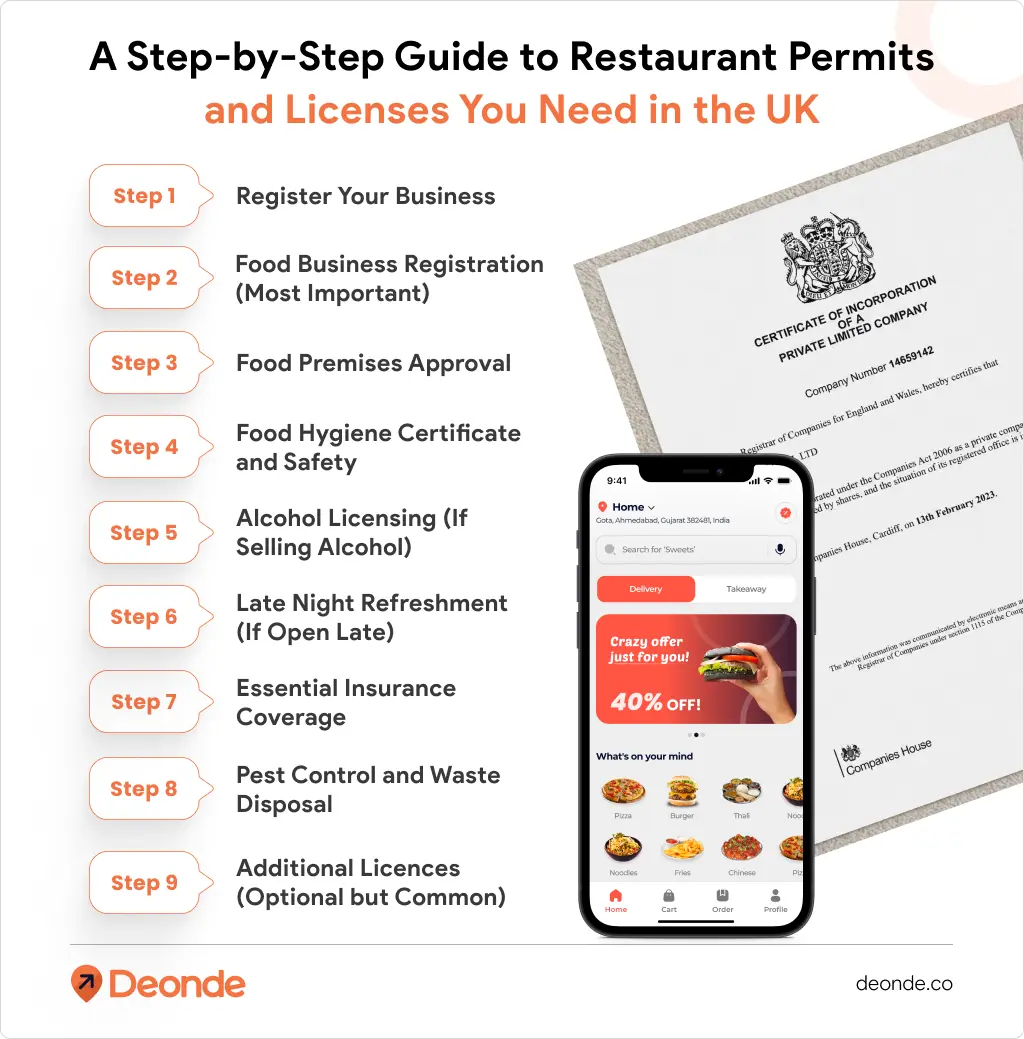
Step 1: Register Your Business
Before you apply for any sector-specific permits, you need a legal business entity. This is the foundation of everything else.
Choose Your Business Structure
You have three options in the UK:
- Sole trader — Simple to set up, but you carry unlimited personal liability. Best for small cafés or low-risk operations.
- Partnership — Two or more people share responsibility and profits. A written agreement is strongly advised.
- Limited company — The most common structure for restaurants. You register with Companies House, and your personal assets are protected from business debts.
Most restaurant owners choose a limited company because it signals professionalism to suppliers, landlords, and investors.
Register with Companies House and HMRC
Once you decide on a structure, you need to register it correctly. If you chose a limited company, register your business name with Companies House. Regardless of your structure, you will need to register for taxes with HMRC. This includes:
- VAT registration restaurant UK — mandatory once your turnover exceeds £90,000 (2025/26 threshold). You can also register voluntarily to reclaim VAT on purchases.
- Employer PAYE restaurant UK — required if you plan to hire staff. You must operate payroll and report deductions to HMRC.
Key Takeaway: Complete your company registration and tax setup before you move on to food-specific licences. You will need your UTR (and company number if you are a limited company) for many applications.
For a full walkthrough of the business setup phase, refer to our How to Start a Restaurant Business checklist
Step 2: Food Business Registration (Most Important)
This is the single most important permit you will obtain.
Food business registration with your local council is a legal requirement for any operation that cooks, stores, handles, prepares, or sells food.
This includes restaurants, cafés, takeaways, catering vans, and even home-based food businesses.
The 28-Day Rule
You must submit your registration at least 28 days before you start trading.
This is not a suggestion — it is a legal requirement under the Food Hygiene (England) Regulations 2013 and equivalent legislation in Scotland and Wales. The 28-day window gives the local authority environmental health team time to review your application and schedule an initial inspection if needed.
How to Register
The process is free and takes about 15–30 minutes. Visit gov.uk, enter your business postcode, and you will be directed to the correct local council portal. You can also use the Food Standards Agency’s central registration tool.
What the Registration Covers
Registration applies to the specific business owner (Food Business Operator) at a specific premises.
If the business changes hands, the new owner must submit a new registration. Similarly, if you move location or change the nature of your food operation, you must update your registration. The food business registration 28 days before opening UK rule resets if you change premises.
Key Takeaway: Do not open before the 28-day period expires. The council can inspect at any point, and operating unregistered is a criminal offence.
Step 3: Food Premises Approval
If you plan to prepare and supply non-vegetarian items — meat, fish, eggs, or dairy — to other businesses, you may need food premises approval UK in addition to standard registration. This is a separate, more rigorous step.
Who Needs It
Food premises approval is required when you handle products of animal origin (POAO) and supply them to other businesses.
In practice, standard restaurants DO NOT need this approval because they sell food directly to the final consumer (the public). A normal restaurant only requires standard food business registration.
Who Is Exempt
- Restaurants, cafés, and takeaways that sell food directly to the public are completely exempt from approval.
- Businesses that do supply other businesses may also be exempt if that B2B supply is “marginal, localised and restricted” (typically meaning it accounts for less than 25% of your total business).
The Inspection Process
Your local council will inspect the premises to ensure facilities meet hygiene and safety standards. They will check chillers, freezers, food storage areas, washing facilities, and waste disposal systems. Approval must be granted before you can handle these ingredients.
Key Takeaway: If you plan to supply other businesses with animal-based products, check with your local council whether you need premises approval. It is better to ask early than to be caught non-compliant.
Step 4: Food Hygiene Certificate and Safety
Your kitchen must meet the standards set by the Food Safety Act 1990 and the Food Hygiene (England) Regulations 2013. Compliance is verified through inspections and scored under the UK Food Hygiene Rating Scheme (the “scores on the doors” system from 0 to 5).
Level 2 Food Hygiene Certificate
While not strictly mandatory by law, holding a Level 2 Food Hygiene Certificate is expected by virtually every local council in the UK. It covers:
- Food safety laws and responsibilities
- Common food hazards (bacterial, chemical, physical, allergenic)
- Temperature control and cross-contamination prevention
- Cleaning and personal hygiene
Most environmental health officers will ask to see your staff’s training certificates during their first inspection. Without them, your food hygiene rating will likely suffer.
HACCP and Safer Food, Better Business
UK law requires every food business to have a documented food safety management system based on HACCP (Hazard Analysis and Critical Control Point) principles.
The Food Standards Agency provides a simplified, free package called Safer Food, Better Business (SFBB), which most small and medium restaurants use. It includes:
- Safe methods for cooking, chilling, and cleaning
- Cross-contamination controls
- A diary to record daily checks (fridge temperatures, cooking logs, etc.)
Implementing a HACCP plan is a strict legal obligation, not an optional extra. Your environmental health officer will ask to see your daily records during every inspection.
Key Takeaway: Get your Level 2 certificate before your first staff member handles food. Use the Safer Food, Better Business pack (or a custom HACCP plan) to manage and record your daily safety checks.
Step 5: Alcohol Licensing (If Selling Alcohol)
If you plan to sell alcohol, you need two separate licences — and the process takes longer than most people expect.
Premises Licence
The premises licence authorises your specific location to sell alcohol. It is issued by the local council’s licensing committee and must include an operating schedule that covers:
- Hours of alcohol sales
- Measures to prevent crime and disorder
- Public safety arrangements
- Prevention of public nuisance
- Protection of children from harm
The application process takes 8 to 12 weeks. You must display a public notice at the premises for 28 days, and authorities (police, environmental health, fire service) can raise objections.
Personal Licence
At least one person connected to the business must hold a personal licence. This is the individual legally responsible for authorising alcohol sales — typically the owner, manager, or Designated Premises Supervisor (DPS).
To qualify, you must complete an accredited licensing qualification (Level 2 Award for Personal Licence Holders) and pass a DBS check.
Costs
Many operators ask how much these licences cost.
The premises licence application fee depends on your local authority but typically ranges from £100 to £1,900, depending on the rateable value of the property.
The personal licence costs approximately £37 for the application, plus £100–£200 for the qualification course.
What Happens if You Skip This
Selling alcohol without a valid licence is a serious criminal offence. The police can apply for a closure order, and you can face an unlimited fine and up to six months in prison.
For managing delivery logistics alongside your bar service, see our guide on restaurant delivery management.
Key Takeaway: Start the alcohol licensing process at least 3 months before your planned opening. The premises licence and personal licence applications run in parallel, not sequentially.
Step 6: Late Night Refreshment (If Open Late)
If you plan to serve hot food or hot drinks between 11:00 PM and 5:00 AM, you need permission for Late Night Refreshment from your local council.
Under UK law, this is not a separate licence but a licensable activity. This means you must apply for a Premises Licence to cover these hours, even if you do not sell alcohol.
- If you are already applying for a Premises Licence for alcohol: You simply include Late Night Refreshment in your operating schedule on the same application.
- If you are strictly alcohol-free: You will still need to go through the Premises Licence application process solely to serve hot food and drinks late at night.
This requirement covers restaurants, takeaways, and mobile food vans operating during late hours. Your local authority sets the conditions, and it follows the standard 28-day public notice process.
Key Takeaway: Do not assume you only need a licence for alcohol. If your restaurant or takeaway plans to trade past 11:00 PM, you must secure a Premises Licence for Late Night Refreshment.
Step 7: Essential Insurance Coverage
Insurance is not just a safety net — in some cases, it is a strict legal requirement.
Employer’s Liability Insurance
If you employ anyone (even part-time or casual staff), you must have Employer’s Liability Insurance by law. It covers compensation claims if an employee is injured or becomes ill due to their work. The minimum legal cover is £5 million, and you can be fined £2,500 for every day you are uninsured.
Public Liability Insurance
Public liability insurance covers claims from customers or members of the public who suffer injury, illness, or property damage because of your business — for example, food poisoning, a slip in the dining area, or a severe allergic reaction. While not strictly a legal requirement under UK law, it is essential. Almost all commercial landlords, local councils, and event organisers will demand proof of it before letting you operate.
Additional Cover to Consider
- Building insurance: Protects your physical premises against fire, flood, and structural damage (often required by your mortgage lender or landlord).
- Contents and equipment insurance: Covers your expensive kitchen equipment, furniture, and stock if damaged or stolen.
- Business interruption insurance: Covers your lost income and ongoing bills if you are forced to close temporarily due to an insured event .
Key Takeaway: Do not treat insurance as an afterthought. Employer’s liability is a legal mandate, and public liability is practically unavoidable. Get quotes from brokers who specialise specifically in the hospitality sector.
Bhai, is step mein laws aur facts bilkul point par hain!
Bas problem wahi purani hai—phrasing thodi ajeeb hai kyunki “waste disposal contract restaurant in the UK” aur “zero food hygiene rating UK” jaise keywords zabardasti daale gaye hain.
Ek aur choti par important detail maine isme add ki hai: UK mein commercial waste ko normal domestic (residential) bins mein daalna illegal hai. Yeh padhne walon ke liye bohot zaroori point hai.
Maine isko natural aur professional bana diya hai:
Step 8: Pest Control and Waste Disposal
Local councils take pest control and waste management very seriously. Under the Prevention of Damage by Pests Act 1949 and standard food hygiene regulations, you have a strict legal duty to keep your premises pest-free.
What You Must Do
- Commercial Waste Contract: You cannot use standard residential council bins for a business. You must legally arrange a commercial waste disposal contract with a licensed waste carrier. Food waste must be stored in secure, sealed bins to prevent attracting pests.
- Pest Control Contract: While you can technically manage this yourself, most local councils strongly expect to see an ongoing contract with a professional pest control provider. You need to keep a logbook on-site showing regular preventative visits.
- Proofing and Maintenance: Maintain a clean, dry kitchen environment. Seal physical entry points (holes, gaps under doors), inspect daily deliveries for hitchhiking pests, and train your staff to spot and report signs of an infestation.
Your Environmental Health Officer (EHO) will scrutinize your pest control logs and waste bins during inspections. Evidence of an active infestation, or poor waste management, will instantly drop your score to a zero food hygiene rating and can lead to an emergency closure order.
Key Takeaway: A professional pest control contract and a licensed commercial waste collection service are fundamental operating costs. Set them up well before your kitchen officially opens.
Step 9: Additional Licences (Optional but Common)
Depending on your concept, location, and operations, you may need one or more of the following permissions.
Music Licence (TheMusicLicence)
If you play any recorded or live music on your premises — even just a Spotify playlist or background radio — you legally need a licence from TheMusicLicence (a joint venture between PPL and PRS for Music). The cost depends on your venue’s square footage, seating capacity, and how you use the music. Playing music without it is a direct breach of copyright law.
Pavement Licence
If you want to place tables and chairs on the public pavement outside your restaurant, you need a Pavement Licence from your local council.
Thanks to recent updates in UK law (making temporary pandemic rules permanent), the process is now streamlined. Councils can charge a maximum application fee of £500 for new licences and £350 for renewals.
Planning Permission and Use Classes
Important Update: In England, the old “A3” use class for restaurants no longer exists. Restaurants now fall under Class E (Commercial, Business and Service).
Because retail shops and offices also fall under Class E, you generally do not need planning permission for a “change of use” to convert a shop into a restaurant.
However, you will still likely need planning permission for physical alterations — such as installing a commercial extraction flue or changing the shopfront. Always consult your local planning authority before signing a lease.
Signage and Advertisement Consent
External illuminated signs, large awnings, and projecting boards usually require Advertisement Consent from your local council’s planning department. Check whether your local authority has a deemed consent policy or if you need to submit a formal application.
Fire Safety Risk Assessment
Under the Regulatory Reform (Fire Safety) Order 2005, there is no physical “Fire Safety Certificate” issued by the government. Instead, the law dictates that you must conduct and document a comprehensive Fire Risk Assessment.
You must implement safety measures, provide fire extinguishers, and maintain clear emergency exits.
Local fire authorities regularly inspect commercial kitchens and can issue immediate enforcement notices if you fall short.
Natasha’s Law and Allergen Requirements
Since October 2021, “Natasha’s Law” legally requires full ingredient and allergen labelling on all foods that are Prepacked for Direct Sale (PPDS) (e.g., grab-and-go sandwiches packaged on-site).
For standard dine-in restaurant meals, you must clearly provide accurate allergen information for every dish — either written on the menu, displayed on a board, or provided verbally by staff with a written matrix to back it up.
| Aspect | Requirement |
| What must be declared | All 14 major allergens (celery, cereals containing gluten, crustaceans, eggs, fish, lupin, milk, molluscs, mustard, peanuts, sesame, soya, sulphur dioxide, tree nuts) |
| Where to display | Menu, chalkboard, or verbally with written record |
| Legal basis | Food Information Regulations 2014 and Natasha’s Law (for PPDS) |
| Penalty for non-compliance | Unlimited fine, prosecution, reputational damage |
Key Takeaway: Check your property’s use class before signing any lease. If you need planning permission in the UK, budget 3–6 months.
Allergen compliance under general UK food law (and Natasha’s law for prepacked items) is non-negotiable — train your front-of-house team thoroughly.
Timeline Checklist
Use this table to schedule your application process and avoid costly delays before opening day.
| Task | When to Do It |
| Register business (Companies House) & set up PAYE/VAT | During initial business setup |
| Check property Use Class (Ensure it is Class E) | Before signing the lease |
| Apply for planning permission (for physical alterations) | 3 to 6 months before opening |
| Apply for Premises Licence (for alcohol & late-night food) | At least 12 weeks before opening |
| Apply for Personal Licence (to authorise alcohol sales) | At least 8 weeks before opening |
| Register food business with the local council | At least 28 days before opening |
| Arrange essential insurance (Employer’s & Public Liability) | Before hiring staff or taking the lease |
| Set up contracts (Commercial waste & pest control) | Before kitchen operations begin |
| Complete staff training (Level 2 Food Hygiene) | Before any staff handle food |
| Implement food safety system (HACCP / SFBB) | Before opening |
| Apply for venue permissions (Music & Pavement licences) | Before opening |
| Conduct Fire Risk Assessment | Before opening |
| Set up allergen tracking (Natasha’s Law compliance) | Before opening |
Common Mistakes to Avoid
1. Opening before the 28-day registration period
Many new operators misunderstand the food business registration 28 days before opening UK rule. You cannot open on day 21, even if you submitted on day 1. Wait the full 28 days.
2. Skipping premises approval for non-veg menus
Your menu includes a chicken dish? Eggs in your breakfast? Butter in your pastry? As long as you sell directly to the public, standard registration covers it. Do not waste time applying for food premises approval UK — that is only required if you supply animal products to other businesses.
3. Not getting a personal alcohol licence
Some owners assume the premises licence is enough. It is not. You need a Designated Premises Supervisor (DPS) who holds a personal licence, and they must legally authorise all alcohol sales (even if they are not physically on-site at all times).
4. Ignoring pest control requirements
Skipping pest control is one of the fastest ways to lose your food hygiene rating UK and trigger enforcement action. It is a legal requirement, not an optional extra.
5. Overlooking Natasha’s law
Many new restaurant owners still confuse the rules. While Natasha’s law allergen requirements UK apply strictly to pre-packaged goods, general UK food law requires you to provide allergen information for every made-to-order dish too. Get your allergen matrix ready before day one.
Conclusion
The legal landscape for opening a restaurant in the UK can feel overwhelming, but it follows a logical sequence: food business registration, a premises licence (if selling alcohol or late-night food), a personal licence, hygiene certification, essential insurance, and any location-specific permits like pavement or music licences.
Compliance with UK hospitality laws is not just about avoiding fines — it is about building a safe, trustworthy business that your customers and staff can rely on.
The best advice we can give is this: contact your local council early. They will tell you exactly which permits apply to your specific concept, location, and menu.
When you are ready to start trading, consider how an online ordering system can help you grow revenue beyond the dining room, and explore tried-and-tested restaurant marketing ideas to build your customer base from day one.
For comparison, you can also review how restaurant permits and licences in the USA differ from the UK system if you operate across both markets.
Get your paperwork right, and the rest becomes much easier.