Skip most people still call it SkipTheDishes is Canada’s homegrown answer to Uber Eats and DoorDash, and over the last two years it’s rebuilt itself into something bigger than a dinner app.
Long before Uber Eats or DoorDash had a Canadian address, SkipTheDishes was already delivering dinner to doorsteps in Winnipeg and Saskatoon.
SkipTheDishes runs a commission-based, three-sided marketplace that connects Canadian diners, independent restaurants, and gig-economy couriers through one app. Skip owns no restaurants and no delivery vehicles.
It earns money by charging restaurants a per-order commission, plus delivery fees, advertising, now direct retail sales through its own dark stores, and service fees paid by customers.
SkipTheDishes never relied on just one way of making money. It stacked several revenue streams on top of a simple three-sided marketplace, then quietly expanded from “get food delivered” into groceries, retail, and even software for other businesses.
This piece walks through exactly how SkipTheDishes works, where each dollar in its revenue model comes from, what it’s like to order from, drive for, or partner with the platform, and where you’ll actually find it across the country.
Also Now That serves more than 5 million customers and over 50,000 restaurant and retail partners nationwide, across more than 480 cities and towns in Canada.
Why should you study SkipTheDishes? Because they solved the hardest problem in tech: Last-Mile Logistics. They took a low-margin industry (food delivery) and used algorithmic dispatching to make it profitable at scale. If you are looking to build a platform that connects supply and demand in real-time, this is the blueprint.
What Is SkipTheDishes? Is SkipTheDishes Canadian?
SkipTheDishes is a technology company that builds the digital infrastructure for local delivery. It is not a restaurant, and it is not a courier company; it is a hyper-local on-demand aggregator.
About SkipTheDishes
To understand the model, you must understand the engine behind it.
SkipTheDishes was founded in Saskatoon, Saskatchewan in 2012 and is still headquartered in Winnipeg, Manitoba. It operates only inside Canada. Its parent, Amsterdam-based Just Eat Takeaway.com, itself became a subsidiary of global investor Prosus in October 2025.
Brothers Josh and Chris Simair started the company in 2012, joined soon after by co-founders Jeff Adamson, Daniel Simair, and Andrew Chau.
In 2016, UK-based Just Eat bought SkipTheDishes for roughly $110 million CAD, with up to $90 million more tied to performance targets.
Just Eat then merged with the Dutch company Takeaway.com in 2020, forming Just Eat Takeaway.com and that’s the moment Skip’s logo flipped from red to the orange, house-shaped mark it uses today.
In October 2024, the company quietly dropped “the Dishes” from its public branding, becoming simply Skip, and brought back longtime spokesperson Jon Hamm to introduce the new name.
The ownership story kept moving. In February 2025, Prosus (majority-owned by South Africa’s Naspers) agreed to buy Just Eat Takeaway.com for €4.1 billion. The deal closed that October, and within weeks Prosus held over 98% of shares.
So today, the chain runs SkipTheDishes → Just Eat Takeaway.com → Prosus. The brand, courier network, and Winnipeg office are entirely Canadian-facing — Skip still doesn’t operate outside Canada — but the parent sits in Europe.
Quick Timeline: From Startup to Empire
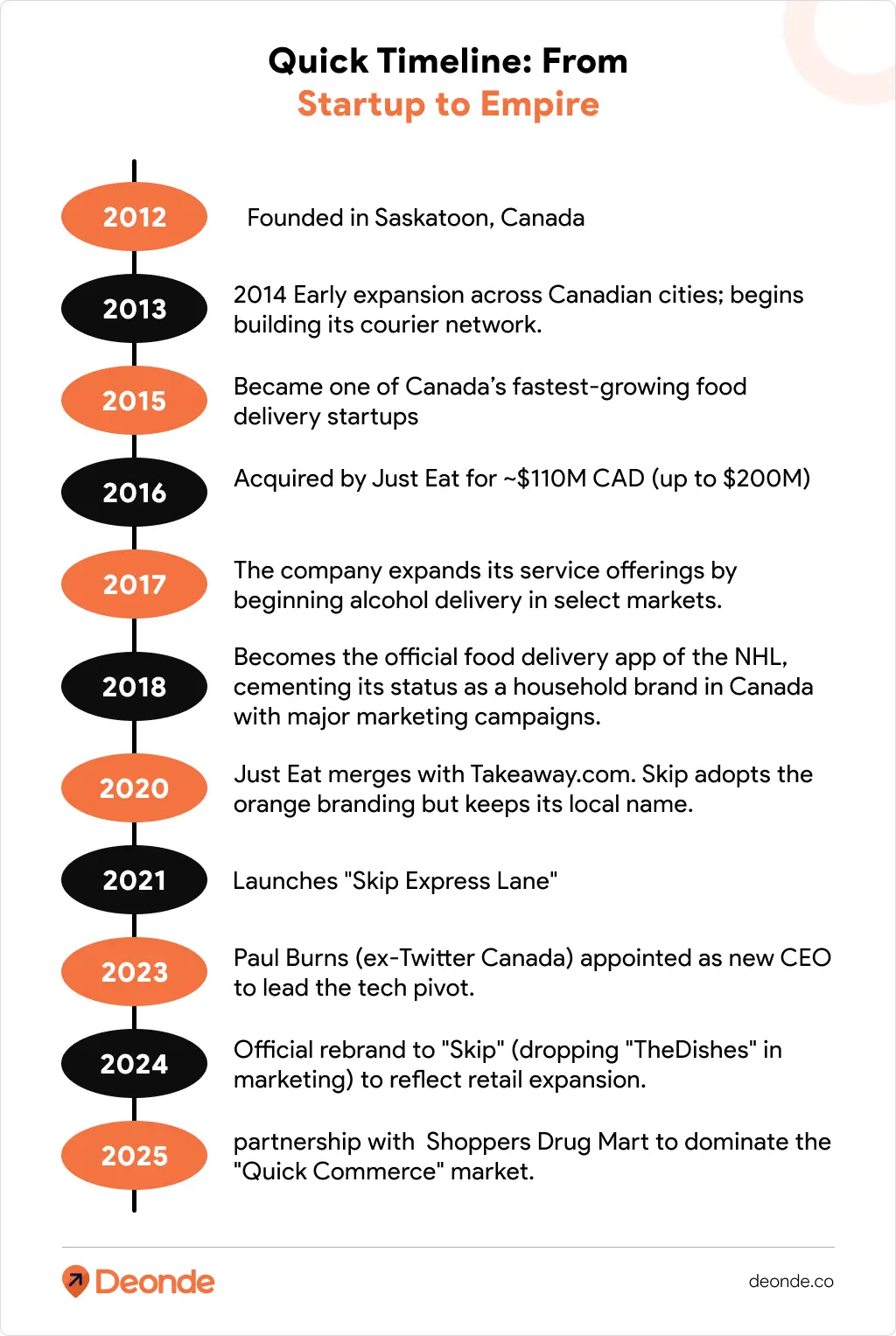
- 2012 – Founded in Saskatoon, Canada
- 2013 – 2014 – Early expansion across Canadian cities; begins building its courier network.
- 2015 – Became one of Canada’s fastest-growing food delivery startups
- 2016 – Acquired by Just Eat for ~$110M CAD (up to $200M)
- 2017 – The company expands its service offerings by beginning alcohol delivery in select markets.
- 2018 – Becomes the official food delivery app of the NHL, cementing its status as a household brand in Canada with major marketing campaigns.
- 2020 – Just Eat merges with Takeaway.com. Skip adopts the orange branding but keeps its local name.
- 2021 – Launches “Skip Express Lane“—their own “dark stores” (micro-fulfillment centers) to deliver groceries in 25 minutes.
- 2023 – Paul Burns (ex-Twitter Canada) appointed as new CEO to lead the tech pivot.
- 2024 – Official rebrand to “Skip” (dropping “TheDishes” in marketing) to reflect retail expansion.
- 2025 – Major strategic partnership with Walmart Canada & Shoppers Drug Mart to dominate the “Quick Commerce” market.
SkipTheDishes Business Model Explained
At its core, SkipTheDishes operates on a Hyperlocal Three-Sided Marketplace model. Unlike traditional delivery services, where a restaurant hires its own driver, Skip acts as the technological “middleman” that matches supply (Restaurants/Retailers) with demand (Hungry Customers) through a freelance logistics network (Couriers).
The company describes its model as “Asset-Light,“ meaning they do not own the restaurants, the food, or the delivery vehicles. Their primary asset is the algorithm that optimizes dispatching to ensure hot food arrives quickly.
The 3 Pillars of the Marketplace
1. The Consumer (Demand Side)
- The Problem: People want variety beyond just pizza and Chinese food, but most local spots don’t deliver.
- The Solution: A single app that tracks orders in real-time (GPS) and offers everything from sushi to alcohol and groceries.
- Why they stay: The “Skip Rewards”loyalty program and the Skip+ subscription (unlimited free delivery) lock them into the ecosystem.
2. The Restaurant & Retail Partners (Supply Side)
- The Problem: Small businesses can’t afford to hire full-time drivers or build complex ordering apps.
- The Solution: Skip provides a “business in a box.” They hand the restaurant a tablet, and suddenly, that business can reach thousands of new customers.
- The “Skip Score”: A unique food algorithm that ranks restaurants based on their efficiency. Faster prep times = higher ranking in the app.
3. The Couriers (Logistics Side)
- The Problem: People want to earn extra money but need flexibility that a 9-to-5 job doesn’t offer.
- The Solution: A gig-economy model where drivers use their own vehicles and choose their own shifts (“The Skip Network”).
- Earnings: They keep 100% of delivery fees and tips, while Skip pays them transit pay based on distance.
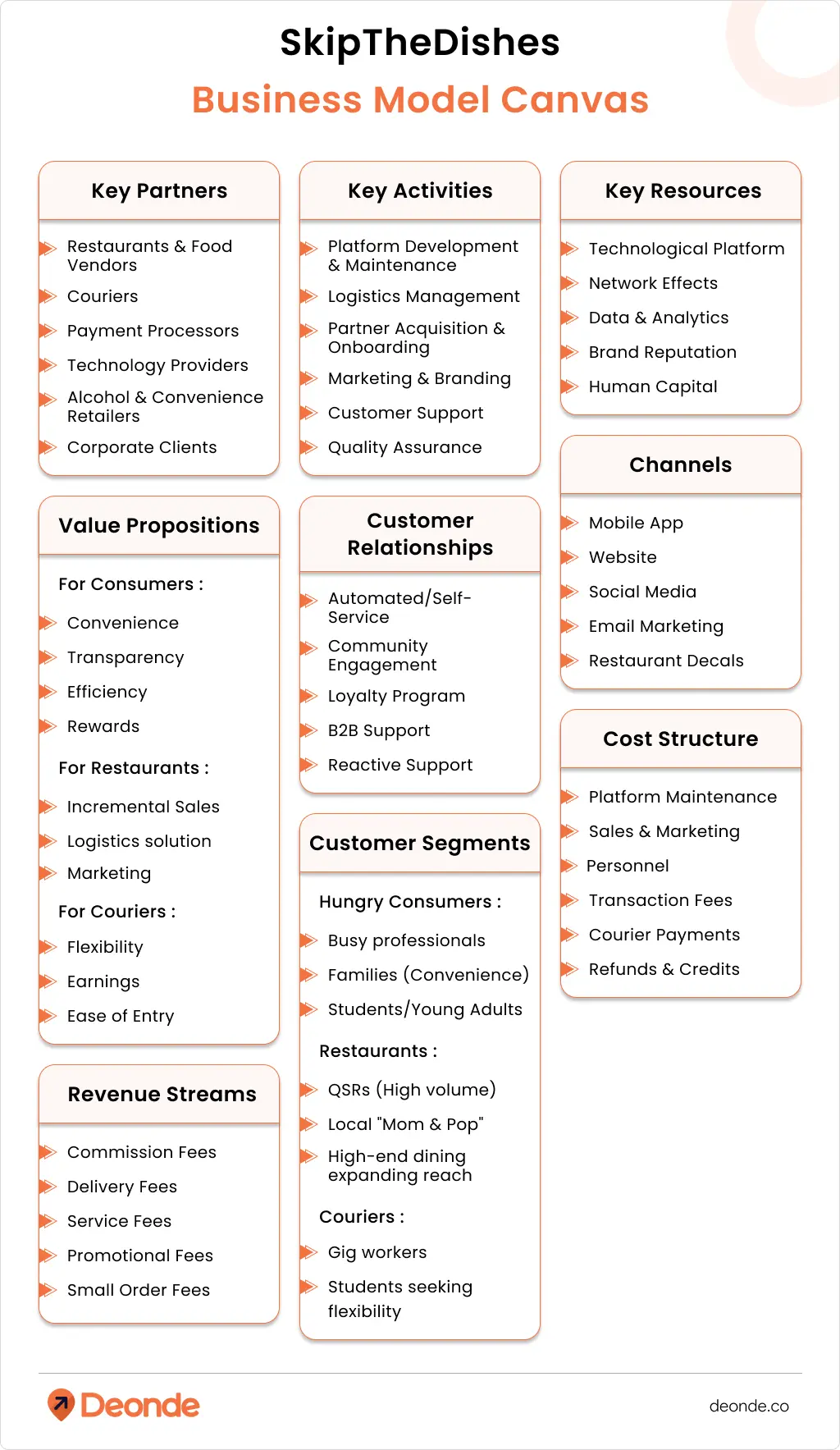
In classic business model canvas terms: restaurants and couriers are the key partners, the dispatch technology is the key resource, and commissions, fees, advertising, and direct retail sales are the revenue streams layered on top of a relatively lean cost base (tech, support staff, and courier payouts).
The Business Model Canvas
Here is the entire business strategy broken down into its key components
How Does SkipTheDishes Work? From Order to Doorstep
If you’ve never used it, how does SkipTheDishes work in practice comes down to a short cycle:
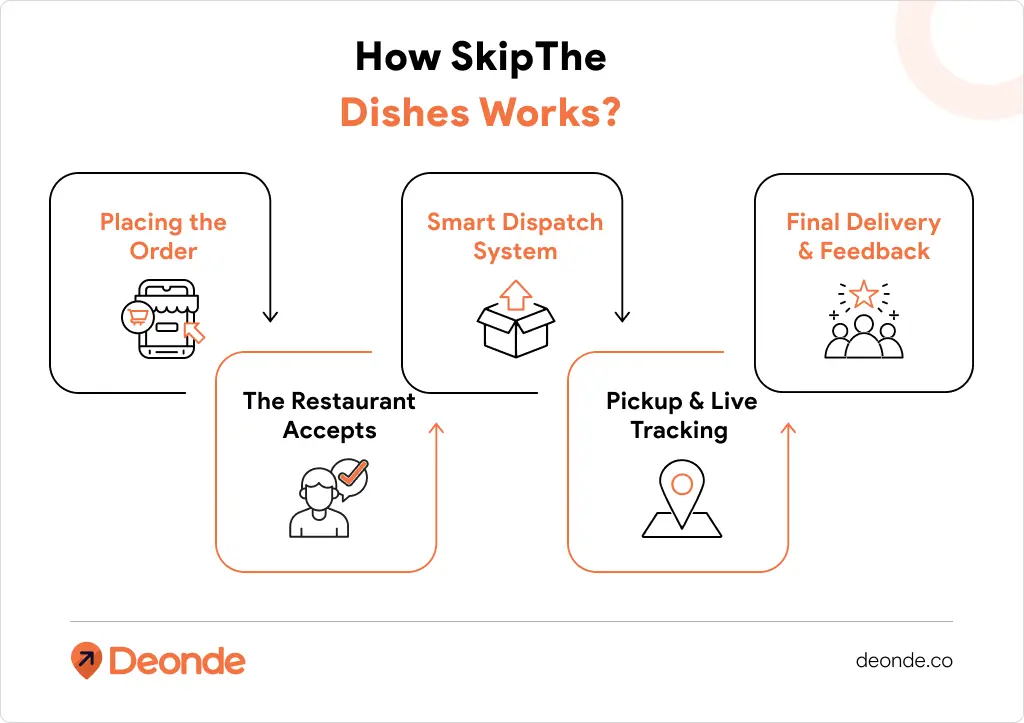
The SkipTheDishes system operates on a seamless 5-step cycle. The technology acts as the bridge connecting the Customer, the Restaurant, and the Courier to ensure the fastest possible delivery.
1. Placing the Order (Customer Step): It starts when a user opens the app or website. After setting their location, they browse menus from various local restaurants. Once the items are selected, the user completes the transaction via online payment or selects their preferred payment method.
2. The Restaurant Accepts: As soon as the order is placed, the restaurant receives a notification on their dedicated Skip Tablet. The restaurant confirms the order and begins food preparation.
Note: The restaurant must input a specific prep time so the system knows exactly when the food will be ready.
3. Smart Dispatch System (The Algorithm): This is where the core technology kicks in. Skip’s proprietary algorithm scans the network to find a driver (courier) who is nearest to the restaurantand available. The order is automatically assigned to that driver, who accepts the request and heads to the restaurant.
4. Pickup & Live Tracking: The courier arrives, picks up the order, and places it inside a Thermal Bagto ensure the food stays hot. During this transit, the customer can watch the Real-Time GPS Trackingon their app to see exactly where the driver is and the estimated arrival time.
5. Final Delivery & FeedbackThe courier arrives at the customer’s location and hands over the order (or leaves it at the door for contactless delivery). Once the delivery is complete, the customer is prompted to rate and review both the restaurant and the driver.
It’s a simple loop, but every step in it is also a revenue opportunity, which brings us to the part most readers actually came for.
How Does SkipTheDishes Make Money: Key Revenue Model
This is the most critical section for your readers. SkipTheDishes is not just a delivery service; it is a multi-stream revenue engine.
Here is a breakdown of their income sources:
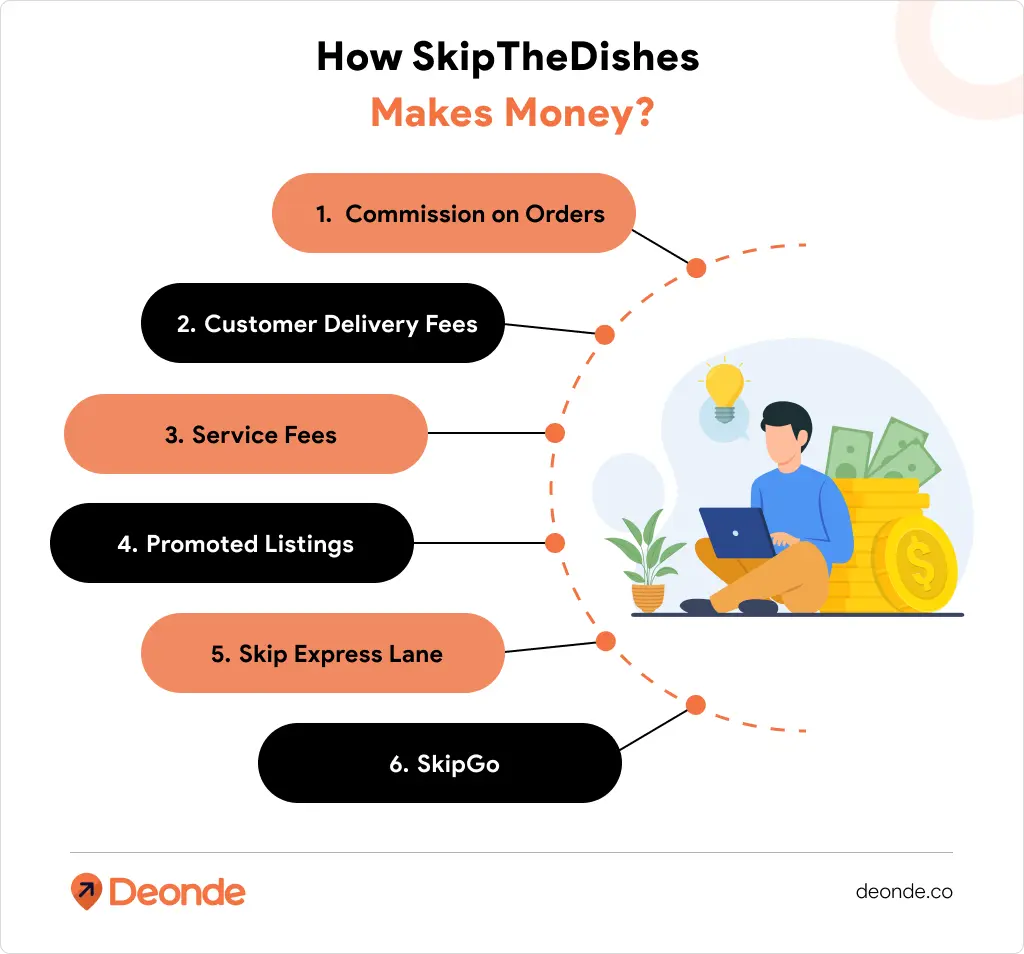
1. Commission on Orders (The Primary Stream)
This is the bulk of their revenue. Every time a customer orders, the restaurant pays a “finder’s fee” to Skip.
- The Rate: Typically ranges from 20% to 30% of the total order value.
- Example: If you order a $50 sushi platter, the restaurant might only keep $35. Skip takes $15.
- Why do restaurants pay this? Because Skip brings them customers they would never get otherwise. It is a marketing cost.
2. Customer Delivery Fees
The customer pays a delivery fee based on the distance from the restaurant.
- The Fee: Usually between $1.99 and $5.99 (variable based on distance and weather).
- Note: 100% of this fee usually goes to the Courier to subsidize their pay, but Skip uses this lever to balance supply and demand.
3. Service Fees
Hidden in the checkout, there is often a small “Service Fee” (usually roughly 99 cents or a small percentage). This goes directly to SkipTheDishes’ bottom line to cover “app maintenance and support.”
4. Promoted Listings (Advertising)
Restaurants can pay extra to appear at the top of the search results.
- If a pizza shop wants to be the #1 result when a user searches “Dinner,” they pay Skip for that placement. This is pure profit for Skip.
5. Skip Express Lane (Direct Sales)
This is a newer, high-margin stream (2021–2025).
- Skip operates its own “Dark Stores” (mini warehouses).
- When a user orders milk, chips, or diapers from “Skip Express Lane,” Skip isn’t just taking a commission—they are the retailer. They make the profit margin on the product plus the delivery fee.
6. SkipGo (White-Label Website & App)
This is a B2B service where Skip provides the technology directly to the restaurant.
- What it is: Skip builds a fully functional website or mobile app for the restaurant. It carries the restaurant’s own brand, logo, and colors—not Skip’s.
- How it works:To the customer, it looks like they are ordering directly from the restaurant’s own site. However, the backend technology and the ordering system are powered entirely by Skip.
- The Benefit: The restaurant gets a professional online ordering platform without needing to hire expensive developers, while Skip earns revenue by powering their tech stack.
What Services Does SkipTheDishes Offer?
SkipTheDishes is a Canadian online food delivery company that serves three main groups — customers, restaurant partners, and delivery couriers.
For customers
- Restaurant food delivery from tens of thousands of partner restaurants across Canada
- Skip Express Lane — groceries and household essentials from Skip’s own dark stores, typically delivered in well under 30 minutes
- Retail delivery from national partners including Walmart Canada, Shoppers Drug Mart, Dollarama and PetSmart
- Alcohol delivery where provincially permitted
- Skip+ — a paid subscription for unlimited free delivery
- Skip Rewards — points on every order, redeemable toward future orders
For restaurant and retail partners, SkipTheDishes offers:
- A marketplace listing with menu and order management through the restaurant portal
- Promoted Listings — paid placement at the top of search results
- SkipGo — a white-label ordering website and app carrying the restaurant’s own branding
- Access to Skip’s courier network without hiring a single driver
- Marketing support, analytics, and catering/large-order tools
For Couriers
- The Skip Network — Gig-economy delivery with flexible shifts
- Transit Pay + 100% Tips — Drivers keep all delivery fees and tips
- Winter Fleet — Specialized snow-capable vehicles for Canadian winters
That restaurant list is worth pausing on, because it’s where Skip stops looking like a delivery app and starts looking like a growth agency.
SkipTheDishes Agency And Merchant Services
Beyond consumer food delivery, SkipTheDishes has expanded its agency-style services for businesses looking to grow their digital presence and order volume.
Through its merchant portal, restaurant partners can access:
- Marketing support Skip runs promotional campaigns (e.g., discount events, national advertising) that drive traffic to partner listings
- Data and analytics partners see order volume, peak hours, and customer feedback through the merchant dashboard
- SkipGo white-label platform a fully branded ordering website and app built on Skip’s infrastructure, allowing restaurants to accept direct orders without marketplace commission
- Catering and large-order fulfillment for restaurants targeting office or event orders
These services position SkipTheDishes as more than a delivery marketplace it acts as a digital growth partner for Canadian food businesses.
Why Do Customers Choose SkipTheDishes?
In a crowded market, why pick Skip over UberEats?
- Regional Loyalty: In Canada, especially in the Prairies and suburbs, Skip was there first. It is a “homegrown” brand.
- Unmatched Reliability (The Winter Fleet): Skip understands Canadian winters better than anyone. They recently launched a specialized Winter Delivery Fleet, complete with snowplows to clear streets and driveways. This ensures that when the weather is at its worst, Skip can still deliver deals and convenience.
- Transparency: Skip was one of the first apps to offer full transparency on tipping. The courier sees the tip before they accept the order, encouraging better service.
- The “Skip Rewards” Program:A loyalty program that rewards users with points for every dollar spent, creating a “lock-in” effect.
SkipTheDishes Restaurant Partner Portal, Merchant Login & Support
The SkipTheDishes restaurant portal is the dashboard partners use to manage orders, menus, payouts, and performance data. Restaurants log in at restaurants.skipthedishes.com using their partner credentials — one login that covers what people search for as partner login, restaurant login, and merchant login.
Inside the portal, restaurant partners can:
- Update menu items and pricing in real time
- Track live and historical order data
- Pull sales and customer-feedback reports
- Manage Partner Pay and payout details
- Connect a POS system (via providers like Deliverect or Cuboh) so orders print straight to the kitchen
Most POS integrations require a Restaurant ID, found by logging into the portal and selecting the specific location — the same portal doubles as the SkipTheDishes portal for switching integration providers or messaging support.
How to Become a SkipTheDishes Driver (Courier): Step-by-Step
To become a SkipTheDishes driver, you need to be the age of majority in your province, pass a background check, and prove you can legally work in Canada. You’ll also need a reliable vehicle, a smartphone, direct deposit details, and an industry-standard thermal delivery bag before you can accept runs.
Here’s the actual path for a SkipTheDishes courier:
- Check eligibility: Age of majority in your province, plus a reliable vehicle — a car in most cities, sometimes a bike.
- Gather your documents: A valid driver’s licence, proof of work eligibility (passport, birth certificate, PR card, work or study permit), and a background check completed within the last 90 days.
- Get your gear: A smartphone with a data plan and a commercial-grade thermal bag — Skip doesn’t require its own branded bag specifically, but whatever you use has to meet its safety standards.
- Apply through the Courier Portal: Upload documents, complete the background check, and add banking details for direct deposit.
- Pick your delivery zones: Choose the areas of your city you want to work, and set weekly availability in the courier app.
Once approved, couriers keep 100% of tips on top of per-delivery transit pay, deposited weekly. It’s a genuinely flexible gig setup you choose shifts rather than being assigned them.
How Did It Become So Popular?
SkipTheDishes didn’t win by accident. They used specific strategies that allowed them to dominate the Canadian market before competitors could catch up.
1. They Targeted “The Ignored Cities”
While Uber Eats and DoorDash were fighting tooth-and-nail for customers in downtown Toronto and Vancouver, Skip went the other way. They launched in Burnaby, Red Deer, Winnipeg, and Saskatoon.
- The Result: They became the default (and often only) app in these areas, building extreme brand loyalty that lasted even when competitors finally showed up.
2. Star Power & “Homegrown”
Marketing is usually boring, but Skip leans into its Canadian identity with massive celebrity partnerships.
- The Celebrity Strategy: It started with Jon Hamm playing a “wannabe Canadian,” but in 2024, Skip brought in actual homegrown talent: Seth Rogen. The new brand campaign leverages Rogen’s iconic humor to cement Skip’s status as a national staple.
- Cultural Moments: Skip isn’t just on TV; they are on the Red Carpet. They teamed up with TikTok Canada to host the first-ever exclusive “Orange Carpet” livestream at the 54th Annual JUNO Awards, positioning the brand at the center of Canadian music and pop culture.
Saving Money on SkipTheDishes: Promo Codes, Discounts, Vouchers and Gift Cards
Skip doesn’t run one permanent public promo code offers rotate, expire, and are often region- or account-specific, so treat any code from a random third-party blog with some skepticism and confirm it works at checkout before relying on it.
That said, there are several legitimate ways to save:
- New-customer sign-up offers. Skip regularly runs a first-order discount for new accounts. A genuine SkipTheDishes promo code Canada shoppers can trust usually comes from the app’s own promotions banner or official social channels — not a generic “coupon” listing site.
- Referral credits. Existing users can share a personal referral link; when a new user signs up and orders, both sides typically get a credit. This is one of the more reliable sources of a working SkipTheDishes discount code, since it comes straight from Skip’s own systems.
- Skip Rewards points. Every paid order earns points that convert into order credit — an ongoing, self-generated discount that doesn’t expire the way a marketing voucher does.
- Seasonal and launch vouchers. Skip runs limited-time voucher codes tied to holidays, restaurant promotions, or new-city launches, sometimes including $0 delivery. These live in the app’s “Offers” section — the most current source of an active SkipTheDishes voucher code Canada-wide.
- Skip+. For frequent orderers, the subscription waives delivery fees entirely, functioning as a bigger, ongoing discount than any single promo code.
- Gift cards. SkipTheDishes gift cards are redeemed by opening the app, tapping the profile icon, selecting Gift Cards, entering the card number in the claim code field, and selecting Redeem to add the credit to your account.
SkipTheDishes Innovations (2024-2026): The Pivot to “Everything”
If 2020 was about survival, 2025 is about ubiquity. Skip has realized that delivering hot food is a low-margin game. The real money is in Retail & Quick Commerce.
To stay relevant for Google’s “Freshness” algorithm, here are the critical updates your readers need to know:
1. The “Skip” Rebrand (Dropping the “Dishes”): You may have noticed their marketing shifting simply to “Skip.”This is intentional. “Dishes” implies dinner. “Skip” implies skippingthe chore of going to the store.
2. The “Everything” Store: Major Retail Partnerships This is the game-changer. Skip has moved far beyond restaurants, with the retail category soaring over 1,700%in growth.
- The Retail Giants: Skip has secured strategic partnerships with Walmart Canada (vast product selection), Shoppers Drug Mart (pharmacy & beauty), and Dollarama (value goods).
- Pet Delivery: Partnering with PetSmart, Skip now offers on-demand delivery for pet essentials nationwide, “making fetch happen” for dog and cat owners who need food or toys instantly.
- The Shift: Couriers are no longer just drivers; they are “Pickers.” They walk into these stores, grab your groceries or pet food, and deliver them. This puts Skip in direct competition with Instacart, but with faster, on-demand speed.
3. “Skip Express Lane” Expansion: Skip now operates its own “Dark Stores”(mini-warehouses closed to the public) in major Canadian cities.
Why it matters: When they deliver from their own warehouse, they keep 100% of the margin on the product (the chips, the milk, the Advil) plus the delivery fee. This is the path to profitability.
4. AI-Driven “Stacking” Efficiency: New updates to the dispatch algorithm in late 2024 allow for smarter “Order Stacking.”
Old Way: One driver = One Order.
New Way: One driver = A hot meal from McDonald’s + A prescription from Shoppers Drug Mart (delivered to neighbors). This doubles the revenue per trip for the courier and Skip.
Competitor Analysis: The “Big Three” War
To understand Skip’s success, you have to look at the broader landscape. When comparing the top online food delivery platforms in Canada, Skip maintains a unique “homegrown” advantage over its US-based rivals.
Here is how Skip stacks up against the global giants:
|
Feature |
SkipTheDishes (Skip) |
UberEats |
DoorDash |
|
Origin / HQ |
Canada (Winnipeg) |
USA (San Francisco) |
USA (San Francisco) |
|
Primary Strength |
Suburbs & Mid-Market Cities (The “Prairie King”) |
Major Metros (Toronto, Vancouver) |
Aggressive Growth & Market Share |
|
Core Audience |
Families, Value-Seekers, “Homegrown” Loyalists |
Urban Professionals, Tech-Savvy Users |
Millennials, Subscription Users (DashPass) |
|
Loyalty Program |
Skip Rewards (Points per dollar) |
Uber One (Combined with Rides) |
DashPass (Subscription model) |
|
Courier Model |
Shift-Based (Drivers schedule shifts; reliability focused) |
On-Demand (Log on whenever; flexibility focused) |
Mixed (leaning towards on-demand) |
|
Merchant Fees |
~20–30% (Generally viewed as “Partner Friendly” in Canada) |
~30% (Often criticized for high fees) |
~25–30% (Variable tiers) |
Takeaways for Founders Who Want to Build an App Like SkipTheDishes
If you want to start a delivery business today, do not copy Uber. Copy Skip’s smart strategy. Here is exactly how to build a profitable business in 2025:
1. Target the “ignored” cities SkipTheDishes did not fight for New York or London. They went to smaller cities (like Winnipeg and Saskatoon) where there was no competition.
- The Lesson: Don’t try to beat the giants in the big metro cities. Launch your app in Tier-2 or Tier-3 cities where customers are waiting for a good service.
2. Don’t write code, just do business (White-Label) Skip spent 10 years building their technology. You don’t have that time.
- The Lesson: Smart founders don’t build from scratch. Use a Readymade White-Label Food Delivery App. It costs way less and lets you launch in just 2 weeks. Your job is to sell to restaurants, not to fix software bugs.
3. Own the network, not the kitchen (Asset-Light) Restaurants have to pay for rent, staff, and food inventory. You don’t.
- The Lesson: Keep your business “Asset-Light.“You don’t own the food; you just connect the buyer and seller. This means you have very low risk compared to opening a restaurant.
4. Cash flow is king (Commission Model) In this model, you make money on every single transaction.
- The Lesson: Charge a fair commission (15-20%) to restaurants and a small fee to customers. Since you collect the money online beforethe food is delivered, you always have cash in the bank to pay your drivers.
5. Speed builds trust Customers don’t care about your logo; they care if the food is hot.
- The Lesson: If you use a white-label app, make sure it has Real-Time GPS Tracking. If a customer can see the driver moving on the map, they trust you. If they trust you, they order again.
Building a Platform Like This Yourself
SkipTheDishes spent over a decade and tens of millions of dollars building this technology the dispatch algorithm, the courier app, the restaurant dashboard, the payments layer.
Most entrepreneurs eyeing a Skip-style delivery business in their own city don’t have a decade to spare, and that’s the gap platforms like Deonde exist to close. Instead of a commission-per-order model, Deonde runs on a fixed monthly subscription and hands you a ready-made SkipTheDishes-style delivery app customer app, courier app, and admin dashboard, under your own brand — instead of giving up a cut of every order to a third-party marketplace.
Conclusion
SkipTheDishes proves that you don’t need to be in Silicon Valley to build a billion-dollar tech empire. By focusing on overlooked markets—the suburbs and mid-sized cities—and prioritizing logistics efficiency over flashy trends, they managed to defeat global giants like Uber on their home turf.
As the company pivots from “SkipTheDishes” to simply “Skip,” expanding into groceries and retail with Quick Commerce, they continue to set the standard for adaptability. They are no longer just delivering dinner; they are building the infrastructure for local commerce.
Launch your own branded ordering system with online ordering and delivery system for Canada — built for Canadian entrepreneurs and local businesses ready to grow online.