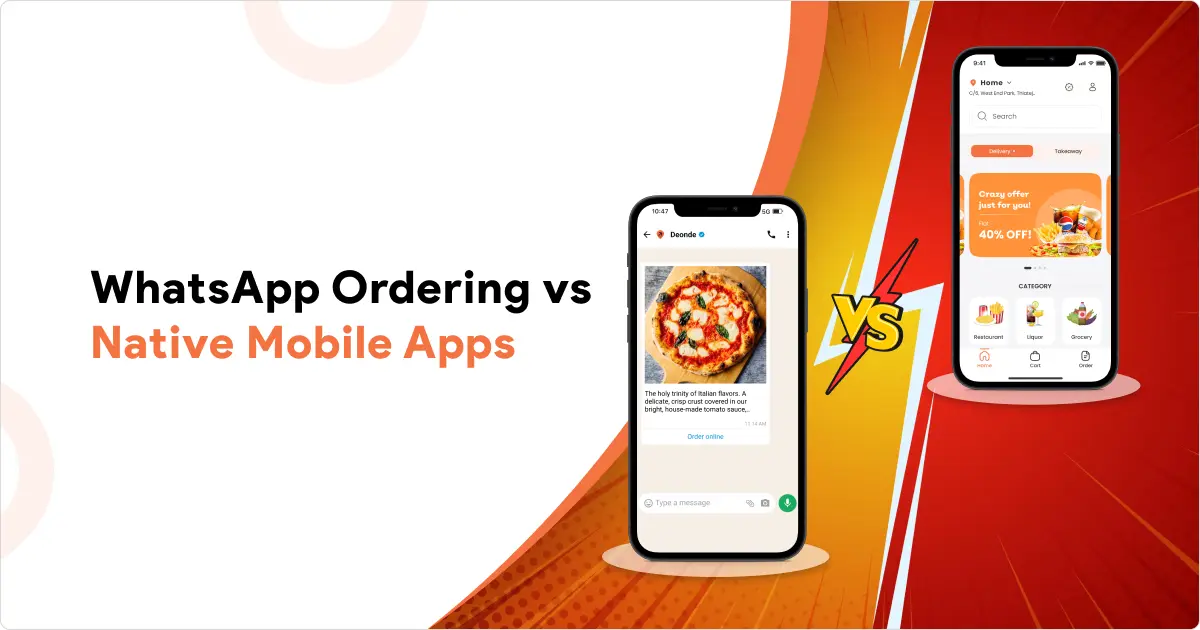
If you run a restaurant, a dark kitchen, a grocery store, or a liquor shop, you know the villain in this story. It’s not your competitors. It’s the Aggregators.
Uber Eats, Zomato, Swiggy, DoorDash—they brought you customers, but at what cost? Usually, a soul-crushing 20% to 30% commission on every order. You are doing the cooking, the stocking, and the hard work, but they are eating your margin.
So, the solution is obvious: Direct Ordering. You need to own your customer.
But here is the million-dollar question: How do you build that direct channel? Do you spend $20,000 to build your own branded Mobile App? Or do you leverage the app that is already on every single one of your customers’ phones: WhatsApp?
In this deep dive, we are stripping away the tech jargon. We are looking at this strictly from the perspective of a Food & Beverage (F&B) operator. We will analyze speed, hunger psychology, reorder rates, and profit margins to tell you exactly which platform wins in 2026.
Defining the Contenders: A Technical Breakdown
Before we dive into the ROI (Return on Investment), we must clarify exactly what we are comparing. Many business owners confuse simple “chatting” with a full-stack ordering engine. Let’s define the terms clearly.
What Is The Meaning Of Mobile Ordering?
Mobile Ordering typically refers to the process where a customer places a food order through a dedicated, branded application installed on their smartphone (iOS or Android). This is the “traditional” digital method used by enterprise giants.
- The Ecosystem: It is a “Closed Ecosystem.” The user must voluntarily enter your specific walled garden.
- The Barrier: It requires a high level of commitment. The user must visit the App Store, download the file, install it, grant permissions, and create a specific account for your brand.
- The Tech: It relies on “Native Code” stored on the user’s device, requiring constant updates for different phone models.
What Is The Meaning Of WhatsApp Ordering?
WhatsApp Ordering means allowing customers to browse, order, and sometimes pay for products directly through WhatsApp chat instead of using a website.
In simple terms, Customers place orders by sending messages on WhatsApp.
- The Experience: There is no download. The user simply sends a message (like “Hi”) or scans a QR code. This triggers an automated bot that presents a Web App (Microsite). The user browses the menu, adds items to a cart, and pays—all without ever feeling like they left the chat.
User Experience (UX): The War on Friction
Friction is the enemy of revenue. Every time you ask a customer to click, wait, or type, you lose 20% of them.
When we look at Mobile Apps vs WhatsApp Ordering from a UX perspective, the difference is stark.
Mobile App Customer Journey
Step 1: Customer sees your ad or promotion
Step 2: Click the link to App Store/Play Store (
Step 3: Wait for the app store to load
Step 4: Click the ‘Download’ button
Step 5: Wait for the download and installation
Step 6: Open the app and grant permissions
Step 7: Create an account with email/phone
Step 8: Verify email or phone number
Step 9: Browse the menu and add items
Step 10: Complete order and payment
Cumulative Conversion Rate: 10-15% (85-90% of potential customers abandon before ordering)
Drop-off happens primarily at steps 3 (download wait), 5 (account creation), and throughout due to impatience.
Strengths:
✓ Premium, polished user interface creates brand impression
✓ Fast, smooth navigation once installed
✓ Offline menu browsing capability
✓ Advanced features (saved addresses, favorites, order history)
✓ Sophisticated loyalty program integration
Weaknesses:
✗ High initial friction discourages first-time orders
✗ Approximately 60% of branded apps are deleted within 30 days of download.
✗ Updates are required if users don’t update; experience degrades
WhatsApp Ordering Customer Journey
Step 1: Customer clicks WhatsApp link or scans QR code
Step 2: WhatsApp opens instantly (app already installed), and the chatbot presents the menu
Step 3: Customer browses, adds items, and completes order in chat
Cumulative Conversion Rate: 35-45% (3-4x higher than mobile apps)
Significantly higher due to zero installation barrier and a familiar interface.
Strengths:
✓ Instant access—no download, no wait
✓ High trust environment (personal messaging app)
✓ Customers never delete WhatsApp (used daily)
✓ 98% message open rate for re-engagement
✓ Familiar interface—minimal learning curve
Weaknesses:
✗ Limited customization—you’re constrained by WhatsApp’s interface
✗ Less sophisticated than native apps for complex features
✗ Dependent on the customer having WhatsApp (though 80%+ in most markets)
✗ Risk of being perceived as ‘less professional’ by some demographics
✗ Over-messaging can lead to blocks—requires restraint
Key Insight: Customers never delete WhatsApp (used 15+ times per day on average). They routinely delete restaurant apps they don’t use weekly. By operating inside WhatsApp, you eliminate the installation barrier.
Feature Comparison: What Each Platform Does Best
Understanding the specific capabilities and limitations of each platform is crucial for making an informed decision. Let’s dive deep into where each platform truly excels and where it falls short.
Where Mobile Apps Excel
1. Advanced Loyalty Programs
Mobile apps can implement sophisticated gamification that keeps customers engaged and coming back:
- Multi-tier membership levels (Bronze, Silver, Gold, Platinum) with escalating benefits
- Points systems with dynamic rewards that adjust based on ordering patterns
- Achievement badges and challenges (“Order 10 times this month for bonus points”)
- Social sharing and referral tracking with automated reward distribution
- Birthday rewards and personalized offers are triggered automatically
WhatsApp can handle basic point tracking through manual messages, but complex gamification with visual progress bars, tier animations, and automated reward triggers requires native app architecture. The psychological engagement of seeing your progress visually drives significantly higher retention.
2. Real-Time Delivery Tracking
If you operate your own delivery fleet, mobile apps provide capabilities that WhatsApp simply cannot match:
- Live GPS map showing driver location with animated movement
- Accurate ETA with traffic updates that recalculate dynamically
- Direct driver-customer communication through in-app calling or messaging
- Route optimization and navigation for delivery efficiency
WhatsApp can send status updates (“Your order is out for delivery”), but cannot provide the interactive live map experience that reduces customer anxiety and support inquiries. The transparency of watching your delivery approach in real-time significantly improves customer satisfaction and reduces “Where is my order?” calls.
3. Deep Analytics and User Behavior Tracking
Native apps enable comprehensive data collection that transforms how you understand and serve your customers:
- Heatmaps showing where users click, revealing which menu items attract attention
- Session recordings for UX improvement to identify friction points in the ordering flow
- A/B testing of menu layouts and promotions to optimize conversion rates
- Predictive analytics for inventory management forecasting demand patterns
- Detailed customer segmentation enabling targeted marketing campaigns
This level of business intelligence is impossible with WhatsApp. You can track order counts and revenue, but you cannot understand why customers behave as they do or optimize experiences based on data. For growing businesses making strategic decisions about menu engineering, pricing strategies, or marketing investments, this analytics gap is significant.
4. Offline Functionality
Apps can cache menu data locally on the device, allowing customers to:
- Browse the menu without an internet connection, perfect for areas with poor connectivity
- Save orders as drafts offline, then submit when the connection returns
- View order history without accessing past orders anytime
WhatsApp requires an active internet connection for all functions. In regions with unstable connectivity or for customers browsing while commuting through areas with poor signal, this offline capability prevents lost orders and improves user experience significantly.
5. Premium Brand Experience
Mobile apps provide complete creative control that communicates quality and professionalism:
- Custom animations and transitions that delight users and reinforce brand personality
- Brand-specific color schemes and fonts create a consistent visual identity
- High-quality food photography galleries with zoom and multiple angles
- Interactive menu experiences (3D models, AR features showing dishes on your table)
- Video content integration showing chef preparation or ingredient sourcing
This level of brand expression is impossible within WhatsApp’s constrained interface. For premium restaurants, specialty liquor shops, or gourmet grocery stores where brand positioning justifies premium pricing, the app becomes an extension of your physical space that reinforces value perception.
Where WhatsApp Ordering Excels
1. Instant Deployment and Testing
WhatsApp systems can launch in 1-2 weeks, providing strategic agility that native apps cannot match:
- No app store approval process (which takes 2-4 weeks and can reject your app for policy violations)
- Instant menu updates without version releases, change prices or items in seconds
- Test pricing and promotions in real-time without waiting for app updates
- Quick iteration based on customer feedback, implement changes immediately
This speed advantage is critical for testing new concepts, responding to competitive moves, or adapting to market changes. A dark kitchen can test five different cuisine concepts in the time it takes to develop and launch a single native app. For startups and experimental ventures, this flexibility is invaluable.
2. Zero Acquisition Barrier
No download friction means orders can happen instantly from discovery to purchase:
- Instant first orders from new customers, no app installation delay
- Share the link on social media, and immediate orders become possible
- QR codes on receipts convert dine-in customers to delivery customers instantly
- Viral potential customers can forward your WhatsApp link to friends who order immediately
Compare this to native apps, where the customer journey includes: search app store → read reviews → wait for download → create account → set up payment → then finally order. Each step introduces friction that causes customer loss. WhatsApp eliminates this entire funnel, dramatically improving conversion from awareness to purchase.
3. Exceptional Re-Engagement Rate
WhatsApp’s 98% message open rate creates unprecedented marketing effectiveness:
- Highly effective promotional campaigns with response rates 20-30x higher than email
- Automated re-order reminders (“Want your usual Friday order?”)
- Weather-based offers (“Raining? 15% off hot soup delivery”)
- Birthday and anniversary messages with special offers that feel personal
Compare this to 3-5% open rates for app push notifications, which users frequently disable entirely. WhatsApp messages get read because they arrive in the same inbox as messages from friends and family. This intimate channel access, when used respectfully and not abused with spam, creates remarkably effective customer retention.
4. Low Technical Overhead
WhatsApp ordering requires minimal technical resources and expertise:
- No technical team required for basic implementations
- SaaS provider handles all maintenance, no servers or infrastructure to manage
- No app store compliance issues, no guidelines to follow or rejections to handle
- No iOS/Android compatibility problems. WhatsApp handles cross-platform issues
- Menu changes take minutes, not days. Staff can update catalogs without developers.
For small restaurants or new dark kitchens without technical staff or budgets for developers, this operational simplicity is decisive. You can manage your entire digital ordering operation with the same staff that handles phone orders, requiring only basic smartphone skills and no programming knowledge.
5. Perfect for Repeat Customers
Once a customer orders via WhatsApp, the relationship becomes remarkably efficient:
- You permanently have their phone number for marketing (with permission)
- They can reorder by simply messaging “Same as last time” or “My usual.”
- Order history stored in chat, customers can scroll back to previous orders easily
- Natural conversation flow feels personal, not transactional
This informal efficiency creates loyalty through convenience. Regular customers develop habits—they know they can just message you any time and get their favorite meal. The conversational interface removes all friction from repeat ordering, making you the default choice rather than requiring them to remember to open your app. For neighborhood restaurants building regular customer bases, this convenience advantage is significant.
Making the Right Choice: Strategic Considerations
When Does WhatsApp Ordering Make Most Sense?
Small Local Operations
If you’re running a neighborhood restaurant with modest order volumes or launching a new dark kitchen concept, WhatsApp provides a perfect starting point. The minimal investment lets you test demand, refine offerings, and build a customer base before committing to expensive technology. Your personal touch becomes a competitive advantage against impersonal, larger chains.
Markets with High WhatsApp Adoption
In regions where WhatsApp dominates communication—Latin America, India, Southeast Asia, the Middle East, and parts of Europe—customers expect businesses to be accessible via WhatsApp. Launching a native app might actually create friction rather than removing it. Understanding regional preferences is critical.
Budget-Constrained Businesses
For liquor shops or grocery stores operating on tight margins, WhatsApp enables digital transformation without financial strain. Capital can be allocated toward inventory expansion, quality improvements, or marketing rather than technology infrastructure. You can always transition to a native app later as revenue grows.
When Native Apps Make Most Sense
Scaling Multi-Location Operations
If you’re operating multiple restaurant locations, managing several dark kitchen brands, or running a growing grocery chain, native apps provide the necessary infrastructure for scalable operations. The automation, analytics, and integration capabilities justify investment through operational efficiencies and improved customer experiences.
Premium Brand Positioning
For restaurants emphasizing premium experiences or specialty stores with carefully curated selections, native apps reinforce brand positioning. The polished interface, advanced features, and seamless experiences communicate quality and professionalism in ways WhatsApp cannot match. Your app becomes an extension of your physical space.
Complex Inventory Requirements
Grocery stores with thousands of products, liquor shops requiring age verification and detailed product information, or dark kitchens offering extensive customization need sophisticated systems. Native apps handle complex catalogs, implement intelligent search, manage real-time inventory across locations, and provide comprehensive product details that WhatsApp’s catalog cannot accommodate.
Conclusion
Aggregators helped food businesses grow, but they also took away a significant share of profits. In 2026, relying only on third-party platforms is no longer sustainable—owning a direct ordering channel is essential.
WhatsApp Ordering offers the fastest and lowest-friction way to start. With no app downloads and a familiar interface, customers place orders instantly, making it ideal for driving first-time and repeat sales.
Native mobile apps are powerful, but they are not for everyone. They make sense only when a business has scale, multiple locations, or needs advanced loyalty and analytics features.
The smartest approach is to start where customers already are. Build revenue and repeat behavior through WhatsApp first, and invest in a mobile app only when growth truly demands it.
If you’re planning to launch direct ordering for your food business, start with the model that matches your current scale—not future assumptions.

FAQs
Q1. What is WhatsApp Ordering?
WhatsApp Ordering allows customers to place orders directly through WhatsApp without downloading any new app, making the process fast and familiar.
Q2. What is Mobile App Ordering?
Mobile App Ordering lets customers order through a restaurant’s own Android or iOS app, offering a more customized and branded experience.
Q3. Which option is easier for customers to use?
WhatsApp Ordering is usually easier because customers already use WhatsApp daily and can order in just a few steps.
Q4. Which option is better for long-term business growth?
Mobile apps are better for long-term growth when a business needs advanced features, loyalty programs, and deeper customer data.
Q5. Can food businesses use WhatsApp Ordering and Mobile Apps together?
Yes, many businesses use WhatsApp for quick and repeat orders while using mobile apps for loyal and high-value customers.
Q6. Which model is better for small or new food businesses?
WhatsApp Ordering is a good starting option because it is affordable and fast to launch, while a ready-made mobile app solution can also be used if the business wants an app without a heavy development cost.