Successful restaurant recruitment for food delivery startups hinges on offering operational autonomy, merchant data ownership, and zero-risk trial terms rather than making false volume guarantees. Founders win early partners by pitching incremental capacity during slow shifts, localized delivery zones, and transparent software instead of competing against aggregator order scale.
- Independent restaurants forfeit 20% to 30% of every ticket to mainstream aggregators, making margin relief their highest operational priority.
- Over 85% of independent restaurant operators dismiss new platform sales pitches that guarantee speculative sales volumes due to past aggregator burnouts.
- Startups that offer self-onboarding menu digitization and a dedicated merchant portal secure initial supplier commitments 3x faster than those pitching volume.
The Trap of Promising Phantom Orders to Local Restaurants
Promising order volume before launch ruins credibility because restaurants track marketing guarantees against real ticket receipts. When early startup volume inevitably lags behind established aggregators, operators churn immediately, write off your service, and poison neighborhood referral networks before your marketplace achieves critical delivery density.
Independent restaurant owners are targeted daily by third-party delivery reps pitching inflated sales projections.
They know that a brand-new marketplace cannot match DoorDash or Uber Eats in app downloads on day one.
When a founder enters a kitchen promising fifty orders a week, the restaurateur immediately checks the numbers.
If those tickets fail to materialize, your credibility evaporates and the tablet gets disconnected permanently.
The smarter approach is radical honesty about early volume coupled with undeniable operational upside.
Position your platform as a zero-risk, high-margin secondary sales channel built specifically to protect the kitchen’s bottom line.
Strategic Value Propositions That Win Operators Without Projected Sales
Winning pitches replace phantom sales promises with concrete operational benefits: zero-risk menu listing, complete diner data ownership, neighborhood exclusivity, and relief from predatory 30% commissions. Restaurants gladly test new delivery channels when platform onboarding requires zero capital outlay, zero workflow interruption, and protects baseline operating margins.
Zero-Risk “Off-Peak” Kitchen Fill Rates
Every restaurant has dead hours between 2:00 PM and 5:00 PM where kitchen staff and fixed utilities are paid but production is near zero.
Position your platform as an off-peak yield manager that monetizes unused kitchen capacity without straining peak dinner rushes.
Frame your service around capturing high-margin incremental tickets that standard marketplace algorithms overlook during slow daytime shifts.
Direct Customer Data and Relationship Ownership
Mainstream food platforms withhold diner names, contact numbers, and order histories to keep merchants trapped within their ecosystem.
Offer complete transparency by providing direct customer access through your platform’s merchant management system.
When kitchen owners realize they can run automated re-engagement campaigns and retain customer loyalty, the lack of instant volume becomes secondary.
Predictable Commission Caps vs. Aggregator Gouging
Aggregators charge anywhere from 20% to 35% per order, completely wiping out profit margins on food that costs 30% to prepare.
Pitch a low, predictable commission or a flat software access tier that leaves 90% or more of ticket value in the restaurant’s account.
By using an automated payment settlement system, you guarantee weekly direct deposits that improve the operator’s cash flow.
A 4-Stage Framework for Restaurant Recruitment for Food Delivery Startups
This four-stage partner recruitment framework sequences targeting, field validation, low-friction onboarding, and operational stabilization. By categorizing local kitchens into high-margin independents, validating menu compatibility, providing hardware setup, and managing early delivery runs personally, founders systematically secure ten dependable anchor merchants before spending consumer acquisition funds.
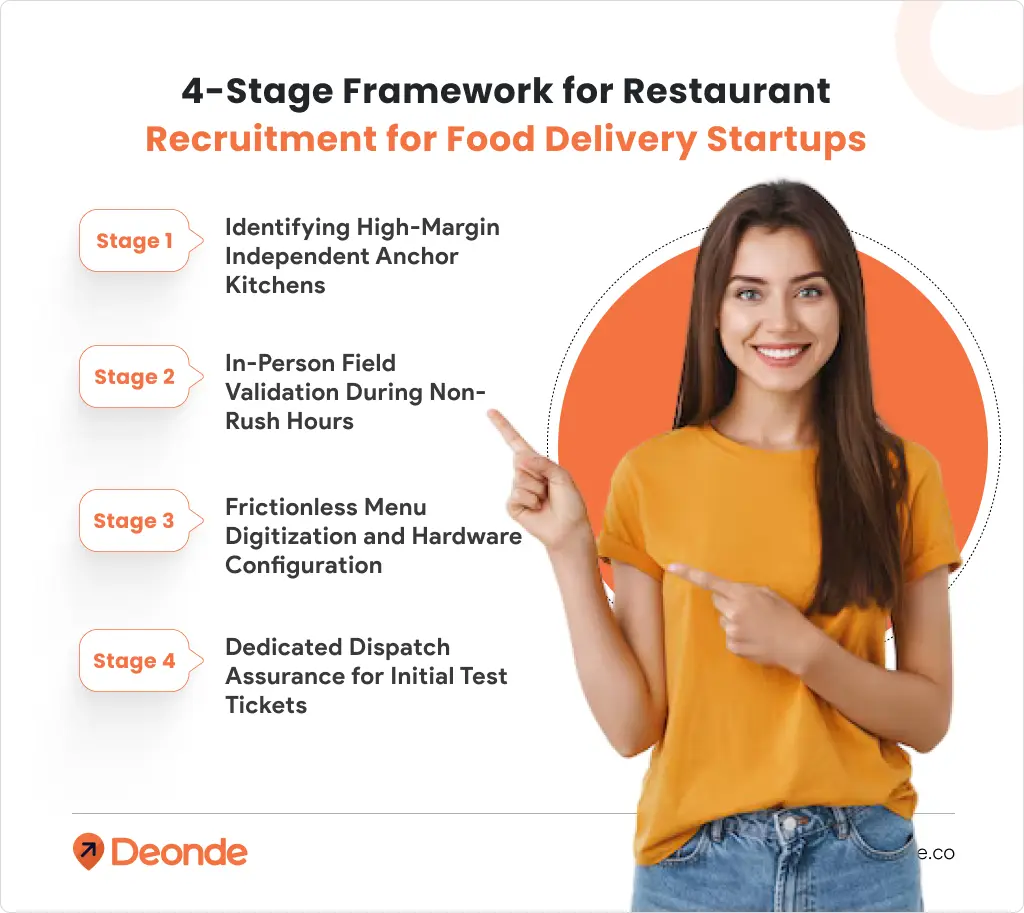
Stage 1: Identifying High-Margin Independent Anchor Kitchens
Avoid national fast-food franchises and high-end fine dining establishments during your initial partner outreach phase.
Focus on local quick-service favorites: pizzerias, gourmet burger spots, specialty taco joints, and authentic Asian kitchens.
These establishments generate consistent repeat business, package food efficiently, and feel the pain of third-party aggregator commissions most acutely.
Stage 2: In-Person Field Validation During Non-Rush Hours
Never pitch an owner during lunch (11:30 AM – 1:30 PM) or dinner (5:30 PM – 8:30 PM) rushes when kitchens are under peak stress.
Visit between 2:30 PM and 4:00 PM on Tuesday through Thursday when the general manager or head chef is reviewing inventory.
Order a beverage or small appetizer first, introduce yourself as a local delivery founder, and request five minutes of their time.
Stage 3: Frictionless Menu Digitization and Hardware Configuration
The biggest hurdle for busy restaurateurs is the manual friction of rebuilding menus, adjusting item modifiers, and installing clunky hardware.
Remove this workload entirely by offering to digitize their entire catalog, photograph dishes, and set up a streamlined partner app on an inexpensive tablet.
Ensure your ordering architecture supports real-time 86’ing so staff never deal with awkward cancellation calls over out-of-stock items.
Stage 4: Dedicated Dispatch Assurance for Initial Test Tickets
During the first 30 days, dispatch reliability matters infinitely more than sheer customer ticket volume.
A single delayed courier or cold food complaint will prompt an owner to shut off your tablet permanently.
Commit to founder-supervised dispatch for every order, utilizing live driver tracking to guarantee couriers arrive exactly as food leaves the kitchen pass.
The Exact 3-Minute Cold Pitch Script for Independent Restaurant Owners
An effective cold pitch addresses owner pain points in ninety seconds: acknowledge aggregator margin bleed, offer zero upfront cost, guarantee seamless POS/order flow, and request an experimental 30-day listing. It focuses entirely on merchant control, transparent payout schedules, and dedicated driver dispatch rather than unverified consumer demand.
Founder: “Hi Marco, I love the wood-fired pies here. I’m building a neighborhood delivery platform specifically for independent downtown kitchens.
I’m not here to promise you 200 orders tomorrow because anyone saying that is lying. You already use DoorDash and Uber Eats, and you know they take 28% of your ticket and keep your customer data.
We operate on a fair 10% rate, give you full access to your customer records, and handle dispatch through trained local couriers within a 3-mile radius.
There is zero setup fee. I will photograph your menu, digitize your modifiers, and provide a test tablet. If we send you three orders next week, you make 90 cents on the dollar. If we send zero, it costs you nothing. Can we set up a 30-day test alongside your existing tablets?”
Overcoming the Common “We Have Too Many Tablets” Objection
Kitchens frequently complain about counter clutter caused by multiple aggregator tablets pinging simultaneously.
Explain that your order management system runs smoothly on an existing Android tablet, web browser, or mobile device without requiring proprietary POS integrations.
Demonstrate how order acceptance takes just two taps, minimizing training time for busy kitchen expeditors.
Technology Foundations Needed to Build Instant Merchant Trust
Restaurant operators judge new delivery platforms by software reliability, simple tablet interfaces, and automated settlement clarity. A battle-tested partner infrastructure featuring white-label store apps, live kitchen status toggles, and instant order notifications demonstrates enterprise stability, separating serious startup operators from fragile amateur delivery experiments.
Restaurateurs quickly reject amateur delivery software that crashes, misses order notifications, or miscalculates regional tax rates.
Launching with an enterprise-ready white-label food delivery platform gives your startup the polished user interface of billion-dollar delivery incumbents.
Your technology stack must feature three non-negotiable tools to secure partner commitments:
- Merchant Order Dashboard: A clean tablet display with visual audio chimes, one-touch prep time adjustments, and print integration.
- Geofenced Driver Management: Smart courier tracking that prevents drivers from arriving twenty minutes before food is packaged.
- Customer Web and Mobile Portals: Fast, branded mobile interfaces that make local ordering seamless for neighborhood diners.
Founders deploying a turnkey multi-restaurant food delivery system eliminate months of risky custom development while demonstrating enterprise capability to skeptical kitchen managers.
Key Onboarding Mistakes That Cause First-Wave Merchant Churn
Early merchant churn stems from slow menu updates, delayed hardware setup, late driver dispatches, and erratic payment payouts. When food sits on counters or accounting reconciliations fail, busy kitchen managers pull their menus off the platform, destroying startup trust across tight-knit local restaurant communities.
Neglecting Modifier Pricing and Kitchen Prep Notes
Nothing frustrates a line cook faster than an order slip lacking critical burger temperatures, allergy alerts, or paid dressing add-ons.
Audit every menu item individually to guarantee that optional choices and mandatory ingredient selections match kitchen POS standards.
Missing a 50-cent cheese modifier damages your operational reputation far more than sending fewer overall orders.
Irregular Driver Dispatch Times During Pilot Orders
If a courier arrives thirty minutes late, food degrades under heat lamps and the customer leaves a scathing review for the restaurant.
Conversely, if a courier arrives fifteen minutes early, they crowd the service counter and stress the kitchen expeditor.
Calibrate your driver arrival windows tightly so orders transfer from heat rack to insulated delivery bag within ninety seconds of completion.
Delayed Weekly Payout Reconciliations
Restaurants run on notoriously tight operating margins and require timely cash flow to pay food distributors and prep cooks.
Provide clear weekly statements detailing gross sales, commission deductions, customer tips, and net bank deposits.
Before launching full operations, calculate startup software expenses using an interactive tool like calculate your cost to keep your merchant commission models profitable.
10-Point Pre-Launch Merchant Acquisition Checklist
This pre-launch partner recruitment checklist provides an actionable roadmap from neighborhood canvassing to contract execution. It ensures startup founders verify menu legalities, configure printer hardware, establish clear delivery zones, and align settlement timetables before onboarding their first ten anchor restaurant partners.
- Map a 3-Mile Delivery Cluster: Target a dense commercial district with at least twenty non-competing independent kitchens.
- Identify 15 Ideal Anchor Targets: Select reputable local spots across pizza, burgers, bowls, wraps, and regional cuisines.
- Audit Off-Peak Staffing Hours: Confirm target restaurants have downtime between 2:00 PM and 4:30 PM for initial pitches.
- Prepare Sample Menu Digitization: Transcribe one target restaurant’s entire menu into your test portal prior to pitching.
- Equip Dedicated Merchant Tablets: Configure entry-level 10-inch Android tablets with pre-installed partner software.
- Establish Low Pilot Commission Rates: Set an introductory merchant rate between 5% and 10% for the first sixty days.
- Draft a 1-Page Plain-English Agreement: Eliminate multi-year lock-ins; provide a 30-day mutual cancellation clause.
- Review Kitchen Packaging Guidelines: Provide food-grade tamper-evident seals and verify insulated bag dimensions.
- Set Up Instant Merchant Support Channels: Create a direct WhatsApp channel connecting store managers to your founding team.
- Test Real-Time Dispatch and Payouts: Book a live demo to review merchant dashboard settings, driver dispatch logic, and automated banking workflows before visiting your first restaurant.