Most grocery delivery startups in Southeast Asia do not fail because of bad ideas. They fail because the region punishes assumptions borrowed from Western markets.
The SEA grocery delivery space looks attractive on paper. A projected market volume of US$30.03 billion in 2025, a young digital population, and rising smartphone penetration. Yet every few months, another funded startup exits or quietly shuts down.
Foodpanda ceased all operations in Thailand in May 2025 after 13 years, citing intense competition, rising costs, and a market that no longer fit its strategy.
If a global operator with deep pockets could not hold ground, a first-year startup faces an even steeper hill.
Here is what is actually going wrong.
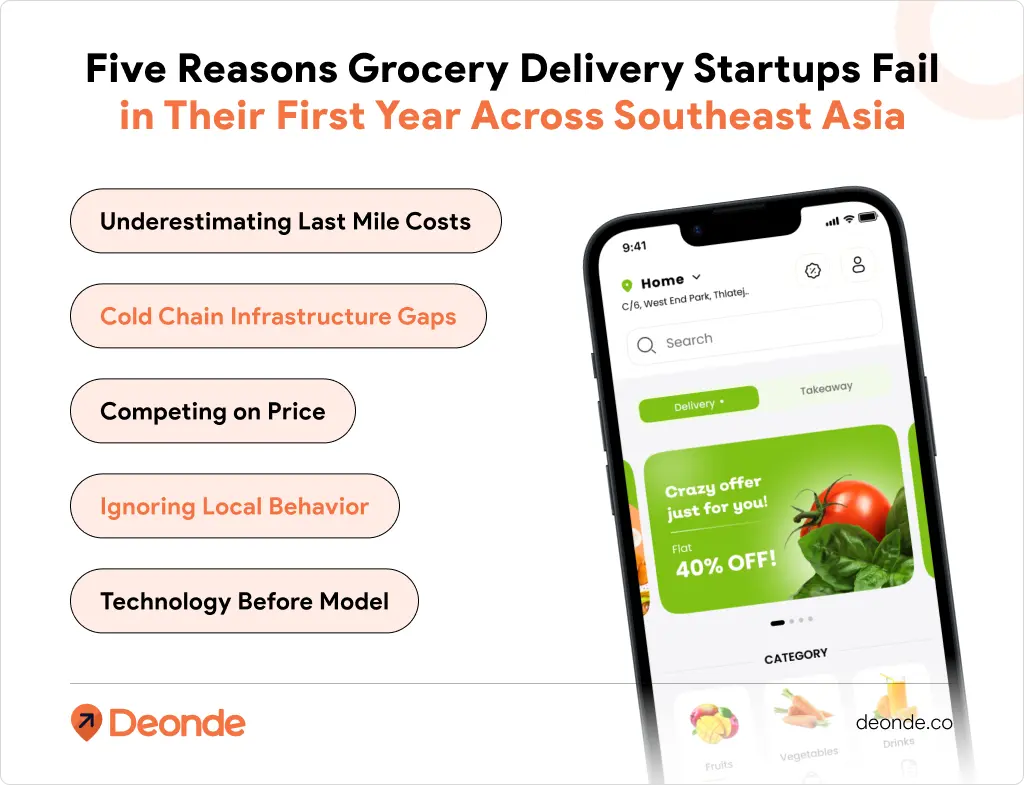
Five Reasons Grocery Delivery Startups Fail in Their First Year Across Southeast Asia
1. Underestimating the True Cost of Last Mile Delivery
Grocery delivery looks like a logistics problem. It is actually a geography problem dressed as a logistics problem.
In Indonesia, deliveries cross thousands of islands. In Manila, motorbike riders navigate chronic traffic that does not follow any predictable pattern. In Vietnam’s Mekong Delta, road infrastructure in suburban zones creates delays that shatter promised delivery windows.
These are not minor friction points. Last mile delivery is consistently the single most expensive stage in the supply chain, and in SEA, that cost is amplified by fragmented road networks, high driver turnover, and the complete absence of the order density that makes urban delivery economics work in markets like China or the US.
Most grocery startups price their delivery fees based on what customers are willing to pay, not what it actually costs to deliver. That gap burns cash from day one.
What you should do instead: Build delivery zone maps before you build your app. Start in one dense urban pocket, achieve order density there, and expand only when unit economics prove positive in that zone. Use delivery zones management tools that let you adjust radius and pricing in real time based on actual delivery cost data.
2. Cold Chain Infrastructure Is Not Ready, and Startups Assume It Is
Grocery is not food delivery. A burger can survive 40 minutes in a bag. Leafy vegetables, fresh fish, dairy, and meat cannot.
Southeast Asia’s tropical climate makes temperature control non-negotiable for fresh groceries. Yet the region’s cold chain infrastructure remains underdeveloped. High humidity, inconsistent power supply in semi-urban areas, and the cost of refrigerated vehicles create a gap that startups routinely underestimate.
The result: spoiled goods, customer complaints, high return rates, and a refund cycle that kills margins before the startup even approaches break-even.
HappyFresh, one of the region’s most prominent online grocery players, faced persistent criticism over product freshness and delivery inconsistencies. The spoilage and high inventory cost problem has been attributed as a core reason why multiple early SEA grocery models failed to scale.
What you should do instead: Source from suppliers with their own cold storage or partner with established 3PL providers that already operate refrigerated last mile in your city. Do not build the cold chain yourself in year one. That capital will kill you.
3. Competing on Price Instead of Building Retention
Grocery delivery in SEA attracted customers through heavy discounts and subsidized delivery fees during the pandemic boom. Those customers never built a habit. They built a dependency on promotions.
When platforms pulled back subsidies as investor pressure mounted in 2022 and 2023, order volumes fell sharply across the region. Deep discounting required for these models to attract consumers makes unit economics nearly impossible without massive, sustained funding. Low average order values, particularly in markets like Indonesia where average orders run around US$8, make every subsidized delivery a guaranteed loss.
First-year startups copy this behavior, burning their seed money chasing customers who will leave the moment the discount ends.
What you should do instead: Build a grocery subscription model from the start. Customers who pay a monthly fee for free or discounted delivery place orders consistently, raising order frequency and lowering customer acquisition cost over time. Tools like subscription management built into your platform let you test this model without custom development.
Moving away from heavy discounts also requires a shift in how you attract customers. Instead of relying on subsidies, you need a proven grocery delivery app marketing strategy focused on acquiring users who will actually stay loyal.
4. Ignoring Local Purchasing Behavior
Grocery shopping in Southeast Asia is deeply cultural. Wet markets in Bangkok, warungs in Jakarta, and sari-sari stores in Manila are not just convenient. They are trusted, social, and deeply embedded in daily life.
Online grocery startups that simply replicate a Western supermarket model online miss this entirely. Customers in many SEA cities still prefer to physically select fresh produce. Trust in produce quality from an app is low, especially among older demographics who control household grocery budgets.
Startups that launch with a broad catalog and generic UX typically achieve low repeat purchase rates because the product does not feel built for the local buyer.
What you should do instead: Start with a curated, high-trust category. Packaged goods, beverages, and household staples carry lower return rates and higher digital purchase comfort. Once you build trust, layer in fresh produce. Use customer reviews and ratings prominently in your app so buyers can see social proof for specific products from people in their area.
If you are determined to focus on fresh food from day one, targeting a premium niche might be your safest bet. For example, learning how to start an online organic grocery delivery business can help you attract buyers who prioritize quality over cheap prices.
5. Building Technology Before Proving the Business Model
Many grocery delivery startups spend six to twelve months and a significant portion of their seed round building a custom app.
Often, founders do this because they immediately research how to build a grocery delivery app like Instacart, without realizing those giants spent billions of dollars to reach that level of custom technology. By the time the app is ready, they have no runway left to test whether the market actually wants what they built.
Custom development creates delays, scope creep, and a product that often lacks the operational features a delivery business actually needs at launch, such as driver management, dispatch systems, real-time tracking, and payment gateway integration.
What you should do instead: Launch with a ready-made grocery delivery platform that includes all core operational tools out of the box. Validate your market, your pricing, and your supplier relationships within the first 90 days. Save custom development for scale. Deonde’s grocery delivery software is built specifically for this launch-first approach.
Once you validate your market and achieve true order density, then you can start evaluating what makes a grocery delivery management system enterprise-ready to handle your next massive phase of growth.
Ready to Launch Without the Mistakes?
If you are building a grocery delivery business in Southeast Asia, Deonde gives you everything you need to go live fast, with driver management, delivery zone tools, real-time tracking, and subscription management built in. Start your free trial today.
FAQ
Why do most grocery delivery startups fail within their first year in SEA? The most common reasons are broken unit economics from high last mile delivery costs, cold chain failures, over-reliance on discounting to acquire customers, and launching in markets where digital grocery trust is still low.
Is grocery delivery a profitable business model in Southeast Asia? It can be, but profitability requires high order density in a defined zone, a product mix with healthy margins, and a retention model built around subscriptions rather than one-off promotions.
What makes grocery delivery harder than food delivery in SEA? Perishability. Food delivery operates in a window of 30 to 45 minutes with a cooked product. Grocery delivery involves fresh produce, temperature control, heavier packaging, and customers with much higher quality expectations.
How can a new grocery delivery startup survive its first year? Start small, stay dense. Focus on one area, one product category, and one reliable supplier network. Use an established platform instead of building from scratch, and build a subscription base before spending on performance marketing.