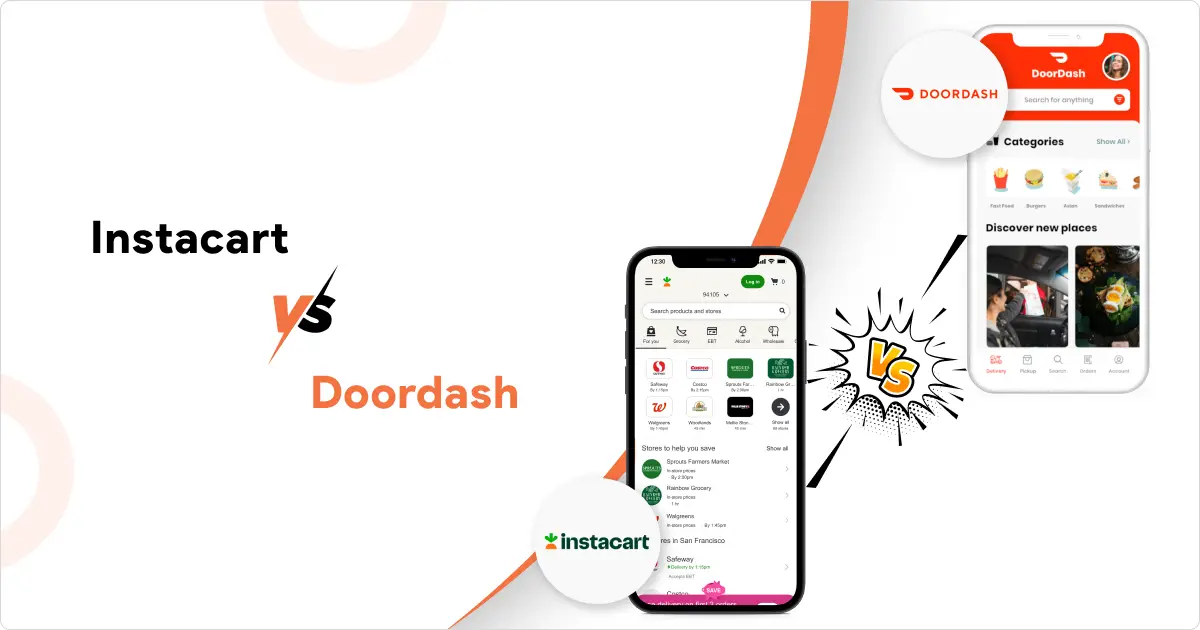
Are you a grocery store owner looking to expand your digital reach, or a busy professional wondering which app will get your weekly essentials delivered fastest? In the competitive world of on-demand delivery, the Instacart vs DoorDash debate confuses many.
While one started as a dedicated grocery shopper and the other as a restaurant food delivery giant, the lines have blurred. DoorDash now delivers groceries, and Instacart has expanded its retail partnerships. But which one is better for your specific needs?
For some, the question is, “Does Instacart offer better prices than DoorDash for large orders?” or “Which app has faster delivery?”
This guide breaks it all down, comparing costs, business models, and features to help you pick the best delivery service. Whether you need a full week’s groceries or just a last-minute dinner ingredient, we’ve got you covered.
We’ll answer burning questions like, “Is Instacart better than DoorDash for groceries?” and “Is Instacart or DoorDash better to work for?” with clear, practical insights.
Let’s dive into the details to uncover which delivery app—Instacart or DoorDash—best matches your requirements.
Instacart vs DoorDash: Which One Should You Choose?
The rise of quick-commerce and on-demand delivery has transformed how we shop. While both platforms are household names in North America, they serve slightly different core purposes. When we analyze DoorDash vs Instacart for customers, three main factors come into play: Cost, Selection, and Service.
1. Instacart App
Founded in 2012 by Apoorva Mehta, Instacart pioneered the third-party grocery delivery model. Unlike food delivery apps that focus on speed for ready-to-eat meals, Instacart focuses on the shopping experience. It partners with over 1,400 retail banners and 80,000 stores across North America. It is the go-to choice for comprehensive grocery hauls.

Primary Benefits for Customers Using Instacart:
- Retail Variety: Partners with major chains like Costco, Walmart, Wegmans, and Aldi, allowing users to shop from specific stores they trust.
- Personal Shoppers: Unlike standard delivery drivers, Instacart shoppers communicate with you about substitutions if an item is out of stock—a feature that answers, “Is Instacart more reliable for fresh produce?”
- Instacart+: For a monthly or annual fee, members get free delivery on orders over $35 and reduced service fees.
- Advanced Filtering: The interface is built for grocery lists, allowing users to filter by dietary needs (e.g., Gluten-Free, Organic) easily.
- Smart Meal Planning: Leveraging a partnership with OpenAI, Instacart now uses ChatGPT technology to help users instantly turn open-ended food questions (e.g., “healthy lunches for kids”) into shoppable recipes and lists.
- Scheduled Delivery: Ideal for planning ahead, allowing you to choose specific one-hour delivery windows.
2. DoorDash App
Established in 2013 as a restaurant delivery giant, DoorDash has expanded into groceries. Through retail partnerships and its own DashMart stores, it uses a massive driver network to deliver essentials fast—perfect for small, quick “top-up” orders.

Primary Benefits for Customers Using DoorDash:
- Speed: DoorDash excels at “I need it now” moments. Delivery times for small grocery orders are often faster than Instacart’s scheduled slots.
- Unified Platform: Users can order dinner from a restaurant and milk from a convenience store in the same app ecosystem.
- DashPass: The same subscription that gives you free delivery on restaurant food ($0 delivery fee on orders over $25 for grocery) applies here, making it a high-value option for existing users.
- Real-Time Tracking: Offers superior map-based tracking so you know exactly when your Dasher is arriving.
- Wide Reach: With coverage in over 7,000 cities, DoorDash is often available in smaller towns where dedicated grocery services might not be. This focus on winning the suburbs was a key strategy by CEO Tony Xu that allowed DoorDash to overtake competitors like Grubhub.
Is DoorDash or Instacart Cheaper?
This is the most common query. The answer lies in your basket size.
- For Small Orders: DoorDash is often cheaper. Their fee structure is built for smaller, quicker transactions. Instacart often has higher service fees that only make sense if you are buying a full cart.
- For Large Orders: Instacart wins. When you buy $150 worth of groceries, Instacart’s fees amortize better, and their item pricing at partners like Walmart is often closer to in-store prices than DoorDash’s markups.
Service Quality & Experience
- Substitutions: Instacart excels here. The chat feature allows real-time communication with your shopper. DoorDash has improved, but it often defaults to refunds or pre-selected backups without the same level of interaction.
- Tracking: DoorDash offers superior real-time map tracking. You can see your driver turn onto your street. Instacart’s tracking is good, but DoorDash’s logistics tech is slightly ahead.
Instacart vs. DoorDash: Comparison
|
Feature |
Instacart |
DoorDash |
|
Founded |
2012 |
2013 |
|
Core Identity |
Retail Tech Partner |
Logistics Aggregator |
|
Global Availability |
2 Countries (US & Canada) |
40+ Countries (Global) |
|
Merchant Partners |
80,000+ Stores (Retail focused) |
500,000+ Restaurants/Stores |
|
Avg. Delivery Time |
Typically 2 to 5 hours. |
Typically 30-45 minutes |
|
Subscription Model |
Instacart+ ($9.99/mo) |
DashPass ($9.99/mo) |
|
Driver Network |
600,000+ Shoppers |
6 Million+ Dashers |
|
Delivery Fees |
$3.99+ for non-members |
$0 delivery fee on their first order |
|
Service Fee |
around 5%+, variable by order/location |
Typically 10-15% of order subtotal, varies by restaurant/shop. |

The Driver’s Perspective: What Pays Better, DoorDash or Instacart?
For gig economy workers, the choice is about maximizing earnings and minimizing stress.
DoorDash for Drivers
- Pros: The workflow is straightforward—pick up a sealed bag and deliver it. There is significantly less mental load compared to shopping for individual items.
- Cons: Lower pay per order. You need to complete 2-3 deliveries to make what one large Instacart order might pay.
Instacart for Shoppers
- Pros: Higher pay per “batch.” Because customers tip on the percentage of the grocery bill (which is higher than a takeout bill), tips can be substantial.
- Cons: It is physically demanding. You are walking miles in stores, lifting heavy cases of water, and managing substitutions.
Verdict: Is Instacart or DoorDash better to work for? If you like driving and hate shopping, choose DoorDash. If you want higher per-order payouts and don’t mind physical work, Instacart is the better option.
DoorDash vs Instacart: The Functionality Comparison
Let’s break down the key features to determine which is better, Instacart or DoorDash, for customers and businesses:
- Ordering Process: Instacart is designed for bulk shopping. Its interface mimics a supermarket aisle, making it easy to build a cart with 50+ items. DoorDash is optimized for speed and smaller baskets, making it better for grabbing 5-10 items quickly.
- Delivery Speed: DoorDash typically wins on speed for immediate needs, often delivering in under an hour. Instacart is better suited for scheduled deliveries (e.g., “Deliver tomorrow between 10 AM and 11 AM”).
- Substitutions: This is a major differentiator. Instacart allows you to pre-select backup items or chat live with your shopper. DoorDash’s substitution options are improving but generally less interactive than Instacart’s dedicated shopper model.
- Restaurant vs. Retail: If you want a hot meal and a bottle of wine, DoorDash is your only option. If you want to shop from Costco without a membership, Instacart is the exclusive partner for many such retailers.
- Promotions: Instacart often offers “buy $50, save $10” type deals on specific brands. DoorDash focuses on delivery fee waivers and percentage discounts on total order value.
Which Has the Better Business Model—Instacart or DoorDash?
The operational strategies differ, which impacts how businesses and entrepreneurs view them:
- Shopper vs. Driver: Instacart’s model relies on “Full-Service Shoppers” who pick, pack, and deliver. This requires more time per order but yields higher order values. DoorDash relies on “Dashers” who mostly just pick up pre-packed bags (for food) or do quick shop-and-deliver runs.
- Partnership Structure: Instacart integrates deeply with retailer inventory systems to show real-time stock. DoorDash often scrapes menus or uses lighter integrations, focusing on logistics over inventory management.
- Revenue Streams: Instacart makes significant revenue from advertising (CPG brands paying to appear at the top of search results). DoorDash relies heavily on delivery fees and restaurant commissions, though its ad business is growing.
- Driver Pay: Instacart shoppers often earn more per order because the effort (shopping + driving) is higher, whereas Dashers rely on volume (doing more deliveries per hour).
Who Wins & Why: Instacart vs DoorDash
In the DoorDash vs Instacart battle, the winner depends on the use case. Instacart wins hands-down for full grocery shopping due to its inventory interface and shopper interaction. DoorDash wins for convenience, speed, and multi-purpose use (food + essentials).
For entrepreneurs and startups, this rivalry highlights a massive opportunity. The market is splitting into “Planned Grocery” (Instacart style) and “Quick Commerce” (DoorDash style).
Which Should You Choose?
For Drivers
- Pick Instacart in case you wish to shop and deliver groceries, do not mind physical efforts, and desire to earn more regularly, which is typically about 15- 20 an hour, depending on the place and tips.
- Pick DoorDash in case of flexible working time, fast pick-ups, and earning between 20-25 per hour during the high demand hours such as lunch, dinner, and weekends.
For Customers
- Pick Instacart when you require a full grocery list, bulk purchases, Costco, fresh products or household deliveries in a single order.
- Pick DoorDash when you would like restaurant food or a couple of needs to be delivered within a short time, usually 20 – 30 minutes.
For Merchants
- Pick Instacart when you have to sell groceries, pantry items, fresh food, or retail goods and need to plan the delivery schedule with an item-by-item shopping.
- Pick DoorDash when you have operate restaurants, cloud kitchens, cafes, or quick-serve brands that depend on fast, on-demand delivery.
The Hidden Cost: Who Owns the Customer?
One critical factor often overlooked is data ownership. When a restaurant or store sells on DoorDash or Instacart, the platform owns the customer data, not you. You cannot easily retarget those customers or build a direct loyalty loop.
- Third-Party Apps: They keep the email, phone number, and buying habits.
- Your Own Platform: You keep 100% of the data to grow your brand.
Beyond the Big Two While Instacart and DoorDash dominate the mass market in North America, their rivalry highlights a massive opportunity for entrepreneurs globally. These giants often struggle to provide hyper-local, specialized service.
Pro Tip for Entrepreneurs: Giant platforms like Instacart and DoorDash struggle with hyper-local, specialized service. There is massive demand for niche delivery platforms—such as organic farm-to-table, local pharmacies, or craft alcohol. This “service gap” is where agile startups can capture significant market share.
Building Your Own Platform You don’t need to be a tech giant to compete. Modern white-label solutions like Deonde empower entrepreneurs to launch their own branded delivery apps.
Moving Forward
Instacart and DoorDash are setting the standards for the delivery economy. Regardless of whether you are a customer, a driver, or a business owner, understanding the nuances of Instacart vs DoorDash is vital.
People who want to build their own hyper-local delivery platform can use Deonde to get a complete set of features—from driver apps to merchant panels. You don’t need to be a tech giant to start a delivery business; you just need the right partner.
Launch your delivery startup today! Explore a free demo at deonde.co to discover how our platform can boost your business with cutting-edge features.
It’s time to decide: Are you team Instacart or team DoorDash? Leave your comments below!

FAQ
1. What’s better, Instacart or DoorDash, for alcohol delivery?
Both deliver alcohol, but Instacart generally has a better selection because it partners with dedicated liquor stores and wholesale clubs, whereas DoorDash relies more on convenience stores and restaurants.
2. Is Instacart or DoorDash better for saving money?
If you plan your meals and shop weekly, Instacart is better for your budget. DoorDash is convenient but the small-cart fees and higher markups add up quickly for regular shopping.
3. What pays better, DoorDash or Instacart, on weekends?
Weekends are prime time for both. However, Sundays are often the busiest days for grocery shopping, making Instacart potentially more lucrative for drivers willing to tackle large orders.
4. Does Deonde allow me to build an app like Instacart or DoorDash?
Yes! Deonde provides a white-label solution that allows you to create a grocery delivery app with features like inventory management, scheduled delivery, and shopper apps, similar to Instacart or DoorDash.