Are you having trouble buying groceries regularly? Is it becoming difficult to wait 2 to 3 days for a list of groceries you made today? Are you worried that the groceries delivered to you are not fresh? Do you need to travel long distances to visit your favorite supermarkets or shops?
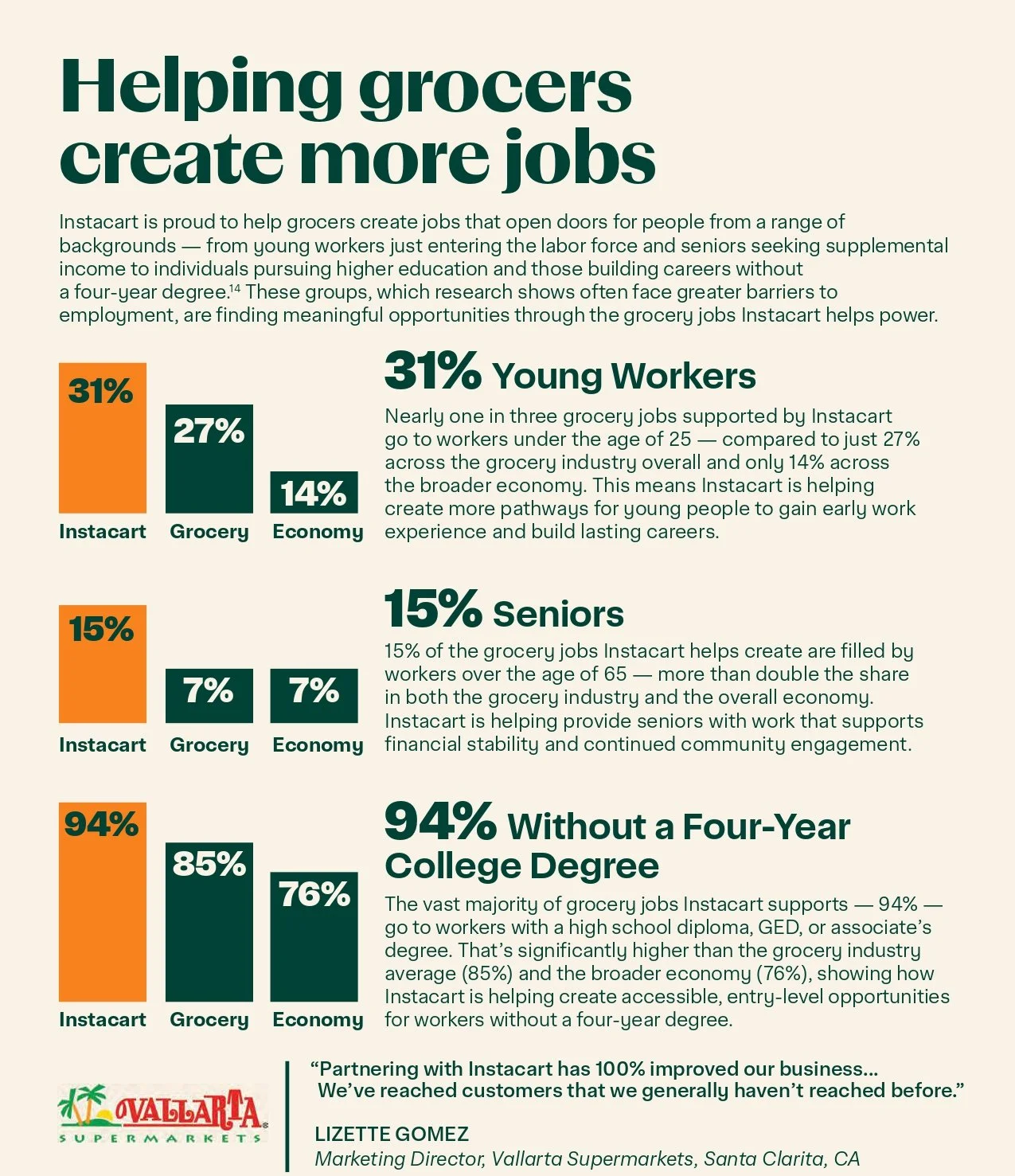
Instacart is a major job creator, supporting over 237,000 grocery jobs—nearly one-third of which are at local small businesses.
Whether you’re an entrepreneur looking to understand the Instacart business model and revenue model, a retailer considering their platform, or simply curious about how this company generates revenue,
This comprehensive guide breaks down everything you need to know about Instacart’s innovative approach to the grocery industry.
What Is Instacart?
Instacart is a top online grocery delivery and pickup service serving the USA and Canada. People order groceries from local stores using a mobile app or website and get them delivered to their doorstep, often the same day.
Today, Instacart operates at a massive scale, having powered more than 1.5 billion orders since its launch.
It is a technology-driven business making grocery shopping as convenient as possible. The Instacart marketplace is built on four interconnected pillars: retailers, shoppers, customers, and CPG brands.
- For Retailers: It provides tools to thrive in an omnichannel world, helping grocers reach new customers and grow revenue.
- For Shoppers: It offers flexible earning opportunities on their own terms.
- For Customers: It delivers time savings and access to fresh, nutritious food.
- For CPG Brands: It opens doors to new customers and provides insights to scale.
This Instacart Business model is becoming so popular among entrepreneurs that they are interested in understanding the Instacart Business Model and its workings, which will help it grow.
Instacart: Company Timeline & Key Milestones
Phase I: Founding & Validation (2012 – 2015)
- 2012 (June): Apoorva Mehta, a former Amazon supply chain engineer, founded Instacart in San Francisco after trying 20 different startup ideas.
- 2012 (August): Instacart participates in the Y Combinator accelerator (Summer ’12 batch).
- 2013: Launches Instacart Express (now Instacart+), a membership model pivotal for retention.
- 2014: Whole Foods Partnership. A pivotal partnership is struck with Whole Foods Market, which becomes a primary driver of Instacart’s early growth.
- 2014: Unicorn Status. Following a $220M Series C led by Kleiner Perkins, Instacart reached a $2 billion valuation.
- 2015: Worker Reclassification. Amid scrutiny over the “gig economy” model, Instacart begins offering some shoppers the option to become part-time employees with benefits.
Phase II: Expansion & The “Grocery Wars” (2016 – 2019)
- 2017 (June): The Amazon Catalyst. Amazon acquires Whole Foods. Fearing Amazon’s dominance, major grocers like Costco, Kroger, and Albertsons rush to partner with Instacart to build their online presence.
- 2017 (November): Expansion. Instacart expands into Canada, marking its first international market.
- 2018: Unata Acquisition. Instacart acquires Unata, a white-label digital platform, to help grocery partners build their own e-commerce websites (early signs of its Enterprise strategy).
- 2019: The Split. The partnership with Whole Foods officially ends as Amazon integrates the chain into its own Prime ecosystem.
Phase III: The Pandemic Boom (2020 – 2021)
- 2020 (March-April): Demand Surge. As lockdowns begin, order volume spikes by 500%. Instacart hires 300,000 new shoppers in a matter of weeks to meet demand.
- 2020 (April): First Profit. For the first time in its history, Instacart posts a monthly profit ($10 million).
- 2021 (July): Leadership Change. Founder Apoorva Mehta steps down as CEO to become Executive Chairman. Fidji Simo, a former Facebook executive, is appointed as the new CEO to transition the company toward advertising and enterprise tech.
- 2021 (October): Smart Carts. Instacart acquires Caper AI for $350 million, moving into hardware with “smart carts” that auto-detect items and accept payment.
Phase IV: The Platform Era & IPO (2022 – 2023)
- 2022 (March): Instacart Platform. The company launches “Instacart Platform,” a suite of enterprise-grade technologies (fulfillment, ads, insights) for retailers to power their own operations.
- 2022 (July): Instacart Express is rebranded as Instacart+.
- 2023 (August): IPO Filing. Instacart files its S-1, revealing it had been profitable for five consecutive quarters.
Phase V: Public Company & AI Focus (2024 – Present)
- 2024 (May): The Uber Partnership. Instacart strikes a major deal with Uber Eats to power a new “Restaurants” tab in the Instacart app, allowing users to order from restaurants directly through the Instacart interface.
- 2024 (Full Year): Profitability Milestone. The company posts its first full year of GAAP profitability, driven largely by its high-margin Retail Media (Ads) business, which reaches over $1.1B in annual revenue.
- 2025 (May): Leadership Transition Begins. Fidji Simo announces she is stepping down as CEO to join OpenAI as their first “CEO of Applications,” reporting to Sam Altman.
- 2025 (August 15): New CEO Appointed. Chris Rogers, the company’s former Chief Business Officer, officially assumes the role of CEO and President.
- 2025 (November): Board Shift. Fidji Simo officially resigns from the Board of Directors on November 21, 2025, to focus fully on OpenAI. Chris Rogers is subsequently appointed as Chair of the Board, consolidating leadership.
- 2025 (December): Deep AI Integration. Instacart launches a native “Checkout App” experience within OpenAI’s ChatGPT, allowing users to turn a conversation about a recipe directly into an Instacart order without leaving the ChatGPT interface.
- 2025 (December): The AI Counter-Strike. The grocery wars heat up immediately as DoorDash unveils its own AI-powered grocery shopping tool just one week after Instacart’s debut, marking a rapid escalation in the battle for generative AI commerce dominance.
Valuation Journey
From seed stage to pandemic unicorn, followed by a market correction and post-IPO recovery.
|
Year |
Milestone |
Valuation |
|
2012 |
Founded (Seed Stage) |
~$10 million |
|
2015 |
Series C (Validation) |
$2 billion |
|
2018 |
Series F (Growth) |
$7.6 billion |
|
2020 |
Series H (Pandemic Boom) |
$13.7 billion |
|
2021 |
Series I (Peak Private) |
$39 billion |
|
2022 |
Internal Fair Value Adjustments |
~$10–13 billion |
|
2023 |
IPO (September) |
$9.9 billion |
|
2024 |
Post-IPO Trading Range |
~$8.9 billion |
|
2025 |
Market Recovery (Current) |
~$11.5 – $12.3 billion |
Total Private Funding: ~$2.9 billion raised (Investors: Sequoia, a16z, D1 Capital, Tiger Global).
Instacart Revenue Growth Timeline
|
Year |
Annual Revenue |
Growth Rate (YoY) |
Key Milestone |
|
2013 |
$10 Million |
— |
Early startup phase (Post-Y Combinator) |
|
2014 |
$75 Million |
650% |
Aggressive expansion to new cities |
|
2015 |
$120 Million |
60% |
Expansion of retail partnerships |
|
2016 |
$185 Million |
54% |
Integrated Whole Foods partnership (pre-Amazon) |
|
2017 |
$300 Million |
62% |
Reached 165+ retail partners |
|
2018 |
$525 Million |
75% |
Expanded into Canada |
|
2019 |
$735 Million |
40% |
Pre-pandemic baseline |
|
2020 |
$1.48 Billion |
101% |
Pandemic-driven surge in online grocery |
|
2021 |
$1.83 Billion |
24% |
Launch of “Instacart Ads” high-margin stream |
|
2022 |
$2.55 Billion |
39% |
Focus on profitability and cost efficiency |
|
2023 |
$3.04 Billion |
19% |
IPO Year (Nasdaq: CART) |
|
2024 |
$3.38 Billion |
11% |
Diversified into “Caper Carts” (Smart Carts) |
|
2025 |
$22.5 billion in added grocer revenue, |
Based 2025 New Economic Impact Report Quantifies Instacart’s Role |
Instacart: Salient Features
For Consumers
Multi-Retailer Shopping
- Order from multiple stores in a single checkout
- Access 500+ million products across grocery, pharmacy, convenience, and alcohol
Flexible Delivery Options
- Same-day delivery (as fast as 30 minutes in select markets)
- Scheduled delivery for specific time windows
- Curbside pickup
- Priority delivery (Instacart+ members)
AI-Powered Features (Updated 2024-2025)
- Ask Instacart: ChatGPT-integrated shopping assistant for meal planning and recipes.
- Smart reordering: AI predicts when you’ll need items based on purchase history
- Dietary filtering: Auto-filter by dietary restrictions (gluten-free, vegan, keto)
For Retailers
Since 2012, we’ve helped U.S. grocers generate $22.5 billion in extra revenue, with $7 billion going directly to small businesses
Caper Carts (AI-Powered Smart Carts) 🛒 Revolutionary in-store technology (Scaled significantly in 2025):
- Automatic item recognition using AI cameras and sensors
- Real-time pricing and running totals on touchscreen
- Personalized promotions are displayed while shopping
- Skip checkout lines – pay directly on the cart
- Now deployed in over 100 cities across the U.S. and internationally
Connected Store Technology
- Carrot Tags: Digital shelf labels with dynamic pricing and pick-to-light functionality
- Store View: AI-powered inventory tracking using computer vision and digital twin technology
- Storefront Pro: White-label e-commerce platform for retailers
Retail Media Network
- Self-service advertising platform for CPG brands
- Access to first-party shopping data
- On-platform and expanded off-platform advertising (CTV, Social, and Video)
Instacart: Customer Segment Explained Clearly
Instacart isn’t just for households. Instacart Business now serves more than 1 million businesses annually. The top users are food service providers (restaurants), offices, and non-profits, proving the model works for B2B wholesale delivery too.
User As a Customer
- Users can order groceries, alcohol, and prescriptions using the Instacart app or the web interface.
- They can securely pay through the app using Credit/Debit cards, Apple Pay, Google Pay, PayPal, or EBT SNAP.
- Users can place a “multi-store order,” adding items from different retailers (e.g., a grocery store and a pharmacy) into a single cart.
- Users can schedule delivery for a specific 1-hour window, choose “Priority” (30 min), or select curbside pickup.
Shopper As a Customer
- Shoppers receive order offers (“batches”) directly on their dedicated Shopper app.
- Shoppers are often positioned near high-demand stores to receive batches faster. They handle the entire process: driving to the store, shopping for items, and delivering to the customer.
- Shoppers are paid per batch based on effort (number of items, heavy weight, driving distance) and keep 100% of customer tips. (Note: In select regions like CA/NYC, they may have guaranteed hourly minimums.)
Store As a Customer
- Instacart partners with more than 1,800 retail banners and delivers from nearly 100,000 stores across the U.S. and Canada.
- These retailers use Instacart’s “Enterprise” platform to power their own websites, manage delivery logistics, and use smart technologies (like Caper Carts) to drive incremental sales and reach digital-first customers.
Instacart Business Model and Revenue Model
Instacart Business Model Canvas
The Instacart Business Model Canvas offers a comprehensive framework to dissect the company’s operational essence. It delineates key elements such as customer segments, value propositions, channels, customer relationships, revenue streams, key resources, activities, partnerships, and cost structure. By examining each component, one gains insight into how Instacart revolutionizes grocery shopping through its innovative platform, seamlessly connecting customers with personal shoppers and retailers. Let’s delve into the intricacies of the Instacart business model canvas to appreciate its creativity and effectiveness.
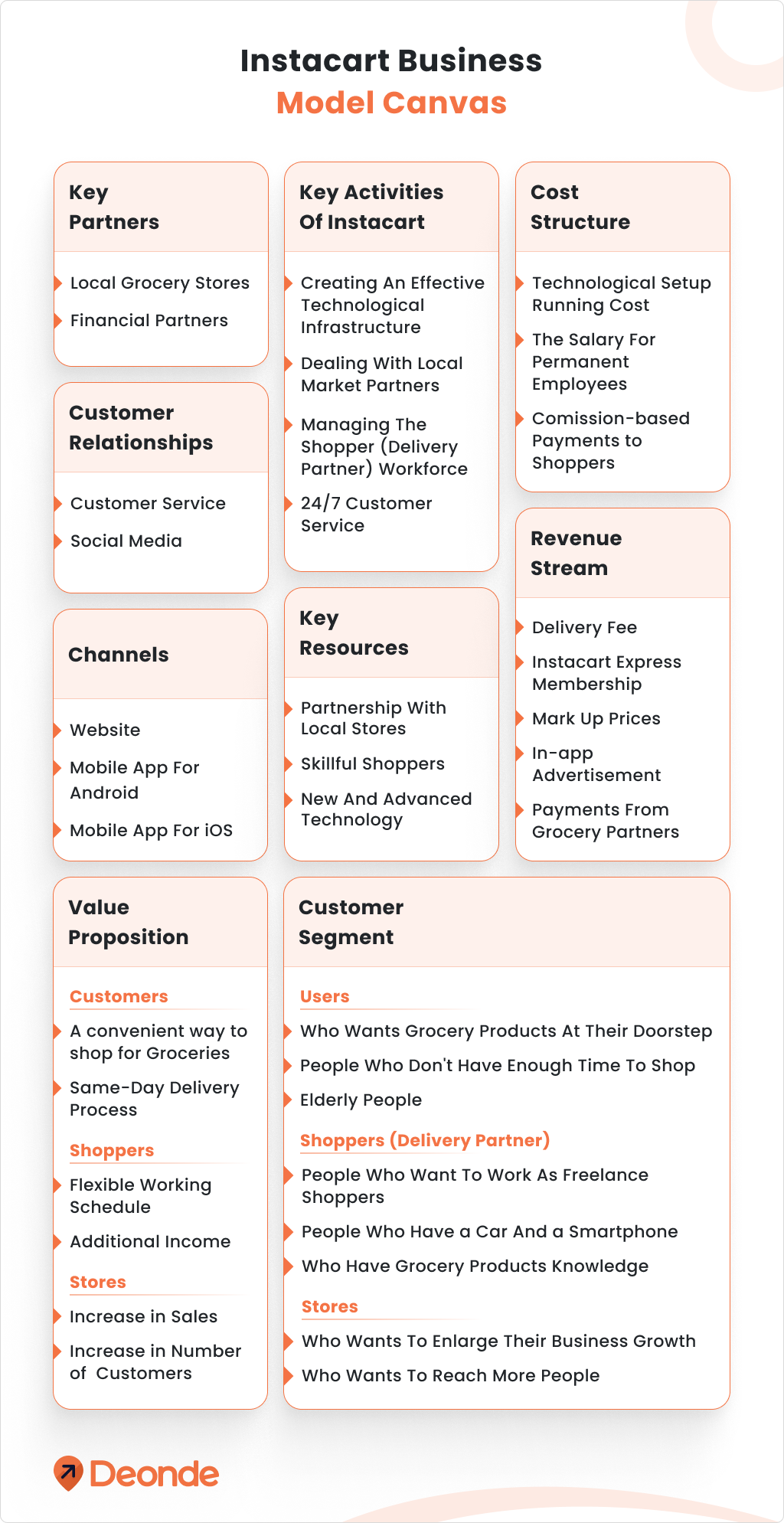
We have seen in the above section that Instacart is generating huge revenues per year. In the years 2020 and 2021, Instacart generated $1.5 billion and $1.8 billion, respectively, in revenue.
These are high rates of revenue generated per year. Let us see, how does Instacart make money? Let us see how it is generating the revenues.
1. Transaction Revenue (55-60% of total revenue)
|
Order Value |
Delivery Speed |
Fees |
|
Above $35 |
Standard (Scheduled window) |
$3.99 |
|
Above $35 |
Priority (ETA <60 mins) |
$5.99+ |
|
Above $35 |
Standard (Scheduled window) |
$7.99 |
|
Above $35 |
Priority (ETA <60 mins) |
$9.99+ |
2. Advertising (35-40% of revenue)
Over $1 Billion Annual Revenue (Stable double-digit YoY growth) This is Instacart’s most profitable business segment, boasting 80%+ gross margins. It is the primary engine funding the company’s profitability.
Instacart has become a leading retail media platform, helping 7,500+ CPG brands reach new customers and increase sales. This includes huge growth for Black- and women-owned businesses.
Advertising Products:
- Sponsored Products: CPG brands pay for top placement in search results.
- Model: Cost-per-click (CPC).
- Example: Pepsi pays to appear first when a user searches “snacks.”
- Display Ads: Banner ads on the app homepage and department “aisles.”
- Shoppable Video Ads: Short-form videos in the feed with embedded “Add to Cart” buttons.
- Off-Platform Advertising:
- TV & Streaming: Partnerships with Roku, Google/YouTube, and The Trade Desk allow brands to target TV ads using Instacart purchase data.
- In-Store Advertising (Caper Carts):
- Ads displayed on smart cart screens based on real-time location in the aisle (e.g., showing a salsa coupon when you enter the chip aisle).
3. Instacart+ Membership (15-20% of revenue)
Pricing:
- $99/year or $9.99/month
- Free 14-day trial for new users
Member Benefits :
- Free Delivery: On grocery orders over $35.
- Restaurant Delivery: Powered by Uber Eats, members get $0 delivery fees on restaurant orders placed through the Instacart app.
- Reduced Service Fees: Fees drop from ~5% to ~1.9%.
- Pickup Perks: 5% credit back on eligible pickup orders.
- Peacock Subscription: Free access to Peacock Premium (select markets/plans).
Business Impact:
- Loyalty: Members spend 2-3x more per month than non-members.
- Retention: Serves as a “recurring revenue” safety net that stabilizes cash flow.
4. Enterprise Platform Services (5-10% of revenue)
Storefront Pro
- White-label e-commerce solution powering websites for retailers like Costco, Sprouts, and Publix.
- Revenue: Monthly SaaS fees + transaction volume fees.
Caper Carts (Smart Carts)
In September 2025, Instacart introduced new savings features for Caper Carts, including digital coupons and Cart Cash. On average, customers using these smart carts save nearly $3 per trip.
- Business Model: Mostly SaaS/Leasing. Retailers pay a monthly subscription per cart rather than buying hardware up front.
- Revenue Share: Instacart shares ad revenue generated on the cart screens with the retailer.
FoodStorm
- Order management software (OMS) specifically for catering and prepared food (deli/bakery) departments.
Carrot Tags
- Electronic Shelf Labels (ESL) with “pick-to-light” functionality to help shoppers find items faster.
- Revenue: Hardware installation + software subscription.
Here is the rewritten section, verified and updated with the latest 2024-2025 data (specifically regarding Caper Cart scale and new AI features).
See Also: Top 5 Grocery Delivery Industry Trends
Instacart: How Does It Find Customers?
There are various ways in which Instacart is receiving regular customers. The ways are mentioned below:
People are getting the desired results from the services of Instacart, which helps them get great word-of-mouth publicity.
Instacart gives the first delivery free to customers, which helps them see and feel the ease and convenience of the service.
Instacart also has great internet and social media marketing. It also helps them get lots of customers.
Various offers are going on on the app which help them bind a customer with them. These happy customers eventually create word-of-mouth publicity.
Instacart vs. Competitors
|
Feature |
Instacart |
Amazon Fresh |
Walmart+ |
DoorDash |
Uber Eats |
|
Primary Focus |
Full Grocery Weekly Shop |
Grocery & Logistics |
Low Price Leader |
Immediate/Rush Needs |
Immediate/Rush Needs |
|
Retail Partners |
1,800+ banners (Costco, Publix, etc.) |
Amazon & Whole Foods |
Walmart Only |
100,000+ locations |
100,000+ locations |
|
Store Count |
Nearly 100,000 stores |
~50 Warehouses + 500 Whole Foods |
4,700+ Stores |
Varies (High Density) |
Varies (High Density) |
|
Market Share |
21.6% (Sales Share) |
22.0% |
25.7% (Market Leader) |
Growing Fast in Grocery |
Growing Fast in Grocery |
|
Membership Cost |
$99/year (Instacart+) |
$139/year (Prime) |
$98/year |
$9.99/mo (DashPass) |
$9.99/mo (Uber One) |
|
Free Delivery Min |
$35+ (Members) |
$100+ (Prime Members) |
$35+ |
$35+ |
$35+ |
|
Fastest Delivery |
30 min (“Priority”) |
Same-Day (2-4 hrs) |
Same-Day (2-4 hrs) |
~30 min (Standard) |
~30 min (Standard) |
|
Alcohol Delivery |
✅ Yes |
✅ Yes (Select Markets) |
✅ Yes |
✅ Yes |
✅ Yes |
|
Prescription |
✅ Yes |
✅ Yes (Amazon Pharmacy) |
✅ Yes |
✅ Yes (Partnered) |
✅ Yes (Uber Health) |
|
In-Store Tech |
Caper Carts (Smart Cart) |
Dash Carts (Smart Cart) |
Scan & Go (Phone App) |
❌ No |
❌ No |
|
AI Features |
Ask Instacart (ChatGPT) |
Rufus (GenAI Assistant) |
GenAI Search |
AI Voice Ordering |
AI Search |
Check out this comprehensive comparison of Instacart vs. DoorDash
Wrapping It Up
In summary, Instacart stands as a pinnacle in the realm of on-demand grocery shopping apps, boasting a trust of over 25+ million customers per year. Its robust business and revenue models have cemented its position as a preferred choice for customers seeking swift and reliable grocery delivery services, including fresh deliveries and 1-hour services. Instacart’s unwavering commitment to its promises has made it a premier choice across the USA.
Inspired by Instacart’s success? If you’re looking to launch a grocery delivery platform, marketplace, or retail technology solution, we can help. Contact us to discuss custom grocery software development tailored to your business needs.
Sources:
- Instacart Economic Impact Report 2025
- Instacart Newsroom