Gone are the days when eating in the restaurant was a compulsion in spite of the heavy rain, bad weather or a tiring day. Today, most people order the food online and get their taste buds delighted unusually.
The online ordering food apps have changed the entire scenario; you must have experienced it, too. Despite having a holiday, you prefer to have food delivered to your doorstep so you can’t miss the comfort of eating at home while watching your favourite football or cricket match!
Major companies like Uber Eats, DoorDash, and Grubhub dominate today’s extremely competitive food sector. Still, local firms and niche players have the opportunity to flourish by providing distinctive value propositions—like specialized cuisines, quicker delivery times, or better customer service.
The food ordering system has a wide market scope in a country or state. People’s tastes and preferences are changing according to their comfort and feasibility. The online food delivery app is a great advantage for food joints or startups.
What if you could launch a powerful, fully-branded food delivery app in a fraction of the time and for a fraction of the cost?
That’s the power of a SaaS (Software-as-a-Service) solution. This guide breaks down everything you need to know about launching your own online food delivery business using a ready-made SaaS platform

What is SaaS?
SaaS (Software as a Service) is a way to use applications over the internet without having to build or install anything. Instead of creating your own system from scratch, you simply use a ready-made one and pay a subscription fee.
Think of it like the difference between how a restaurant handled deliveries in the past versus using a modern food delivery app like Zomato or Swiggy.
The Old Way (Printing Paper Menus & Taking Phone Orders)
A restaurant used to print thousands of paper menus and distribute them. They had to take all orders over a busy phone line and manage their own delivery drivers.
If a price changed or an item was sold out, the paper menu was instantly outdated. This was expensive and difficult to manage.
This is like traditional software. You buy it once, you own it, but it never gets updated, and you are responsible for all the hard work.
The SaaS Way (Building Your Own Food Delivery App)
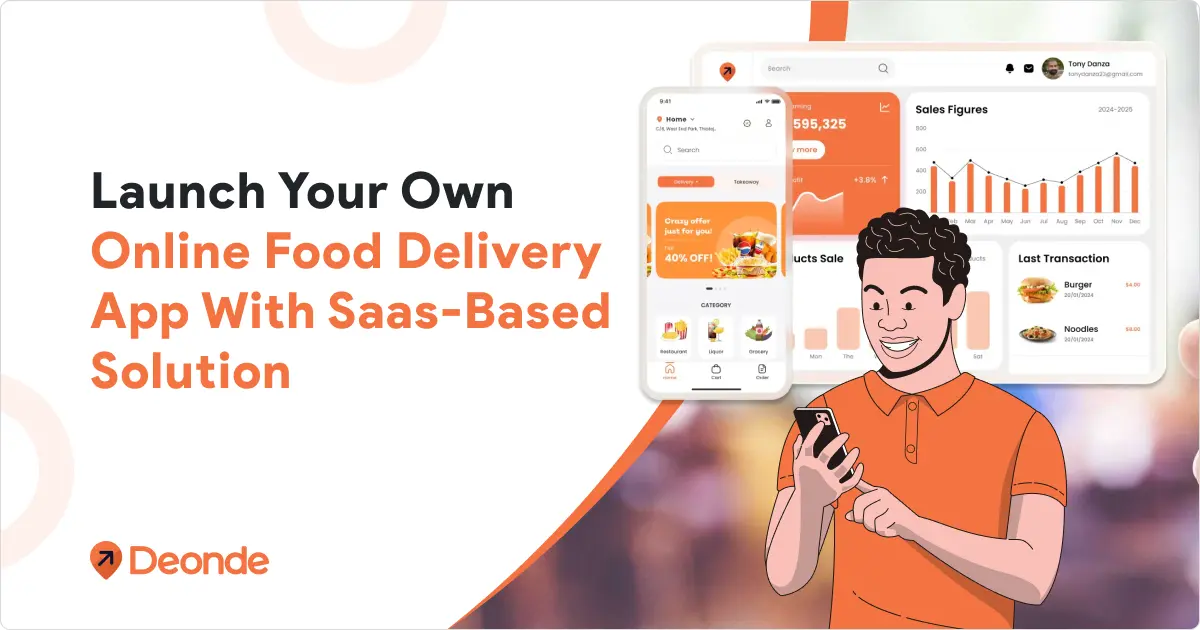
Now, with a SaaS platform, you can launch your own branded food delivery app. You pay a subscription and get a complete, ready-made system: an app for customers, a panel for restaurants, and an app for drivers.
You control the branding, the restaurants you partner with, and the business rules. You can update menus instantly, track deliveries in real-time, and accept online payments, all under your own company name.
This is exactly how SaaS works. You pay a subscription to get a powerful, ready-made platform that lets you launch your own business quickly, is always up-to-date, and has all the modern features you need.
Key Features of SaaS:
- No Building from Scratch: You get a ready-made platform instantly.
- Pay-as-you-go: You pay a small subscription fee (usually monthly or yearly) instead of a large upfront cost.
- Automatic Updates: The provider handles all the maintenance and updates. You are always using the latest and most secure version.
- Access from Anywhere: You can manage your entire business on any device with an internet connection.
What is a SaaS-Based Food Delivery Solution?
A SaaS-based food delivery solution is a ready-made, cloud-hosted platform that enables businesses to launch and manage their food delivery services. These solutions are typically offered on a subscription basis, allowing companies to access the software without significant upfront investment.
SaaS platforms are designed to be scalable, meaning they can grow with your business. Whether starting small with a local delivery service or expanding to multiple cities, a SaaS-based solution can adapt to your needs. SaaS providers often handle maintenance, updates, and technical support, freeing your team to focus on core business activities
Many people are not actually aware of the SaaS-Based food delivery applications as they are business owners and not tech geeks. To make it easy for you, here I shall explain in the layman language.
SaaS-Based solutions subscription/monthly recurring based solution, that can be elaborated as Software as a Service. It is a software distribution model introduced for years in which the third-party provider hosts apps from his side and makes it public for the customers for further use, on the internet.
When you invest in a food delivery SaaS-Based software, you all the above-mentioned benefits. The installation and configuration time is not relevant here as the software is already available in the cloud for install.
Key Differences Between SaaS and Custom-Built Apps
|
Feature |
SaaS-Based Solution |
Custom-Built App |
|
Cost |
Low initial investment with subscription-based pricing |
High development costs upfront |
|
Time to Market |
Faster implementation |
Longer development timeline |
|
Scalability |
Easily scalable as your business grows |
Requires additional development for scale |
|
Maintenance |
Handled by the SaaS provider |
Requires in-house or outsourced support |
|
Development Time |
Ready to launch in days or weeks |
Requires months of development |
|
Customization |
Limited customization options |
Fully customizable to specific needs |
|
Maintenance & Updates |
Handled by the SaaS provider |
Requires continuous investment and technical team |
|
Technical Expertise |
No coding knowledge required |
Requires a dedicated development team |
|
Integration |
Pre-built integrations with payment gateways & tools |
Custom API integrations needed |
6 Key Advantages of a SaaS Platform for Your Food Delivery Business
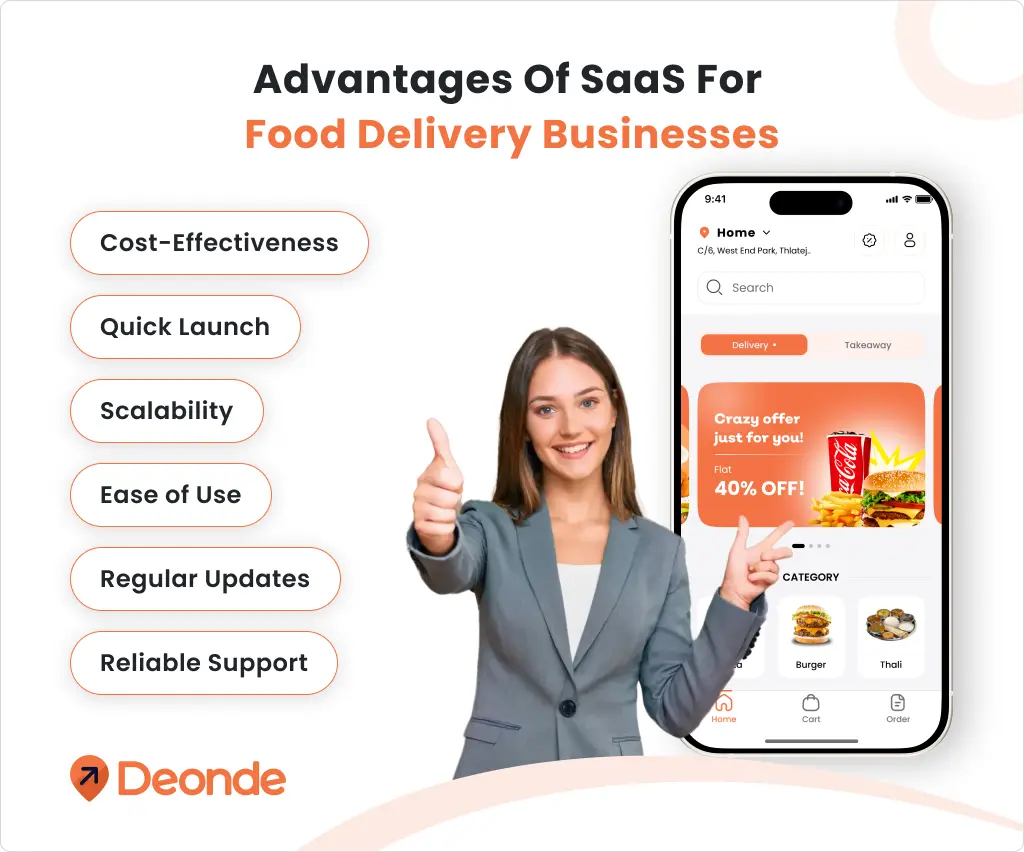
SaaS-based food delivery solutions offer numerous benefits for businesses looking to enter the online food delivery market. Here are some of the key advantages:
1. Cost-Effectiveness
Building a custom app can cost anywhere from $30,000 to $150,000+. With SaaS solutions eliminate the need for large upfront investments, making them affordable for startups and small businesses. The subscription-based pricing model also allows for predictable monthly expenses.
2. Quick Launch
With a SaaS platform, you can launch your food delivery service in a fraction of the time it would take to build a custom app. This allows you to start generating revenue sooner and gain a competitive edge.
3. Scalability
SaaS platforms are designed to grow with your business. Whether starting with a single restaurant or expanding to multiple locations, a SaaS solution can easily scale to meet your needs.
4. Ease of Use
SaaS platforms are user-friendly and require minimal technical expertise to set up and manage. This allows you to focus on running your business rather than dealing with technical issues.
5. Regular Updates
SaaS providers regularly update their platforms to include new features, security patches, and performance improvements. This ensures that your platform remains up-to-date and competitive.
6. Reliable Support
Most SaaS providers offer 24/7 technical support, ensuring that any issues are resolved quickly and minimizing downtime.
The 4 Essential Components of a Complete Food Delivery System
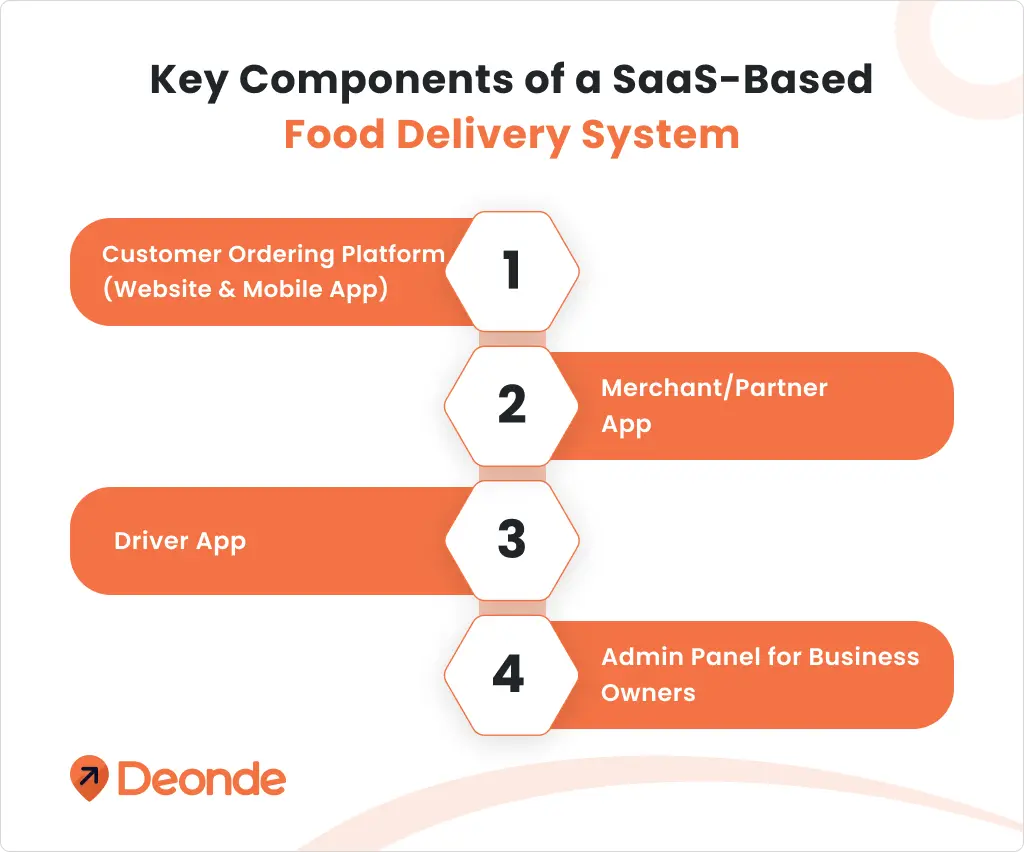
A SaaS-based food delivery system typically consists of four main components, each designed to streamline operations and enhance the user experience. Let’s take a closer look at each of these components:
1. Customer Ordering Platform (Website & Mobile App)
The customer app is the heart of your food delivery business. It allows users to browse restaurants, view menus, place orders, and track deliveries in real time. A well-designed platform should be intuitive, visually appealing, and optimized for both desktop and mobile devices.
Key features of a customer ordering platform include:
- User-friendly interface for browsing Items and placing orders.
- Multiple payment options (credit/debit cards, digital wallets, cash-on-delivery).
- Order tracking with real-time updates.
- Customer reviews and ratings.
- Push notifications for promotions and order updates.
2. Merchant/Partner App
The merchant app is designed for restaurant partners, enabling them to manage orders, update menus, and track performance. This component is essential for ensuring smooth communication between your platform and restaurant partners.
Key features of a merchant app include:
- Order acceptance and management.
- Menu management (adding, editing, and removing items).
- Real-time analytics and reports.
- Customer communication tools.
- Integration with POS systems for seamless transactions.
3. Driver App
The driver app is a critical component of any food delivery system, as it ensures that orders are delivered efficiently and on time. The app provides drivers with all the information they need to complete deliveries, including pickup and drop-off locations, order details, and navigation tools.
Key features of a driver app include:
- Real-time order notifications
- Route optimization and navigation
- Earnings tracking
- Delivery status updates
- In-app communication with customers
4. Admin Panel for Business Owners
The admin panel serves as the control center for your food delivery business. It allows you to manage all aspects of your platform, from customer orders to restaurant partnerships and driver assignments.
Key features of an admin panel include:
- Dashboard with real-time business insights.
- Order and transaction management.
- Customer and vendor support tools.
- Marketing and promotional campaign management.
- Performance analytics and reporting tools.
Key Takeaways for Launching a SaaS-Based Food Delivery Business
When investing in a food delivery SaaS-based software, you get the above benefits. The installation and configuration time is not relevant here as the software is already available in the cloud for installation.
Hence, you can start your online food delivery business quickly. You just have to pay the rental by successfully subscribing to the third-party provider. The hardware and software license or rental costs are cheaper than designing and developing an independent food delivery app.
So what are you waiting for? If your food joint needs to be explored regarding the online delivery model, here is what you should do next.
Opt for a SaaS-based food delivery business application and start delivering food with comparatively low costs and investments. There is always a good scope for starting your online business with a rent-based platform to avoid one-time costs or lumpsum investments. Ready to launch your food delivery business? Get started with Deonde’s SaaS solution today.
P.S. The food delivery market is poised to revolutionize online delivery models by 2025, particularly in the US, Canada, UAE, and Singapore. Discover the latest food delivery trends shaping these markets by clicking here.
Frequently Asked Questions (FAQs)
1. How long does launching a food delivery business with SaaS take?
A SaaS-based food delivery platform can be launched within a few days to weeks, depending on the level of customization required.
2. Can I customize a SaaS-based food delivery platform?
Yes, Deonde offers customization options to match your brand identity and business needs.
3. How do I attract restaurants and delivery partners to my platform?
Offering competitive commissions, marketing support, and an easy-to-use interface can help attract restaurants and delivery partners.
4. What makes a SaaS-based solution better than a custom-built app?
SaaS solutions are cost-effective, scalable, and have built-in maintenance and updates, making them more efficient than custom-built apps.

Our Popular Blogs