Starting a cloud kitchen business means running a food delivery operation without a dine-in space — just a kitchen, the right equipment, and an online ordering system.
It’s one of the fastest-growing food business models in the world, with lower startup costs than a traditional restaurant and the flexibility to run multiple brands from a single kitchen.
This model saves money because you spend less on rent and setup. You only focus on cooking and sending orders to customers.
There are many ways to do it: one brand, many brands in one kitchen, or even renting space in a shared kitchen.
To begin, you need the right licenses, a safe kitchen space, good cooking tools, and an app or website to take orders.
A cloud kitchen can make good profit if you keep food tasty, deliver fast, and control costs. The main challenge is heavy competition and high fees from delivery apps.
If you already have a kitchen, you can also rent it out to other food brands. This way you earn money without running a food brand yourself.
In this step-by-step guide, you’ll learn exactly how to start a cloud kitchen business — from picking your model and calculating costs, to getting licensed, building your tech stack, and marketing your brand.
Cloud kitchens are one of the fastest-growing food delivery business models out there — and they’re covered alongside every other model in our complete startup guide.
Whether you want to run it from a shared kitchen, a rented commercial space, or even explore running one from home, this guide covers it all.
What is a Cloud Kitchen?
A cloud kitchen, also known as a ghost kitchenor virtual kitchen, is a commercial cooking facility that operates solely to prepare food for delivery. Unlike traditional restaurants, it doesn’t offer dine-in services. Instead, it leverages third-party delivery platforms to reach customers efficiently.
In-depth Blog: What is Cloud Kitchen and What are its Benefits?
Why Choose a Cloud Kitchen?
The rise of food delivery apps and changing consumer habits have made the cloud kitchen an incredibly attractive business model. Its primary advantages include:
- Lower Startup and Operational Costs: Without the need for a customer-facing space, you can operate from a more affordable location, reducing rent and utility expenses.
- Enhanced Flexibility and Agility: Test new food concepts, menus, and brands with minimal risk. You can pivot quickly based on customer data and market trends.
- Increased Efficiency: The entire operation is optimized for delivery, from kitchen layout to packaging, leading to faster order fulfillment.
- Data-Driven Decisions: Cloud kitchens live online, providing a wealth of data on customer preferences, popular items, and peak ordering times.
Types of Cloud Kitchen Models
Choosing the right operational structure is a critical first step. Each cloud kitchen model offers unique pros and cons.
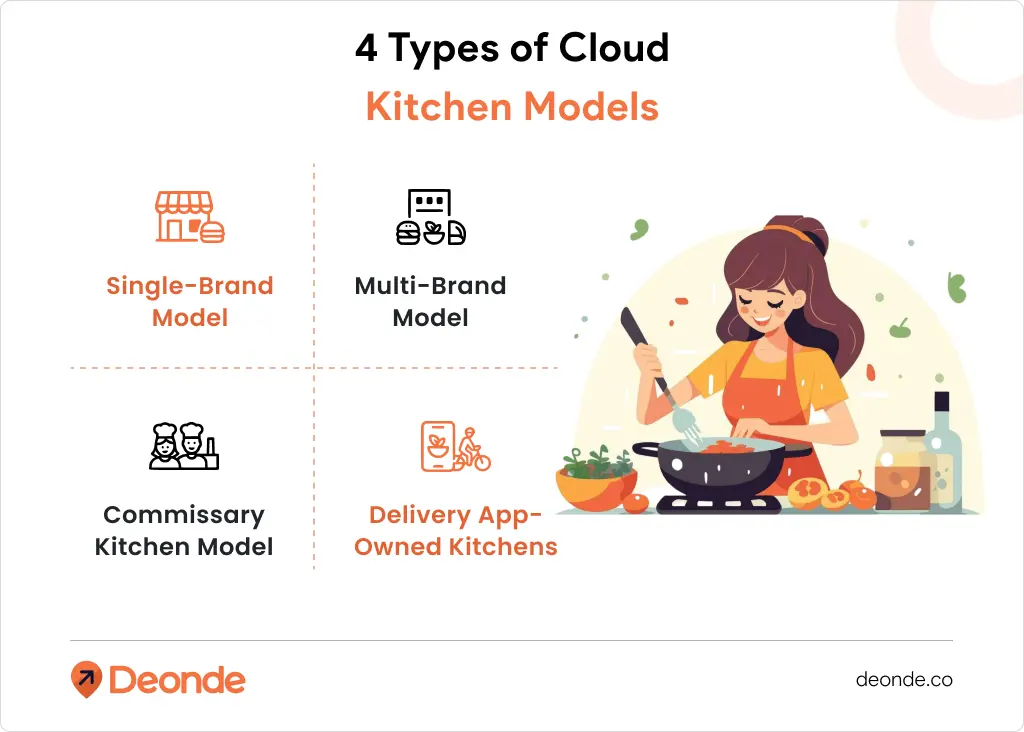
1. The Independent (Single-Brand) Model: One brand, one kitchen, full control.
- Pros: Complete autonomy over menu, operations, and brand identity.
- Cons: You bear all costs and responsibilities for the kitchen space.
- Ideal For: Established brands moving into delivery or entrepreneurs with a singular, strong food concept.
2. The Multi-Brand Model: A single company operates multiple virtual brands from one kitchen.
- Pros: Diversifies revenue streams and captures a wider market. Maximizes ingredient and staff utilization (e.g., chicken can be used for a wing brand, a sandwich brand, and a salad brand).
- Cons:Requires sophisticated marketing to build each brand distinctly. Can create operational complexity.
- Ideal For: Experienced operators looking to dominate a specific delivery area with multiple offerings.
3. The Host (Commissary) Kitchen Model: A large facility rents out individual, equipped kitchen stations to multiple food brands.
- Pros: For the host, it’s a real estate play with recurring revenue. For the tenant, it offers a plug-and-play solution with low startup costs.
- Cons: For the host, it requires significant capital investment and property management. For the tenant, there’s less control over the facility.
- Ideal For: Property owners who want to rent kitchen space for a food business and entrepreneurs who want the fastest route to market.
4. Delivery App-Owned Kitchens:Major delivery platforms like DoorDash and Zomato operate their own host kitchens, often inviting top-performing restaurant partners to expand into new areas.
- Pros: Access to the platform’s existing logistics, marketing muscle, and customer data.
- Cons: High dependence on the platform, less operational freedom.
- Ideal For: Successful restaurants looking for a low-risk expansion partnership.
Can You Start a Cloud Kitchen from Home?
This is one of the most common questions for first-time operators. The short answer:
it depends on your country and local regulations.
In most countries, you cannot legally operate a commercial food business from a
standard home kitchen. Here’s why — and what your options are:
Why home kitchens usually don’t qualify:
– They don’t meet commercial health and safety standards
– They may not be zoned for commercial food production
– Most food delivery platforms require a registered commercial kitchen address
What you CAN do from home
– Apply for a “home kitchen license” or cottage food permit (available in many US states, parts of India, and the UK) for low-risk food items
– Register your home address as your business address and rent a certified commissary kitchen nearby for actual food production
– Start with a cloud kitchen pod or shared kitchen and scale from there
In India: The FSSAI allows home-based food businesses under certain conditions.
You’ll need an FSSAI registration (Basic or State license depending on turnover)
and must follow safety guidelines.
In the UK: You can register your home as a food business with your local council.
The council will inspect your kitchen before you can trade.
In the US: Laws vary by state. Check your state’s cottage food law to see what
products you can sell from home.
Cloud Kitchen Business Plan: What to Include
Before you spend a single rupee or dollar, you need a written business plan.
Here’s what a solid cloud kitchen business plan must cover:
1. Executive Summary
A one-page overview of your concept, target market, and financial goals.
2. Business Model
Are you running a single brand, multi-brand, or commissary (host) model?
Define your revenue streams (direct orders vs. third-party platforms) and
your target profit margins.
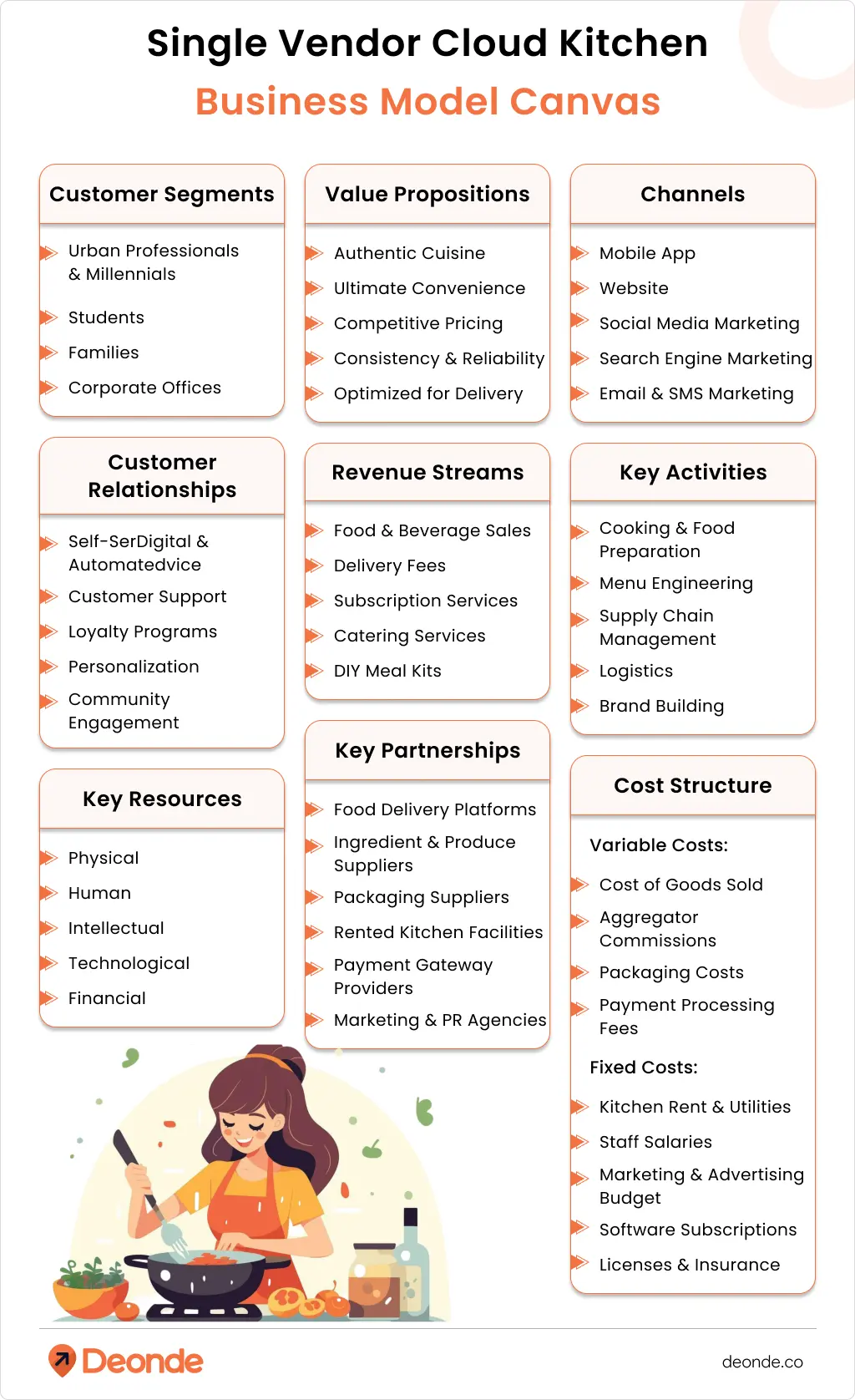
Single-Vendor Cloud Kitchen Business Model: A Deep Dive
For an entrepreneur looking to start a cloud kitchen, understanding the business model is crucial for achieving profitability and sustainability. Unlike a traditional restaurant, the single-vendor cloud kitchen model is a pure-play delivery operation optimized for efficiency and scalability.
The Value Proposition
The primary value a single-vendor cloud kitchen offers is high-quality, delivery-optimized food from a focused brand. It meets the modern consumer’s demand for convenience, variety, and speed, without the overhead of a dine-in experience.
Key Revenue Streams
- Direct Online Sales (Highest Margin):Orders placed through the brand’s own mobile app or website. This is the most profitable channel as it avoids the high commission fees of third-party apps, allowing the business to keep 100% of the profit.
- Third-Party Marketplace Sales (Highest Volume): Integrated delivery platforms like Uber Eats, DoorDash, and Grubhub drive orders but charge a 15-30% commission, significantly affecting margins.
- Subscription/Package Deals: Some kitchens boost customer loyalty and average order value (AOV) by offering weekly meal plans, subscription boxes, or bundled family meals at a discounted rate.
Cost Structure
The profitability of the cloud kitchen model hinges on meticulous cost control. The main cost drivers are:
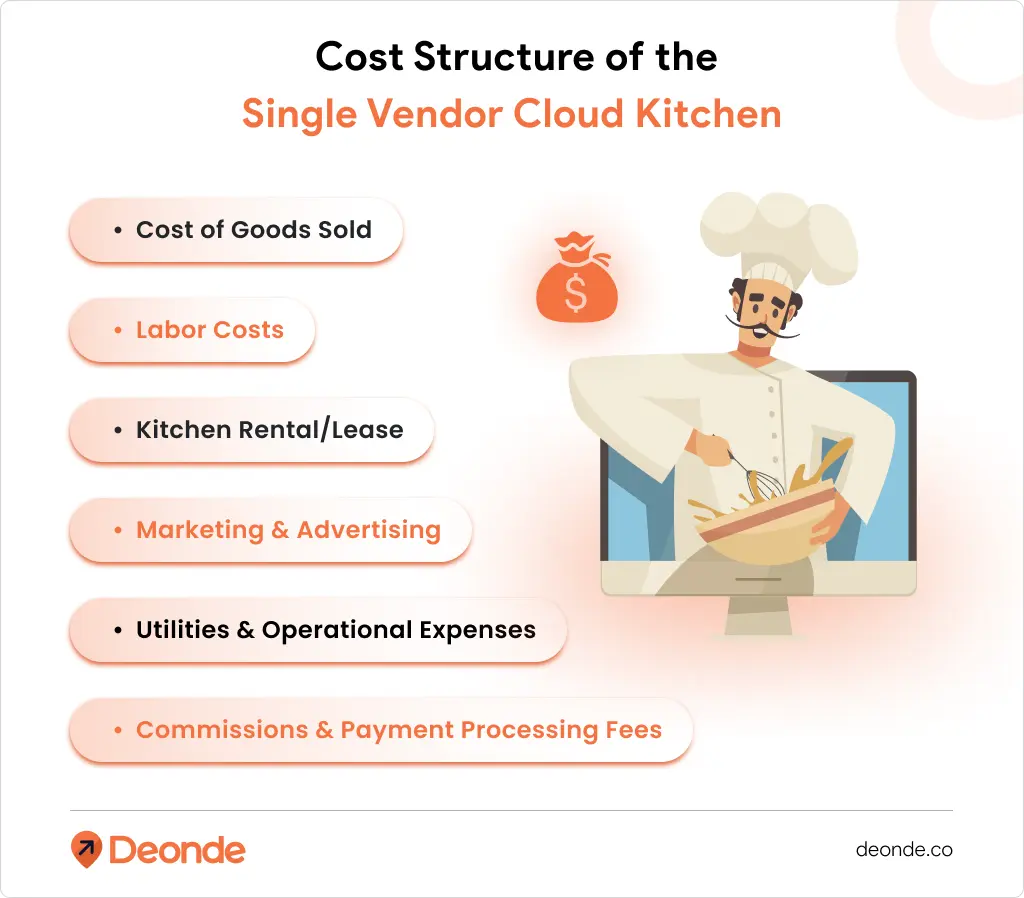
- Cost of Goods Sold (CoGS): The cost of food ingredients, beverages, and packaging. Typically, CoGS should be maintained between 25-35% of revenue.
- Labor Costs: Wages for chefs, cooks, and prep staff. With no front-of-house, labor is more efficient but still a major cost, ideally at 20-25% of revenue.
- Kitchen Rental/Lease: The fixed monthly cost for the physical space. This is often a major advantage over traditional restaurants, as kitchen space in non-prime locations is cheaper.
- Commissions & Payment Processing Fees: The 15-30% cut taken by third-party delivery apps and the 2-3% processing fee for online payments.
- Marketing & Advertising: Digital marketing spend on social media ads, Google Ads, and promotions within the delivery apps to acquire new customers.
- Utilities & Operational Expenses: Gas, electricity, water, internet, and software subscriptions (POS, inventory management).
Key Metrics for Success (KPIs)
To track performance, a cloud kitchen must obsess over these metrics:
- Average Order Value (AOV): The average amount spent each time a customer places an order. Strategies to increase AOV include bundling items, upselling, and offering family packs.
- Customer Acquisition Cost (CAC): The total cost of sales and marketing needed to acquire a new customer. This must be compared to the customer’s lifetime value.
- Customer Lifetime Value (CLV): The total revenue a business can expect from a single customer account. A high CLV indicates strong brand loyalty and repeat business. A healthy business has a CLV that is 3x its CAC.
- Order Volume & Capacity Utilization: Tracking daily order numbers and ensuring the kitchen operates at an optimal capacity to cover fixed costs without being overwhelmed.
- Food Cost Percentage: (Total Cost of Ingredients / Total Sales) x 100. This must be monitored daily to prevent waste and menu pricing issues.
Path to Profitability and Scaling
A single-vendor cloud kitchen becomes profitable by mastering its unit economics: the profit earned on each individual order. The goal is to ensure the revenue from an order exceeds the variable costs (food, packaging, delivery commission) associated with fulfilling it.
Scaling strategies include:
- Geographical Expansion: Replicating the successful model by opening kitchens in new neighborhoods or cities to expand delivery radius and reach new customer bases.
- Menu Expansion & Virtual Brands: Leverage existing kitchen infrastructure and staff to launch multiple virtual brands (e.g., pizza and wings) from the same location, maximizing fixed cost utilization and market share.
- Optimizing the Direct Channel: Shifting marketing focus to drive more orders through the brand’s own website, thereby increasing margins on every sale and building an owned customer database.
Multi-Vendor Cloud Kitchen Business Model: The Kitchen-as-a-Service Platform
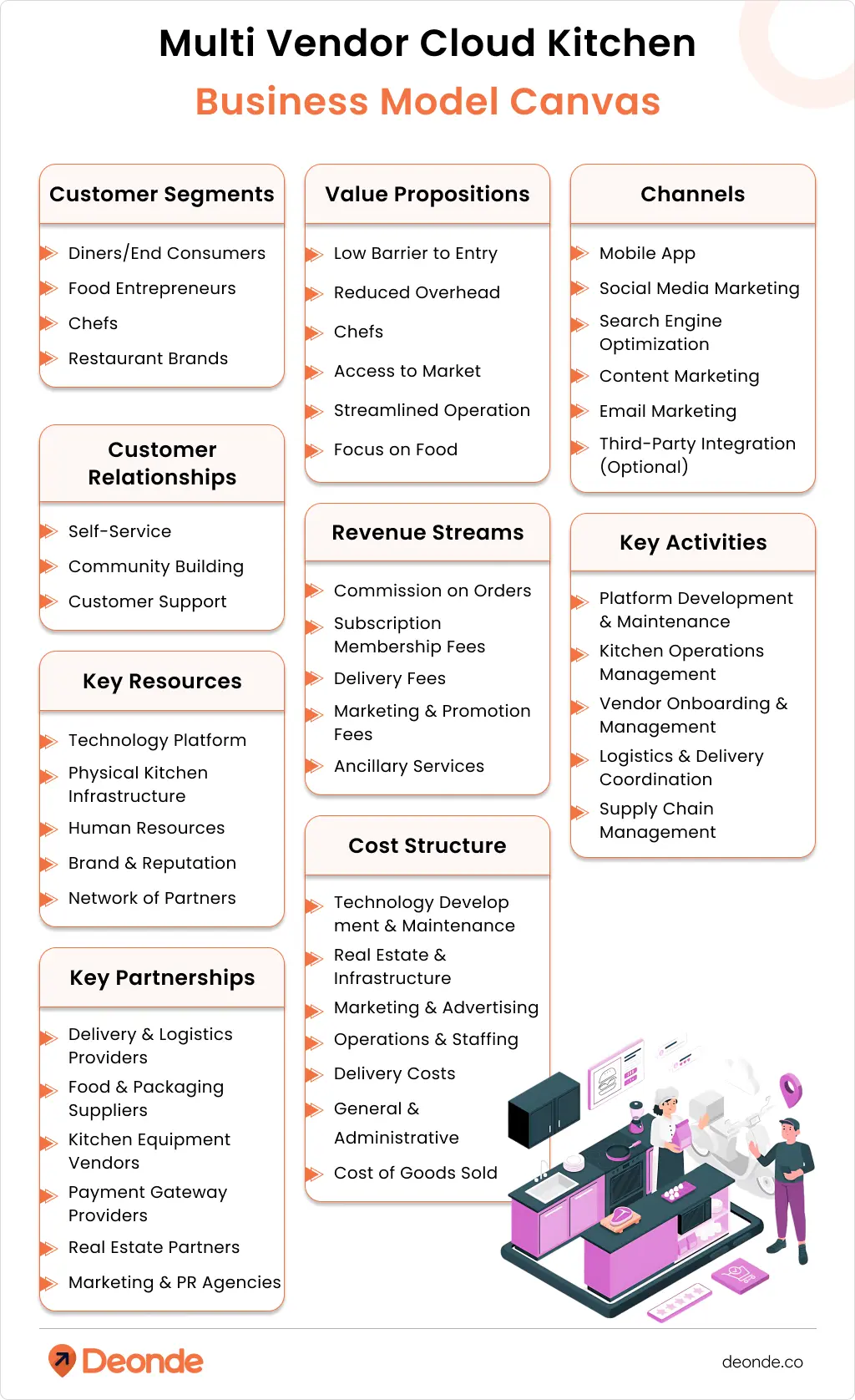
A multi-vendor cloud kitchen operates as a “Kitchen-as-a-Service” (KaaS) platform, providing infrastructure for multiple independent food brands to operate under one roof. This model is essential for entrepreneurs seeking to rent kitchen space or for investors building a scalable food business platform.
The Value Proposition
The multi-vendor model creates value for two distinct customer segments:
- For Tenant Brands (Vendors): For vendors, the multi-vendor model offers ready-to-use, compliant kitchens at low cost, no big investment or long leases. It makes launching a cloud kitchen brand faster and easier.
- For Customers: It increases the variety of high-quality delivery options available in a neighborhood, as these hubs often host a diverse range of culinary concepts.
Key Revenue Streams for the Kitchen Host
The host’s revenue is generated directly from the tenant brands, not from food sales. This creates a more predictable, recurring revenue model.
1. Rental Fees (Most Common): Charging brands a fixed fee for access to the kitchen. This can be structured in several ways:
- Shift-Based Rental: A brand rents a station for a specific shift (e.g., lunch 11 am – 3 pm or dinner 5 pm – 10 pm).
- Full-Time Rental: A brand rents a station 24/7, giving them exclusive access.
- Hybrid Model: A smaller fixed monthly fee plus a percentage of sales.
2. Revenue Share Agreement: Instead of a fixed rent, the host takes a percentage of the gross sales generated by each tenant brand (e.g., 3-8%). This aligns the host’s success with the tenant’s success but is riskier for the host.
3. Value-Added Services (High-Margin Upsells): This is where significant profitability lies. The host can offer:
4. Packaging Procurement: Sourcing and selling packaging to tenants at a markup.
- Ingredient Sourcing: Using bulk purchasing power to buy ingredients and resell them to tenants.
- Shared Delivery Fleet: Managing a dedicated fleet of drivers to reduce tenants’ reliance on high-commission third-party apps.
- Marketing & Photography Services: Providing professional services to help tenants launch and market their brands.
- Software Licensing: Providing access to a shared POS or order aggregation system for a monthly fee.
Cost Structure for the Host
The host bears the capital and fixed operational costs:
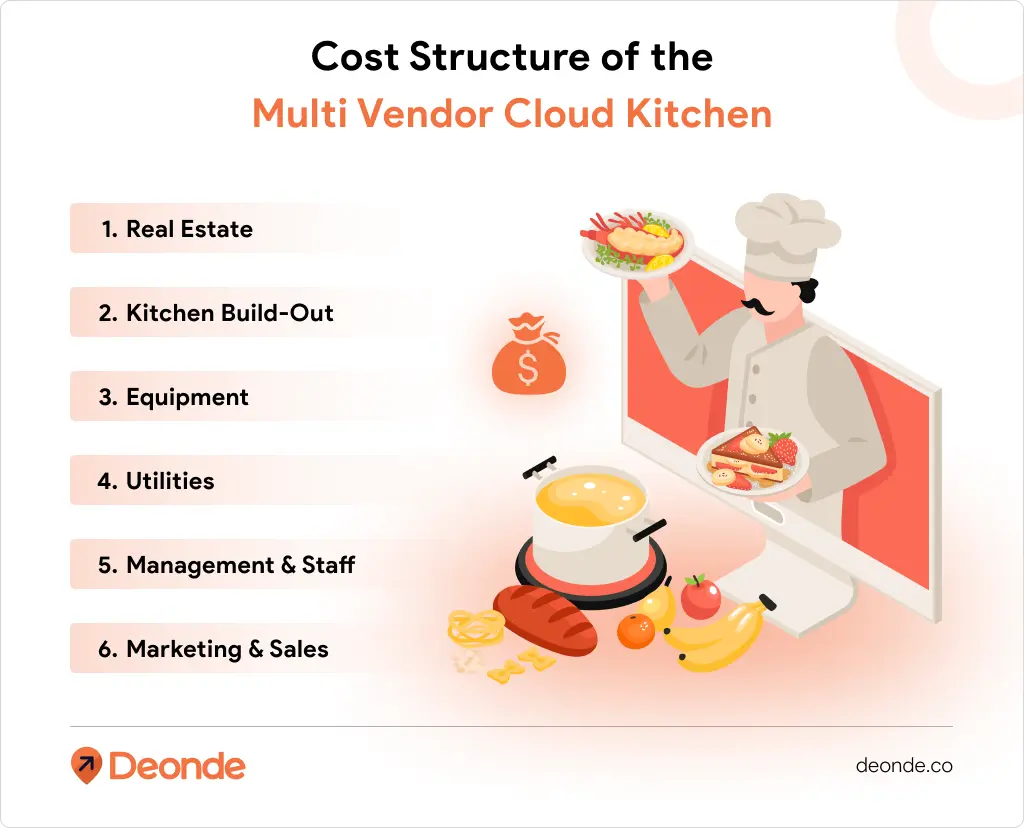
- Real Estate: Lease or mortgage payments for a large, industrially-zoned property.
- Kitchen Build-Out & Equipment: High upfront cost of installing multiple cooking stations, ventilation, refrigeration, and fire suppression systems.
- Utilities: Gas, water, electricity, and internet for the entire facility.
- Management & Staff: Salaries for a facility manager, cleaning crew, and potentially a maintenance technician.
- Marketing & Sales: Costs associated with attracting and onboarding new tenant brands.
Key Metrics for Success (KPIs for the Host)
The host’s business model thrives on efficiency and occupancy.
- Station Occupancy Rate: The percentage of rented kitchen stations vs. available stations. This is the most critical metric. A low occupancy rate quickly leads to unprofitability.
- Revenue per Available Station: Similar to “RevPAR” in hotels, this measures how effectively each station is generating income.
- Tenant Churn Rate: The rate at which brands leave the facility. High churn indicates problems with the value proposition, cost, or management.
- Take Rate from Value-Added Services: The percentage of total revenue that comes from high-margin services beyond basic rent.
- Customer Acquisition Cost (CAC) per Tenant: The sales and marketing cost to attract one new food brand to the kitchen.
Path to Profitability and Scaling
A multi-vendor kitchen becomes profitable by maximizing station occupancy and increasing the revenue generated per station through value-added services.
Scaling strategies include:
- Geographical Expansion: Replicating the successful kitchen hub model in new cities or neighborhoods.
- Franchising the Model: Licensing the brand, operating system, and business model to other operators.
- Vertical Integration: Launching a host-owned virtual brand within its own kitchen to capture direct food sales revenue and fill unused station capacity.
- Platform Dominance: Becoming the default “Kitchen-as-a-Service” provider in a region, giving the host significant leverage with suppliers and delivery apps.
Also Read: How to Start Your Online Food Delivery Business in 2026
3. Market Research
– Who are your target customers? (age, location, ordering habits)
– Which cuisines are underserved in your area?
– Who are your top 3 competitors on Uber Eats / Zomato / Swiggy?
4. Startup Cost Breakdown
| Item | Estimated Cost (USD) |
|---|---|
| Kitchen rental deposit | $1,000 – $5,000 |
| Equipment (if not shared kitchen) | $5,000 – $20,000 |
| Licenses and permits | $500 – $2,000 |
| Initial food inventory | $1,000 – $3,000 |
| Packaging and branding | $500 – $2,000 |
| Technology (website, POS, ordering app) | $500 – $5,000 |
| Marketing (launch promotions, ads) | $1,000 – $5,000 |
| Total estimated range | $9,500 – $42,000 |
For India, expect ₹3–15 lakhs depending on city and kitchen type.
5. Revenue Projections
Model your first 6–12 months. Include:
– Expected number of orders per day
– Average order value (target ₹400–₹800 or $15–$30)
– Revenue split between direct orders and third-party platforms
6. Operations Plan
Kitchen workflow, staff roles, delivery logistics, and technology stack.
7. Marketing Plan
How you’ll acquire your first 100 customers — delivery app listings,
social media, Google Ads, and launch promotions.
Cloud Kitchen Startup Cost: A Realistic Breakdown
One of the biggest questions before starting is: how much does a cloud kitchen cost?
Here’s a realistic breakdown based on different setup types.
Shared/Commissary Kitchen (Lowest Cost)
Rent an existing certified kitchen by the hour or shift.
– Monthly rental: $500 – $2,000 / ₹15,000 – ₹60,000
– No equipment investment needed
– Best for: First-time operators testing a concept
Dedicated Leased Kitchen Space (Mid Range)
Rent your own commercial kitchen space.
- Setup cost: $15,000 – $40,000 / ₹5 – ₹15 lakhs
- Monthly rent: $2,000 – $6,000 / ₹50,000 – ₹1.5 lakhs
- Best for: Operators ready to scale
Full Build-Out Kitchen (Highest Cost)
Build your own commercial kitchen from scratch.
- Setup cost: $40,000 – $100,000+
- Best for: Multi-brand operators or commissary hosts
Key ongoing costs to plan for:
- Third-party platform commissions: 15–30% per order
- Food cost (target): 25–35% of revenue
- Labor: 20–25% of revenue
- Marketing: 5–10% of revenue
A cloud kitchen becomes profitable when your gross margin (revenue minus food + packaging costs) consistently exceeds your fixed costs (rent + labor).
A Step-by-Step Guide: Launching Your Single-Vendor Cloud Kitchen
This is your actionable roadmap from concept to first order.
Step 1: Solidify Your Concept & Menu
Start with a strong concept. Pick a cuisine you love that works well for delivery, stays fresh, holds heat, and looks appetizing. Research your local market to avoid crowded niches and find real demand. Then, build a small, focused menu. A tighter menu cuts costs, keeps operations simple, and ensures every dish is top quality.
Step 2: Crunch the Numbers: How Much Does It Cost to Start a Cloud Kitchen?
This is the most common question, and the answer varies widely. A rough breakdown of initial costs includes:
- Kitchen Rental Deposit: First and last month’s rent for a commissary or shared kitchen space.
- Licenses & Permits: Health department permits, business license, and food handler certifications.
- Equipment: This can be a major cost. You may need ovens, grills, fryers, refrigeration, and food prep stations. Many spaces offer equipped kitchens for a higher rent.
- Initial Food Inventory: Stocking up on your core ingredients.
- Packaging: Delivery-friendly containers, bags, stickers, and napkins.
- Technology: A tablet or simple POS system to manage orders.
- Marketing: Budget for photography and initial launch promotions.
A realistic starting range can be anywhere from $15,000 to $50,000+, depending on location, equipment needs, and concept.
Step 3: Secure Your Location and Legalities
You can’t run a cloud kitchen from a regular home kitchen. Rent space in a commissary, shared kitchen, or cloud kitchen pod. Then, secure licenses, permits, and insurance—these are must-haves to operate legally.
Step 4: Build Your Technology Stack
Your tech is your storefront and your engine. You will need:
- Delivery App Integration: List your brand on major platforms like Uber Eats, DoorDash, and Grubhub. This is your primary source of customers initially.
- Direct Ordering Website: Use a simple platform to build a website where customers can order directly from you. This saves you the high commission fees charged by the apps.
- Order Management: A system, even if it’s just a dedicated tablet, to consolidate orders from all channels so your kitchen staff isn’t checking multiple devices.
Step 5: Master Marketing and Launch
Since you have no physical presence, your entire marketing strategy is digital.
- Optimize Your Delivery App Listings: Use professional, high-quality photos of every menu item. Write compelling descriptions. Encourage happy customers to leave reviews.
- Leverage Social Media: Instagram and Facebook are essential for building a brand personality. Show behind-the-scenes content, promote new dishes, and run targeted ads to people in your delivery radius.
- Offer Launch Promotions: Drive initial traffic with a strong first-order discount or free delivery offer.
A Step-by-Step Guide: Launching Your Multi-Vendor Cloud Kitchen
Step 1: Strategic Concept Development & Menu Engineering
This is the most critical phase. Your brands must be distinct yet operationally synergistic.
- Identify Cuisine Gaps: Analyze delivery app data in your target area. What cuisines are missing or underserved?
- Ensure Operational Synergy: Select concepts with shared ingredients, equipment, and labor. A pizza kitchen, for instance, can easily add garlic bread, pasta, and salads, optimizing resource use.
- Craft Unique Brand Identities: Give each brand its own name, logo, and packaging so it feels like a separate restaurant. Customers shouldn’t realize the brands come from the same kitchen.
Step 2: Financial Modeling and Cost Analysis
How much does it cost to start a cloud kitchen of this type? While higher than a single brand, the ROI potential is far greater.
- Initial Investment: Includes kitchen rental (a larger space may be needed), potential equipment upgrades, brand identity design (logos, menus for each brand), and advanced tech stack for multi-brand order management.
- Variable Costs: Food costs remain the largest variable. The key is to engineer menus that share high-cost ingredients (e.g., cheese, chicken, bases for sauces) across different brands to simplify inventory and secure bulk purchasing discounts.
- Projected Revenue: Model revenue per brand based on market research. The sum of these revenue streams should far exceed the income of a single-brand operation, justifying the initial outlay.
Step 3: Technology: The Central Nervous System
A multi-brand operation cannot function without robust technology.
- Multi-Brand Order Aggregation: You need a dedicated Kitchen Display System (KDS) or software that can receive orders from all delivery apps (Uber Eats, DoorDash, etc.) for all your brands and route them to the correct preparation station on a single screen. This prevents chaos during rush hours.
- Integrated POS and Inventory Management: Software that tracks sales per brand and automatically updates inventory levels is non-negotiable for controlling food costs across multiple menus.
Step 4: Operational Execution and Kitchen Workflow
Efficiency is everything. The kitchen layout must be designed for parallel processing.
- Station-Based Layout: Organize your kitchen into dedicated stations (e.g., fry station, grill station, salad station) that can fulfill components for multiple brands simultaneously.
- Staff Training: Kitchen staff must be cross-trained to prepare items from every brand according to specific recipes and quality standards.
- Packaging and Logistics: Implement a foolproof system to ensure the right food goes into the right branded packaging and is handed to the correct delivery driver. Mixing up orders between brands is a critical failure point.
Step 5: Launch and Multi-Brand Marketing
Launch brands strategically, not all at once.
- Staggered Launch: Start with your anchor brand (the strongest concept), then launch subsequent brands one at a time once operations are stable.
- Cross-Promotion: Use the packaging and digital receipts from one brand to promote the others. Offer a discount for trying a “sister restaurant.”
- Unified Digital Strategy: While brands are separate, your overall digital marketing strategy should aim to build a reputation for hosting multiple high-quality delivery concepts.
Conclusion: The Future is in the Cloud
The cloud kitchen model is transforming the food industry, offering flexibility and efficiency for single concepts, multi-brand operations, and future food hubs.
Success, however, isn’t guaranteed. It hinges on a deep understanding of your chosen model, meticulous financial planning, and a mastery of digital marketing.
The businesses that thrive will be those that embrace technology, obsess over unit economics, and consistently deliver a high-quality, convenient experience to the end customer.
The kitchen may be virtual, but the path to profitability is very real and requires a solid strategy from day one.
Thinking of starting a cloud kitchen? Contact Deonde for setup support to drive leads.