Every app you use to run your food business — your ordering system, your driver tracking tool, your customer loyalty program — is almost certainly built on SaaS. So what is SaaS, exactly, and why does it matter to your business?
SaaS, or Software as a Service, is a model where software is delivered over the internet instead of being installed on your computer or server. You subscribe, log in, and use it — no installation, no hardware, no maintenance team required. That’s the SaaS meaning in its simplest form.
I still remember the moment SaaS clicked for me. It was 2019, and I was helping a client migrate their entire accounting system from desktop QuickBooks to the cloud version. What should have been a nightmare of data transfers and software installations took exactly 47 minutes.
That’s when I realized we weren’t just talking about software anymore – we were talking about a fundamental shift in how businesses operate.
This guide explains SaaS from the ground up: what it means, how it works, what a SaaS platform looks like in practice, and why B2B SaaS has become the backbone of modern business operations.
What Does SaaS Stand For?
SaaS stands for Software as a Service. It belongs to a broader category of cloud-based models alongside IaaS (Infrastructure as a Service) and PaaS (Platform as a Service).
Before SaaS became mainstream, businesses had to buy software outright, install it on physical machines, and hire IT staff to maintain it. Updates had to be manually applied. If your server crashed, you lost access to your data. SaaS changed all of that.
With SaaS, the software lives in the cloud. The vendor manages the infrastructure, the updates, the security, and the uptime. You simply access the product through a browser or app — and pay a recurring subscription fee.
Think of it like renting an apartment versus buying a house. You get full access to the space without owning or maintaining the building.
How Does a SaaS Platform Work?
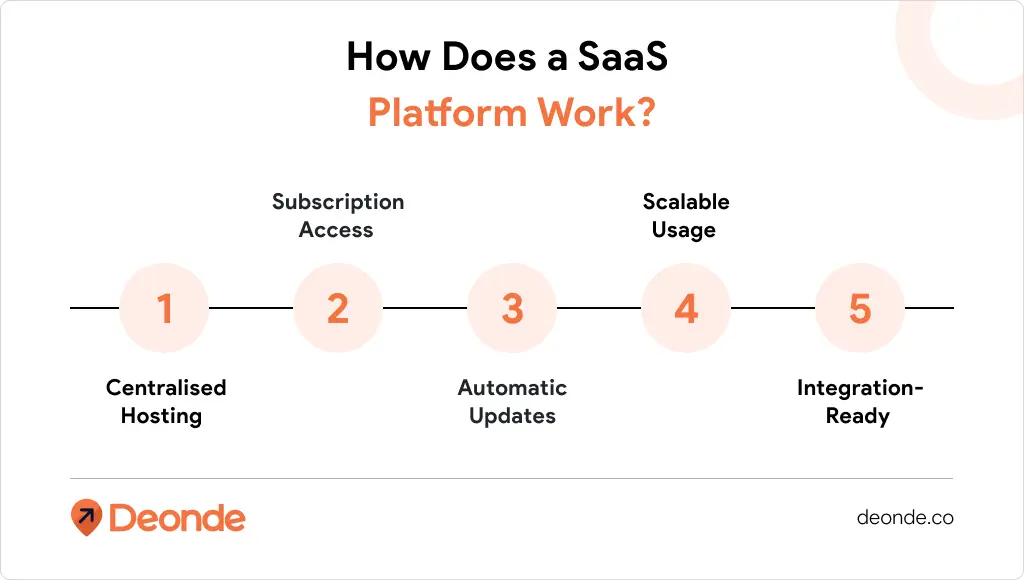
A SaaS platform runs on shared cloud infrastructure managed entirely by the software provider. Here’s how the model functions in practice:
- Centralised Hosting All data and software logic sit on the provider’s servers (or a cloud provider like AWS or Google Cloud). Every customer accesses the same application, though their data remains private and isolated.
- Subscription Access Customers pay monthly or annually for a licence. Access is tied to login credentials — cancel the subscription and access is revoked.
- Automatic Updates The vendor pushes updates, patches, and new features to all users simultaneously. You never need to download or install anything manually.
- Scalable Usage Most SaaS platforms let you add users, features, or capacity as your business grows — without switching to a new system.
- Integration-Ready Modern SaaS software connects with other tools via APIs — payments, marketing platforms, logistics systems, and more. Deonde, for example, supports third-party delivery integrations directly within its platform.
What Is a SaaS Company?
A SaaS company builds, hosts, and sells software products via subscription. Instead of selling a product once, a SaaS company earns recurring revenue as long as customers keep subscribing.
Well-known global SaaS companies include Salesforce (CRM), Slack (communication), Zoom (video conferencing), and Shopify (e-commerce). In the food and delivery space, Deonde is a SaaS company — it provides a multi-restaurant food delivery system that restaurant owners and delivery businesses subscribe to and run without building software from scratch.
Key characteristics of a SaaS company:
- Revenue model is subscription-based (monthly or annual)
- Product is accessed online — no physical distribution
- One product version serves thousands of customers simultaneously
- Customer success and onboarding are core parts of the business
The SaaS company’s meaning is fundamentally about continuous value delivery — you keep paying because you keep getting value. The moment the software stops serving you, you cancel. That model forces SaaS companies to keep improving their product.
B2B SaaS: What It Means and Why It Dominates
B2B SaaS refers to software sold by one business to another business — as opposed to B2C SaaS, which is sold directly to individual consumers.
B2B SaaS meaning: a company builds a software product that solves a specific operational problem for business customers, and sells it on a recurring subscription basis.
Examples of B2B SaaS by category:
|
Category |
B2B SaaS Example |
|
Food Delivery Operations |
Deonde |
|
CRM |
Salesforce, HubSpot |
|
HR Management |
BambooHR, Workday |
|
Accounting |
QuickBooks Online, Xero |
|
Project Management |
Asana, Monday.com |
B2B SaaS typically has longer sales cycles than B2C, higher contract values, and lower churn because business customers integrate the software deeply into their operations. Once a restaurant owner builds their ordering flow on a SaaS platform, switching is disruptive — which is why B2B SaaS retention rates tend to be high.
For food entrepreneurs and delivery business operators, B2B SaaS solutions are the most practical path to launching quickly. Instead of spending ₹20–50 lakhs on custom food delivery app development, you subscribe to a ready-made SaaS platform like Deonde and go live in days.
What Is SaaS Sales?
SaaS sales is the process of selling subscription-based software to customers — typically businesses. It differs significantly from traditional software sales.
In traditional software sales, a customer pays once for a licence and you move on. In SaaS sales, the relationship doesn’t end at the first transaction. Because revenue is recurring, SaaS sales teams focus on:
- Acquisition — Getting new customers to sign up (often via free trials or demos)
- Onboarding — Helping customers see value quickly to reduce early cancellations
- Expansion — Upselling higher-tier plans or additional features over time
- Retention — Reducing churn so customers keep renewing
SaaS sales teams track metrics like Monthly Recurring Revenue (MRR), Annual Recurring Revenue (ARR), Customer Acquisition Cost (CAC), and Customer Lifetime Value (CLV). These numbers tell you not just how much you sold, but how healthy your business model actually is.
If you’re evaluating a SaaS platform for your food business, understanding SaaS sales tactics helps you negotiate better — free trials, annual discounts, and feature-gating are all standard SaaS sales levers you should be aware of.
What Is a SaaS Product?
A SaaS product is the software application itself — the thing customers subscribe to and use. It’s built once and delivered continuously to all subscribers.
A good SaaS product typically includes:
- A core feature set that solves the primary problem (e.g., online ordering for restaurants)
- A user interface accessible via browser or mobile app
- Admin controls so different team members have appropriate access levels
- Analytics and reporting so users can measure their results
- Integrations with the tools the customer already uses
Deonde Ressto, for instance, is a SaaS product built for restaurants. It includes an online ordering system, menu management, driver management, and analytics — all accessible from a single dashboard, with no server setup required.
What Is a SaaS Product Manager?
A SaaS product manager (SaaS PM) is responsible for defining what the software product does, why, and for whom. They sit between engineering, design, and sales — translating customer problems into product decisions.
In a SaaS company, the product manager’s job never really ends. Because SaaS is always evolving, SaaS PMs continuously:
- Gather customer feedback and usage data
- Prioritise which features to build next
- Define the roadmap (short-term and long-term)
- Work with engineers to ship improvements
- Measure whether new features are actually being used
If you’re building a SaaS startup, your product manager role is critical from day one. The best SaaS products are built around obsessive customer understanding — not assumptions.
SaaS Business Models: How SaaS Companies Make Money?
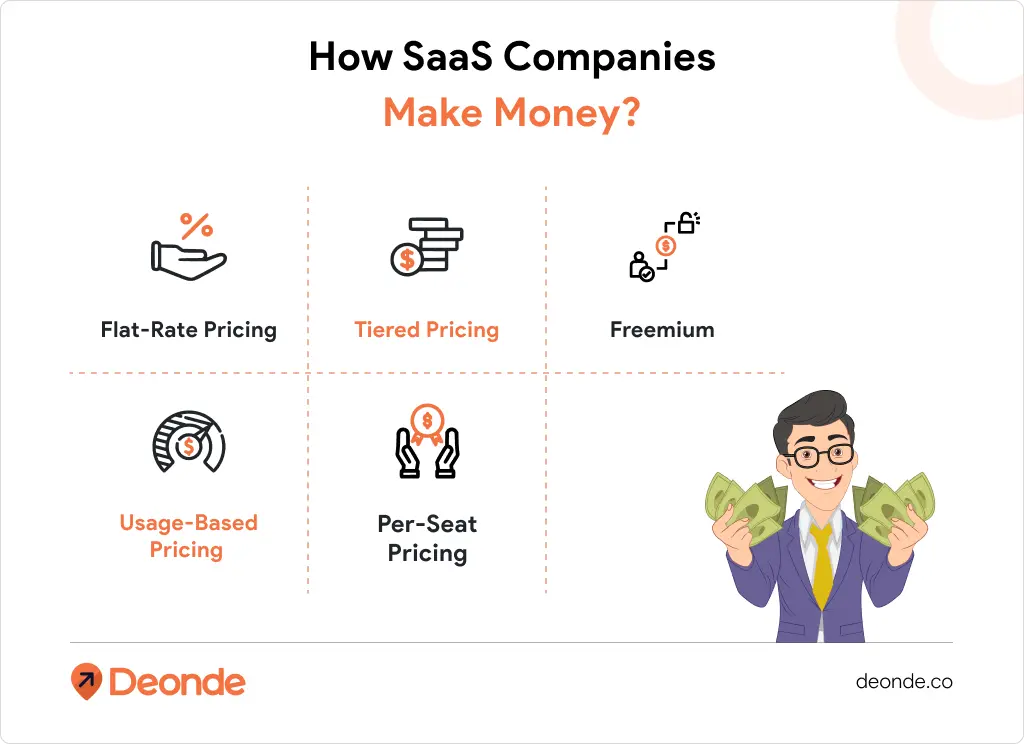
SaaS businesses generate revenue primarily through subscriptions, but the model has several common variations:
- Flat-Rate Pricing One price, one plan, one feature set. Simple to understand but limits revenue expansion.
- Tiered Pricing Different plans at different price points (Starter, Growth, Enterprise). Each tier unlocks more features or capacity. This is the most common SaaS business structure.
- Usage-Based Pricing Customers pay based on how much they use — number of orders processed, API calls made, or transactions completed. Common in infrastructure and payments SaaS.
- Freemium A free plan with limited features. Customers upgrade to paid plans when they need more. Effective for customer acquisition but requires a strong conversion strategy.
- Per-Seat Pricing Pricing is per user account. Common in B2B SaaS tools like project management or CRM platforms.
Understanding these models helps you evaluate any SaaS tool you’re considering. For delivery businesses, SaaS-based food delivery solutions typically use tiered pricing — where your monthly fee scales with your order volume or number of active stores.
SaaS Website: What to Look for Before You Subscribe
A SaaS website is more than a marketing page — it’s how you evaluate whether a product is worth your subscription. When assessing a SaaS website, look for:
Transparent Pricing: If pricing is hidden, expect complexity. Good SaaS companies publish their plans openly. See pricing page as an example of what clear, honest pricing looks like.
Live Demo or Free Trial: A confident SaaS product lets you try before you buy. Deonde offers live demos across all its delivery verticals — restaurant, grocery, tiffin, and more.
Customer Stories: Real case studies show you how businesses similar to yours are using the product. The Chowman case study shows how a restaurant chain scaled with Deonde.
Integration Documentation: A SaaS platform with no integration options will eventually box you in. Check what payment gateways, delivery partners, and tools it connects with.
SaaS Ideas That Are Still Winning in 2026
SaaS is not a saturated space — nearly every industry still has operational problems that a focused SaaS product could solve. Some SaaS ideas with strong demand:
- Hyperlocal delivery management for neighbourhood retailers
- Subscription box management for D2C food brands
- Milk and dairy delivery scheduling for local dairies
- Tiffin service management for home-cooked food operators
- Cloud kitchen operations software for multi-brand virtual restaurants
Each of these points back to a real business pain. If you’re exploring any of these, Deonde’s hyperlocal delivery software, subscription management, and cloud kitchen solution are ready-built SaaS platforms targeting exactly these markets.
SaaS vs Custom Software: Which Should You Choose?
This is the question most food entrepreneurs face before launching. Here’s a direct comparison:
|
Factor |
SaaS |
Custom Development |
|
Launch Time |
Days to weeks |
3–12 months |
|
Upfront Cost |
Low (monthly subscription) |
High (₹10–50 lakhs+) |
|
Maintenance |
Handled by vendor |
Your responsibility |
|
Customisation |
Limited to platform options |
Fully flexible |
|
Scalability |
Built-in |
Depends on architecture |
|
Risk |
Low — proven product |
High — unproven build |
For most startups and growing food businesses, SaaS is the right starting point. You validate your business model first — then invest in custom features only if you’ve outgrown what the platform offers.
The Bottom Line
SaaS is not just a technology term — it’s the operational model that has made it possible for small food businesses to compete with enterprise chains. The question for any food entrepreneur is not whether to use SaaS, but which SaaS platforms to choose.
If you’re running or building a food delivery, restaurant, grocery, or any other delivery business, explore how Deonde’s SaaS platform can give you a full ordering and delivery system — without writing a single line of code.

Frequently Asked Questions
1. What Is A SaaS Company And How Does It Make Money?
A SaaS company builds software and sells access to it via recurring subscriptions — monthly or annually. Revenue compounds as long as customers keep renewing. Most SaaS companies grow through a combination of new customer acquisition and expansion of existing accounts.
2. What Is SaaS Sales And How Is It Different From Traditional Sales?
SaaS sales focuses on recurring revenue rather than one-time transactions. The process involves acquiring, onboarding, expanding, and retaining subscribers — with success measured by MRR, ARR, and churn rate rather than just closed deals.
3. What Is A SaaS Product Manager Responsible For?
A SaaS PM defines what gets built, when, and why — based on customer needs, usage data, and business goals. They manage the product roadmap, prioritise features, and ensure the product continues delivering value to subscribers.
4. What Does SaaS Mean For A Small Food Business?
For a small restaurant or delivery business, SaaS means you can access enterprise-grade ordering, delivery management, and marketing tools — at a fraction of the cost of building them yourself. You pay monthly, scale as you grow, and avoid the overhead of maintaining your own software infrastructure.