Local restaurants often lose 15% to 30% of every order to big delivery apps. At the same time, customers now expect their food, groceries, or everyday essentials in 30 minutes or less.
That gap between what merchants want and what customers expect is exactly why so many entrepreneurs are building their own hyperlocal food delivery marketplace instead of just plugging into Uber Eats or DoorDash.
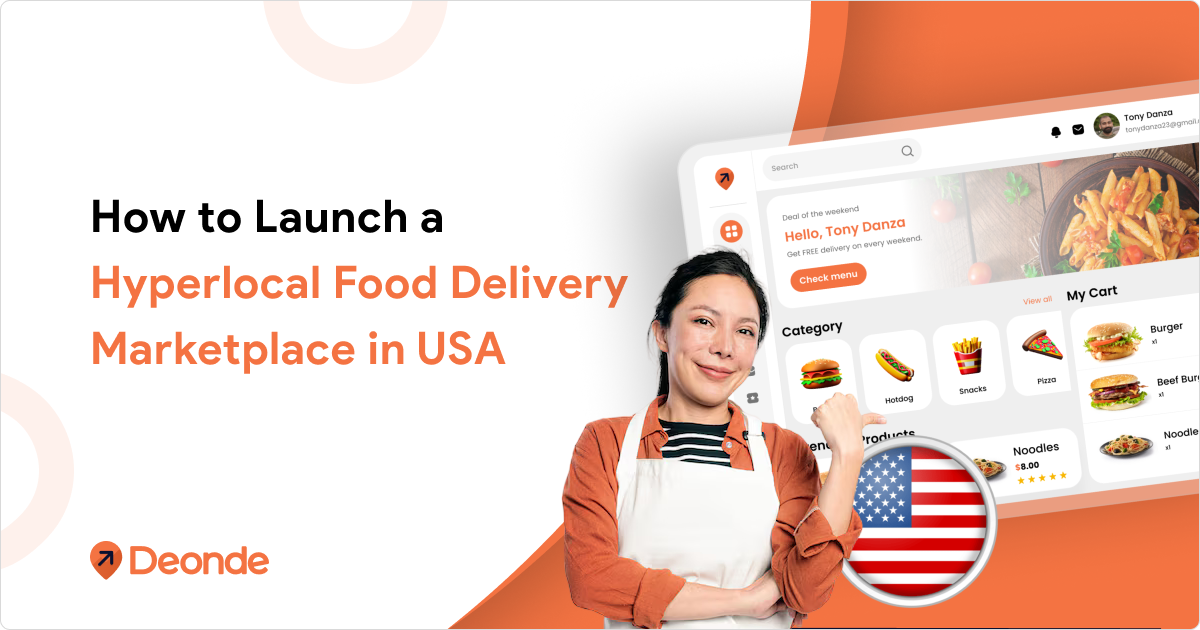
A hyperlocal food delivery marketplace connects nearby restaurants and shops with local customers, all through one app.
You control the brand, the delivery zone, and the rules. Done right, it can beat national delivery apps on speed, cost, and customer loyalty, right in your own city or neighborhood.
So, What is the Hyperlocal Food Delivery Marketplace?
A hyper-local food delivery marketplace connects people in a specific neighborhood or city with nearby restaurants, and handles the ordering, payment, and delivery all in one place.
This model is different from a single-restaurant app, which only serves one business. A hyperlocal marketplace is multi-vendor.
It lists many restaurants or shops in one app, similar to Uber Eats or DoorDash, but scoped to your own city and running on your own hyperlocal delivery software instead of a national platform’s rules and fees.
It’s also different from regular online shopping, which can take days to arrive. A hyperlocal model is built for speed, often 30 minutes to a few hours.
That’s why the space overlaps so much with what the industry calls quick commerce, or Q-commerce.
See our breakdown of hyperlocal delivery vs. quick commerce for the full comparison.
Think of platforms like Deonde, which give you the technology to build this kind of marketplace without writing a single line of code. You get a customer app, restaurant dashboard, delivery
This guide walks through every step of launching one in the US: picking a business model, handling the legal and driver basics, choosing your tech stack, signing up restaurants, hiring drivers, and marketing your launch.
The Market Is Booming — 2026 Numbers
The numbers tell a clear story: launching a hyperlocal food delivery marketplace in the US in 2026 means entering one of the fastest‑growing segments of the digital economy.
Several structural trends are fueling this growth and making 2026 an ideal time to launch a US‑focused hyperlocal delivery platform:
- US online food delivery: $34.9B in 2025, projected to reach $75.4B by 2034 at 8.94% CAGR.
- Global hyperlocal market: Over $4T in 2025; hyperlocal food delivery alone estimated at $252–562B depending on the report.
- Dual‑income households: Around 60% of US households are dual‑income, making food delivery a daily convenience, not a luxury.
- Smartphone adoption: About 97% of US adults own a smartphone, enabling instant ordering from anywhere.
- Online ordering dominance: Roughly 67% of restaurant sales now come from online or phone orders, rising to 75% for QSRs.
- Delivery’s growing share: Delivery accounted for 22% of global foodservice spend in 2025, up from 9% in 2019.
- Mobile‑first behavior: More than 70% of online food orders are placed via mobile apps; 78% of US adults have at least one food app installed.
- High‑frequency users: 92% of Gen Z order food online weekly (5+ orders/month), with strong preference for direct restaurant ordering (~70%).
For a deeper look at these numbers, check our online food delivery statistics breakdown.
Why Launch a Hyperlocal Food Delivery Marketplace in the US Right Now?
Three forces are pushing US entrepreneurs toward hyperlocal delivery right now.
Restaurants want out from under commission fees. National apps often charge 15% to 30% per order. Many owners would rather pay one flat monthly fee for their own commission-free ordering system and keep their customer data and relationships in-house.
Customers expect near-instant delivery. Meals, groceries, and even medicine are now expected within 10 to 30 minutes in many US cities, not the next day.
That expectation is fueling growth in dark stores and micro-fulfillment centers: small, local warehouses built just for fast picking and packing.
See how dark stores compare to micro-fulfillment centers if you’re weighing that option for your own launch.
The playbook already works. US quick-commerce companies like Gopuff built large businesses on exactly this model: local inventory, fast delivery, one app.
Read the Gopuff business model breakdown to see how it scaled. You don’t need to invent a new category. You need to execute a proven model well in your own market.
Here’s how running your own hyperlocal marketplace stacks up against plugging into a national aggregator:
| Factor | National Aggregator (Uber Eats, DoorDash) | Your Own Hyperlocal Marketplace |
| Commission per order | Often 15%–30% | Set by you |
| Customer data | Owned by the aggregator | Owned by you |
| Branding | Aggregator’s brand | Your brand |
| Delivery zones | Set by the platform | Set by you |
| Vendor mix | Shared with every competitor | Restaurants and shops you choose |
| Pricing control | Limited | Full control |
Convinced? Here’s exactly how to build one, step by step.
How to Launch a Hyperlocal Food Delivery Marketplace: Step-by-Step Guide
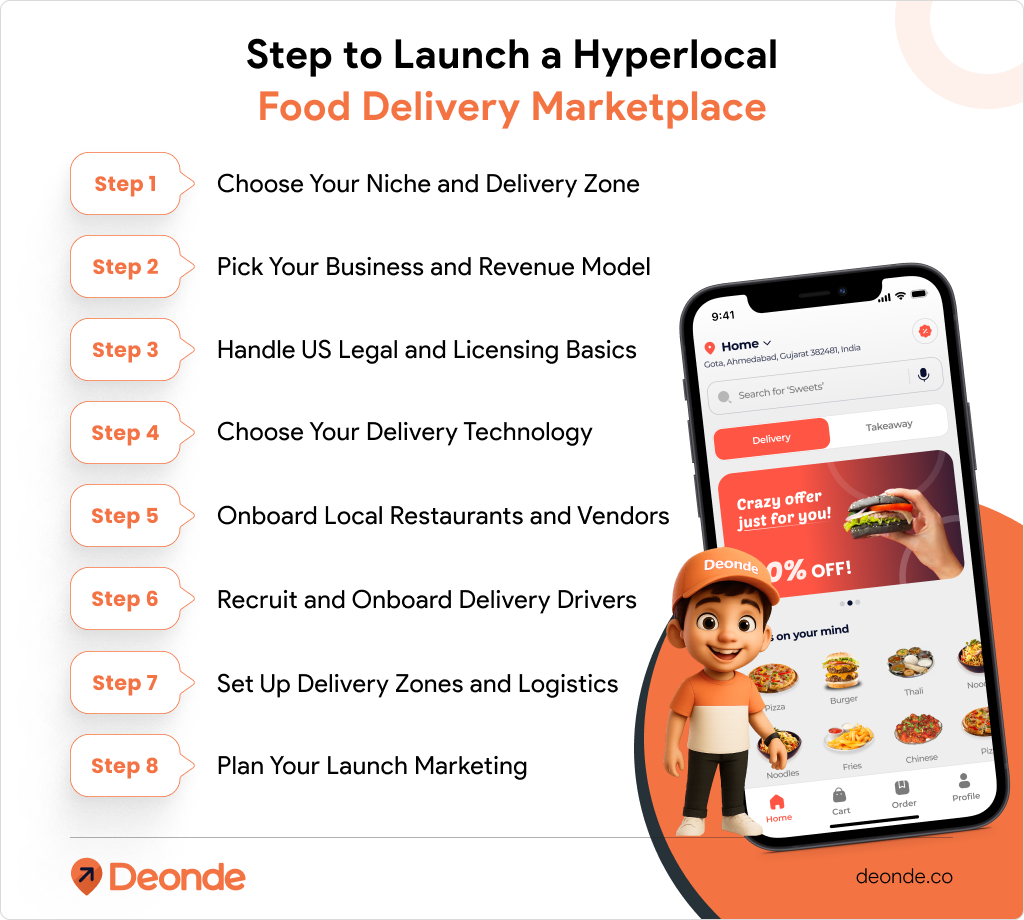
Step 1: Choose Your Niche and Delivery Zone
Start small and specific. Pick one city, one neighborhood, or a handful of zip codes, not an entire state. Decide whether you’ll focus only on restaurants at first, or add groceries and other essentials later.
Many hyperlocal marketplaces start with food, then expand into grocery delivery software once they have delivery density in a zone.
Density matters more than size at this stage. Fifty loyal customers packed into a 3-mile radius are worth more than 500 spread across a whole city, because a tight zone keeps delivery times short and delivery costs low.
Step 2: Pick Your Business and Revenue Model
Most hyperlocal marketplaces make money one of four ways, or some mix of them:
- A commission on each order from restaurants and vendors
- A flat delivery fee charged to customers
- A monthly subscription for free or discounted delivery
- A software licensing fee, if you eventually sell your platform to other operators
Review common food delivery business models before you lock this in. Your choice shapes your pricing, your driver pay, and even which software features you’ll need.
Many US hyperlocal marketplaces settle on a hybrid: a lower commission than the national apps, plus a small delivery fee, to stay attractive to both restaurants and customers.
Step 3: Handle US Legal and Licensing Basics
Before you take your first order, cover these basics:
- Register your business (an LLC is common) and get an EIN from the IRS
- Check your city and state requirements for a general business license
- Confirm each restaurant or vendor on your platform holds its own valid food service license. Your marketplace usually doesn’t need a food handler’s permit unless you’re also running your own dark store or kitchen
- Get general liability insurance, plus delivery or commercial auto coverage for your drivers
The trickiest US-specific issue is driver classification. Most hyperlocal marketplaces treat drivers as independent contractors, but the rules differ by state and keep changing. California, for example, leans toward classifying workers as employees under its “ABC test,” though it carved out a separate status for app-based drivers through Proposition 22. Many other states use a looser test based on how much control you have over a driver’s schedule.
Some cities add their own pay or benefit rules on top, and federal guidance has also shifted more than once in 2026.
This is one part of your launch worth paying an expert for. Talk to a local employment attorney before you finalize driver agreements. If you’re onboarding restaurants directly, our guide to restaurant permits and licenses in the US is a good starting point for what to ask your vendors.
This section is general information, not legal advice. Rules vary by state and change often.
Step 4: Choose Your Delivery Technology
You have two real choices: build custom software from scratch, or launch on a ready-made white-label food delivery platform you brand as your own. Building from scratch can take 6 to 12 months and a full engineering team. A white-label platform can get you live in weeks instead.
Whichever route you pick, you need four connected pieces:
- A customer app for browsing, ordering, and tracking
- A restaurant and vendor app for managing menus, inventory, and incoming orders
- A driver app for accepting orders and navigating deliveries
- An admin panel for managing zones, pricing, payouts, and reports
Our guide on choosing the right tech stack for your food delivery app breaks down what to look for in each piece, including payments, maps, and notifications.
Step 5: Onboard Local Restaurants and Vendors
Your marketplace is only as good as the vendors on it. Start with 10 to 20 restaurants or shops you can sign up in person.
A small, well-chosen list beats a long one with poor service. Keep onboarding simple: an easy menu upload, clear commission terms, and fast payouts build trust quickly.
Many hyperlocal marketplaces win their first vendors by leading with the commission-free pitch, since high fees are the single biggest complaint restaurants have about existing apps.
Step 6: Recruit and Onboard Delivery Drivers
Recruit locally. Drivers who already live in your delivery zone spend less time and gas getting to each order. Offer clear, competitive pay per delivery, and be upfront about how tips and bonuses work.
A short, simple onboarding flow, background check, vehicle details, brief training, keeps good drivers from dropping out before their first shift.
Sign up more drivers than you think you’ll need at launch. Slow deliveries in week one can hurt customer trust fast, and it’s hard to win back.
Step 7: Set Up Delivery Zones and Logistics
Use a proper delivery zone management system to map exact boundaries, assign each order to the nearest available driver, and adjust zones as you grow.
Real-time tracking and route optimization keep delivery times predictable, which matters to repeat customers more than almost anything else.
Our guide to delivery route optimization covers practical ways to cut delivery time without hiring more drivers.
Step 8: Plan Your Launch Marketing
Go local first. Flyers, neighborhood Facebook and Instagram groups, and partnerships with the restaurants you’ve already onboarded (they want you to succeed too) all work well for a hyperlocal launch.
Offer a limited-time discount or free delivery to your first few hundred customers to build early order volume. Restaurant marketing software can help you and your vendors run coupons, loyalty programs, and repeat-order campaigns from day one.
Common Mistakes to Avoid
- Launching across too wide an area before you have enough drivers to cover it
- Signing up vendors without agreeing on clear commission and payout terms upfront
- Ignoring driver classification rules until a state audit or lawsuit forces the issue
- Underpricing delivery just to compete, then losing money on every order
- Skipping real-time order tracking, which customers now expect as standard, not a bonus
How Much Does It Cost to Launch a Hyperlocal Food Delivery Marketplace?
Cost depends heavily on your build-or-buy decision. Custom software from a development agency can run well into six figures once you add ongoing maintenance.
A ready-made platform is usually priced as a monthly or annual subscription, which is far more predictable for a new business.
This comparison of SaaS pricing vs. custom development cost lays out the real numbers side by side, and this breakdown of what it costs to build an app like Uber Eats shows what a custom build typically involves.
If you want exact pricing for a ready-made hyperlocal platform, see Deonde’s pricing page for current plans.
Solving the Chicken-and-Egg Problem
Every marketplace faces the same problem: customers won’t come without restaurants, and restaurants won’t join without customers. You break this cycle by signing restaurants first.
Here’s the playbook that works:
- Sign 10-15 restaurants before you launch. Offer them zero commission for the first 30 days. You’re asking them to take a chance on you — make it risk-free.
- Drive traffic to those restaurants. Run ads, drop flyers, post in neighborhood groups. Send people to the platform to order from those specific restaurants.
- Show restaurants results. After 30 days, show each restaurant how many orders they got through your platform. Then introduce your commission structure. By now, they’ve seen value — switching off is harder than staying on.
The key insight: you’re not trying to serve everyone on day one. You’re trying to create a small, working loop where restaurants get orders, customers get food, and drivers get paid. Once that loop works, you add more restaurants and customers.
If you’re expanding to a new area, our guide on grocery delivery management systems covers how the same principles apply beyond restaurant food.
Launch Your Hyperlocal Food Delivery Marketplace with Deonde
Deonde offers a ready-made, white-label hyperlocal delivery software solution with the customer app, vendor app, driver app, and admin panel already built, and already running real delivery businesses across the US and beyond.
Instead of spending months building from zero, you set your zones, pricing, and vendor list, then go live in weeks.
Explore Deonde’s online ordering and delivery system built for the US market to see what’s included.
Final Thoughts on Launching Your Hyperlocal Food Delivery Marketplace
Launching a hyperlocal food delivery marketplace isn’t about outspending Uber Eats or DoorDash. It’s about serving your neighborhood better than they can. Get your niche, legal basics, tech, vendors, and drivers right, and a tight delivery zone can beat a national app on speed, price, and loyalty, every time.
Ready to move from planning to launch?Start your free trial with Deonde and get your customer app, vendor app, driver app, and admin panel running in weeks, not months.
Frequently Asked Questions
1. How much does it cost to launch a hyperlocal delivery marketplace?
Custom development often runs well into six figures. A white-label platform is far cheaper upfront and usually billed monthly. See Deonde’s pricing for current plans.
2. Do I need a special license to run a food delivery marketplace in the US?
You need a standard business license, and in most cases your restaurant partners hold the food service licenses, not you. Check your city and state rules, and confirm with a local attorney if you’re also running your own dark store or kitchen.
3. Should my delivery drivers be employees or independent contractors?
Most hyperlocal marketplaces use independent contractors, but classification rules differ by state and are actively changing in 2026. Confirm your setup with a local employment attorney before you launch.
4. How long does it take to launch a hyperlocal delivery app?
On a white-label platform, many businesses go live in a few weeks. Custom-built software usually takes 6 to 12 months. Our guide on how long it takes to develop a food delivery app walks through the full timeline.
5. Can I start in one neighborhood and expand later?
Yes, and it’s the smarter approach. Prove your model in one tight delivery zone, then use this guide on expanding your food delivery business to a new city when you’re ready to grow.