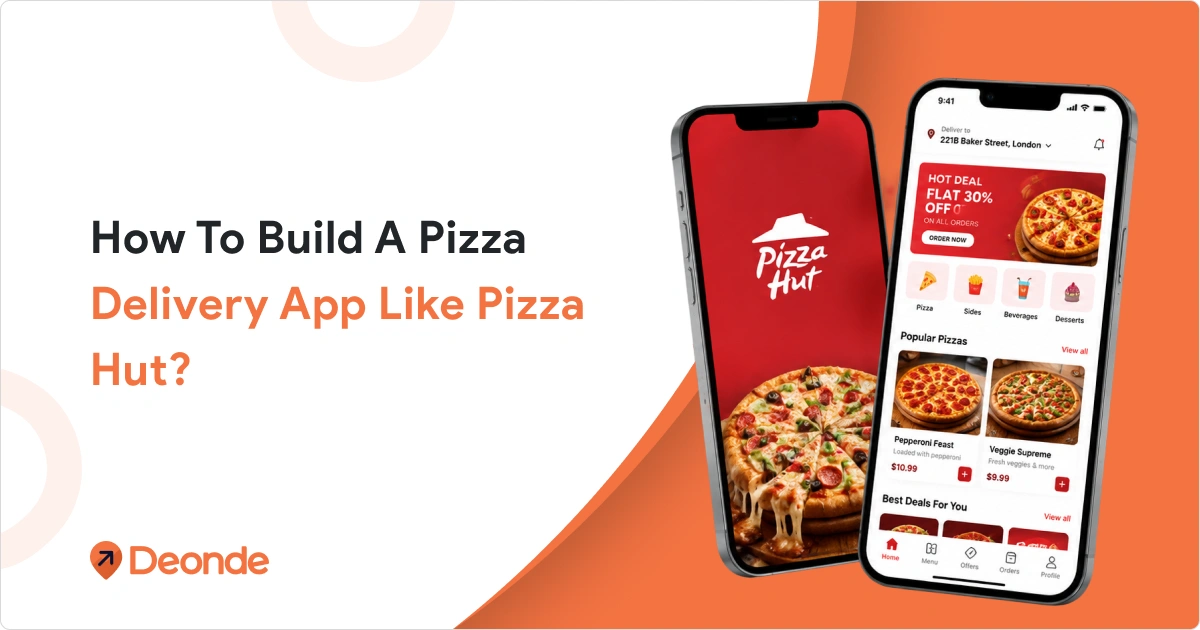
You can build a pizza delivery app like Pizza Hut without spending months and hundreds of thousands of dollars.
The features that make Pizza Hut’s app successful- build-your-own pizza, loyalty points, live order tracking, and scheduled delivery are the same features a ready-made pizza delivery platform gives you for a flat monthly fee.
Do you know that Pizza Hut operates more than 20,000 restaurants across over 108 countries and pulls in over $13 billion? The brand that turned pan pizza into a global obsession now runs much of its business through a mobile app.
Over the last decade, Pizza Hut has quietly built one of the most complete digital ordering experiences in the restaurant world.
Customers build their own pizza, schedule a delivery three days ahead, earn Hut Rewards points on every order, and watch their driver approach on a live map. The app is not a side channel for the brand; it is how a large part of its business now happens.
So, how can we develop an on-demand pizza delivery app just like Pizza Hut? What features should we include, and how do we streamline workflows for customers, drivers, and store managers?
Let’s find out. If you’re evaluating how to do this without a big engineering budget, you may want to look at a pizza delivery software platform built for exactly this.
Why Develop an App Like Pizza Hut?
Because customers now expect to order a pizza in seconds, and a direct ordering app keeps both the profit and the customer relationship with you instead of a third-party marketplace.
Pizza delivery is no longer a small, local business.
The pizza foodservice market is projected to reach USD 257.17 billion by 2031, according to Mordor Intelligence. A large share of that growth is flowing through digital ordering.
Given these changing consumer habits, launching an online pizza delivery app presents a huge opportunity. So, if you want to develop a pizza or food delivery app, now is the time to do so.
Here’s what an app does for your business specifically:
- It keeps your margins. Marketplace apps typically take 15–30% of every order. A direct ordering app keeps 100% of the revenue.
- It makes customers repeat. A loyalty program and one-tap reordering turn occasional buyers into regulars.
- It gives you your data back. Every order on your app is a customer you can reach again with name, number, order history included.
- It builds your brand. Your logo, your menu, your app. No competitor ads sitting next to your pizza.
That’s the strategy Pizza Hut proved at global scale. Its app keeps customers inside the brand’s own ecosystem instead of handing them to an aggregator.
Must-Have Features for a Pizza Hut-Style Delivery App
Your feature list drives your timeline, your budget, and your development approach, so it’s worth getting specific before you start building.
Here’s what a Pizza Hut-style stack typically includes, broken into its four core pieces.
1. The Customer App
This is where the ordering experience actually happens, so it carries the most weight:
- Pizza builder/customization flow — crust, sauce, size, and topping selection with live price updates
- Multiple ordering channels — native app, a branded ordering website, WhatsApp ordering, and QR-code menus for dine-in or in-store orders
- Guest checkout and saved profiles — let first-time visitors order without friction while still rewarding repeat customers.
- One-tap reorder and order history — the fastest path back to a customer’s usual order.
- Live order tracking — from kitchen to doorstep, with map-based driver location
- Order-ahead / scheduling — for parties, offices, and planned events
- Points-based loyalty and rewards — your own version of Hut Rewards, run through a loyalty management system.
- Flexible, secure payments — cards, wallets, and cash on delivery through an integrated online payment system
- Ratings and reviews — collected and managed through an online review management tool
2. The Delivery / Driver App
This is what keeps the promises made in the customer app:
- Accept/decline controls so drivers can manage their own availability.
- Turn-by-turn GPS navigation tied to live delivery zone management
- Route and dispatch optimization so orders route to the closest available driver
- In-app messaging with customers and the restaurant
- An earnings tracker covering trips, tips, and incentives
3. The Restaurant / Franchise Admin Panel
This is the piece Pizza Hut leans on hardest, given how many independently owned kitchens it coordinates:
- A central admin panel and partner app so each franchisee manages their own location without touching anyone else’s
- POS integration so online and in-store orders hit the same kitchen queue
- Order and refund management from a single dashboard
- Coupon, promo, and campaign tools
- Location-level and network-wide analytics
4. Pickup, Curbside, and Contactless Options
Not every order is a delivery. Build in:
- Curbside pickup with a one-tap “I’m here” check-in
- Contactless delivery as a default, not a special request
- A store locator that checks delivery eligibility by address before checkout
ALSO READ: 5 Features Your Pizza Delivery Application Must Have
How to Create a Pizza Delivery App Like Pizza Hut?
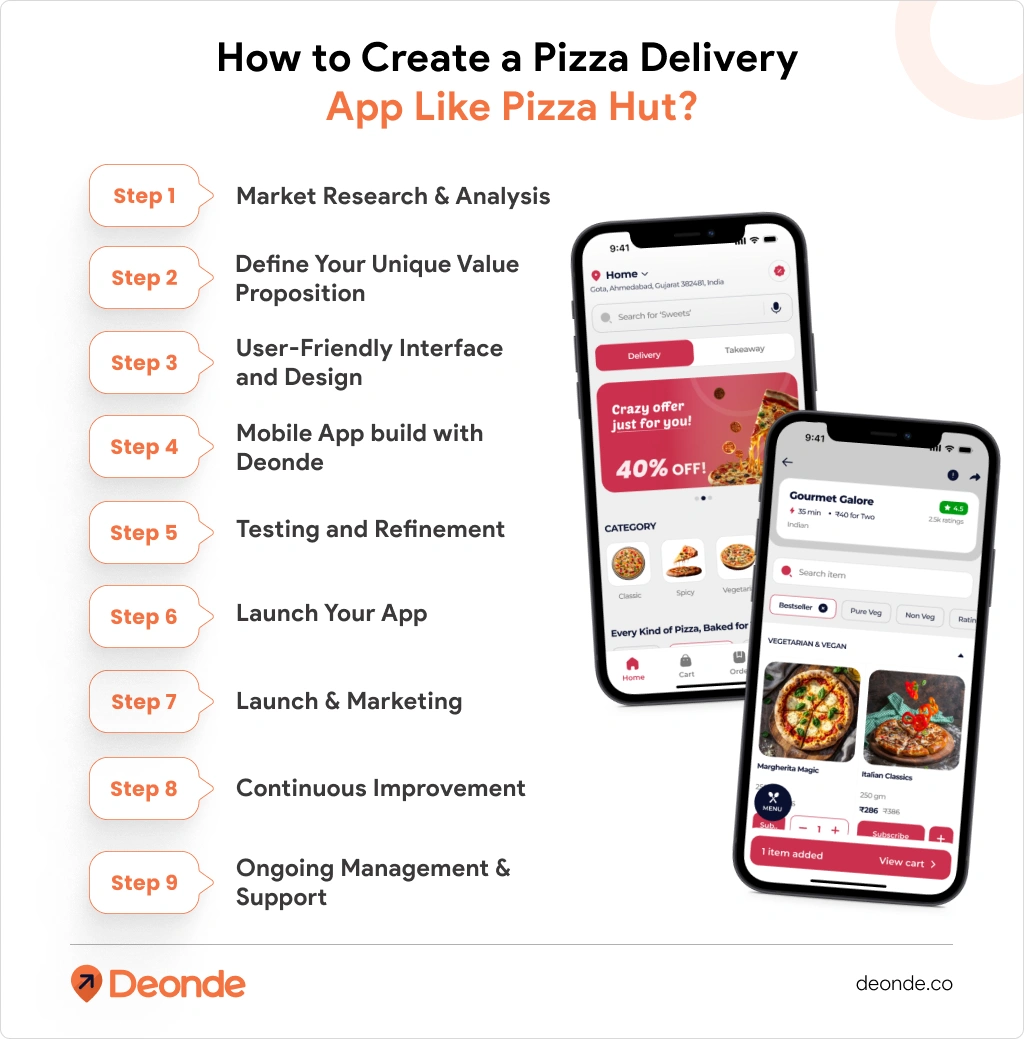
Now let’s walk through the steps to actually build a pizza delivery app like Pizza Hut from idea to launch.
1. Market Research & Analysis
Before writing a single line of code, research your target audience and the existing market thoroughly. Study customer preferences and dissect competitor apps Pizza Hut, Domino’s, and Papa John’s to identify their strengths and weaknesses.
Most importantly, find the gap you can fill with unique value: faster delivery, better pricing, a specific neighborhood, or a signature product.
2. Define Your Unique Value Proposition
Create a detailed list of features, prioritized by user needs and your unique value proposition. Start with core features: ordering, menu navigation, payment, and tracking. Then add differentiators like a standout loyalty program or personalized recommendations.
Here, Deonde can help you prioritize features based on your target customers and business model. We’ll help you decide workflows, so you know which features are essential and which are optional.
3. User-Friendly Interface and Design
Design an intuitive, visually appealing interface for your customers and your staff. Focus on easy navigation, clear call-to-actions, and mobile responsiveness. Nobody wants to fight a confusing menu at dinner time.
At Deonde, we know how much app design impacts the ordering experience, so we offer templates and wireframes you can customize to match your brand.
4. Mobile App Development with Deonde
Without a platform like Deonde, you’d have to build a development team and oversee every part of building your pizza delivery app from scratch. That means months of work and a large budget.
With Deonde — a white label, SaaS-based pizza delivery platform you sign up, customize, and start selling. You can have a customized pizza delivery app live in days. And you can scale up or scale down as you grow.
Here’s how Deonde simplifies the process:
- Branding: Upload your logo, choose your brand colors, and customize the app to match your pizzeria’s identity.
- Menu Integration: Add your pizza menu categories, descriptions, prices, sizes, toppings, and offers.
- Location Setup: Define your service areas and delivery zones with mapping integration.
- Payment Gateway Integration: Connect your preferred payment gateways to start accepting online orders.
- Delivery Configuration: Set delivery fees, estimated times, and dispatch rules.
- Other Customizations: Loyalty programs, promotions, push notifications configured to your business.
5. Testing and Refinement
Once your app is ready, our team at Deonde thoroughly tests it to make sure everything works smoothly. We double-check ordering workflows, payment integration, delivery tracking, and every essential feature. Based on the trial run, we make adjustments and fix bugs before you launch.
6. Launch Your App
Once you’re happy with the result, Deonde assists with launch and deployment, publishing your app on the Apple App Store and Google Play Store, or providing the files to distribute it yourself.
7. Launch & Marketing
A great app won’t sell itself. Prepare a solid marketing strategy using social media, online advertising, and local partnerships to drive downloads.
For pizza-specific ideas, our pizza marketing ideas guide is a good starting point. And remember — every customer who orders through your app is data you own, not a customer you’re renting from a marketplace.
8. Continuous Improvement
Regularly gather user feedback and monitor app performance. Update the app with new features, respond to reviews, and adapt to changing customer preferences.
Pizza Hut’s app wasn’t built in a day; it’s refined constantly, and that’s why it stays ahead.
9. Ongoing Management and Support
With Deonde, you receive ongoing support and regular maintenance — app updates, server maintenance, and technical help. We handle the technical side so you can focus on making great pizza.
Cost of Developing a Pizza Delivery App Like Pizza Hut
Now the question everyone asks: how much does it cost to build a pizza delivery app like Pizza Hut?
The honest answer is that there’s no single price. The restaurant app development cost depends on the features you select, the number of screens, the design, the technology, the developers’ location, and the backend infrastructure you need.
If you choose a complex custom app for both iPhone and Android with loyalty, live tracking, scheduled ordering, and a full admin suite, you could spend anywhere from $100,000 to $500,000.
If you want a simpler app that covers the essentials well, you could build it for $10,000 to $50,000.
And don’t forget the ongoing costs. Custom apps come with maintenance, hosting, updates, and a development team on retainer expenses that never stop.
That’s exactly why more pizzerias now ask the smarter question: is a ready-made pizza delivery app as good as a custom-built one? The answer is often yes if you pick the right one.
A Better, Faster, & Economical Way to Develop a Pizza Delivery App
The pizza delivery business is booming, and technology is at the heart of its growth. Building a successful app is crucial, but it doesn’t have to mean building from scratch.
A white label pizza delivery platform gives you a fully branded app and website, your logo, your colors, your menu without the months of development and six-figure budgets.
Companies like Deonde provide ready-to-use apps similar to Pizza Hut’s, customized to your brand and live in days. Here’s why that route works so well:
Faster Development Cycle
Instead of starting from zero, Deonde gives you a ready-made platform that’s customized to your specific needs. We also have a library of pre-built modules for common features, payment gateways, mapping services, and loyalty tools that plug in without custom coding. You go to market in days, not years.
Cost-Effectiveness
Custom development is expensive. A white label solution runs on a flat monthly subscription — and with Deonde, there’s zero commission on your orders, so you keep 100% of every sale. You pick a plan that fits your budget instead of financing a development project.
Ongoing Support and Maintenance
Deonde handles updates, bug fixes, server maintenance, and technical support for the life of your app. You don’t need an in-house engineering team. You just run your business.
By choosing a white label platform, you can make an app like Pizza Hut without the risk, cost, or wait time of custom development — and focus on what actually matters: making great pizza and serving your customers.
Conclusion
Developing a pizza delivery app like Pizza Hut requires careful planning, the right features, and a focus on customer experience.
Start with market research and a clear unique value proposition. Build in pizza customization, loyalty rewards, live order tracking, and scheduled ordering the features that make Pizza Hut’s app work. And secure payments on the back end.
But you don’t have to build it from scratch to compete. A ready-made white label solution gets you the same customer experience: your brand, your app, your data, zero commission at a fraction of the cost and time.
If you’re ready to see what your own pizza delivery app could look like, book a quick demo with Deonde and launch your own branded pizza ordering platform in days.

FAQ’s
Q: Why should I develop a pizza delivery app like Pizza Hut?
A: Customers expect to order in seconds and track delivery live. A direct ordering app delivers that while keeping your data and your profits — instead of paying marketplace commissions of 15–30% on every order.
Q: What features does the Pizza Hut app have?
A: The essentials are build-your-own pizza, loyalty points, live order tracking, scheduled ordering, curbside pickup, multiple payment options, and reviews. The same set works for any branded pizza app.
Q: How much does it cost to build a pizza delivery app like Pizza Hut?
A: Roughly $10,000–$50,000 for a simple app and $100,000–$500,000+ for a complex custom build. A ready-made white label platform runs on a flat monthly subscription instead.
Q: Is a ready-made pizza delivery app as good as a custom build?
A: For most pizzerias, yes. You get the same customer features, fully branded, in days and for a fraction of the cost. Custom builds only make sense for enterprises with requirements no existing platform covers.
Q: Can I run multiple pizza stores on one app?
A: Yes. A platform built for multi-store operations lets you manage every location’s menu, delivery zones, drivers, and reports from one dashboard.