
The restaurant industry has always been fast-paced, but the post-pandemic era has accelerated change at an unprecedented rate. Today, survival is no longer just about serving great food—it’s about agility, smart use of technology, and deeply understanding the evolving expectations of modern diners.
These shifting restaurant industry trends show that success now comes from personalization, sustainability, experience-driven dining, and smarter operations.
Based on insights from industry experts and emerging market forecasts, we’ve identified the 10 most important restaurant business trends shaping the industry right now. From back-of-house operations to customer-facing digital experiences, these trends highlight what restaurant owners must adopt to stay competitive and future-ready.
Why Restaurant Business Owners Need to Follow Trends and Adapt Accordingly
Restaurant business owners need to follow evolving trends because customer behavior, technology, and operational costs are changing faster than traditional restaurant models can handle. What worked a few years ago may no longer attract or retain today’s diners.
Following restaurant business trends helps owners understand where customer expectations are heading, whether it’s digital ordering, sustainability, personalized experiences, or new dining formats. Adapting to these trends allows restaurants to stay relevant, improve efficiency, and compete effectively in a crowded market.
More importantly, trends are not just about growth; they are about survival. Restaurants that align their operations, menus, and marketing with current trends are better positioned to reduce risks, control costs, and build long-term customer loyalty.
Key Statistics That Explain Why Restaurant Trends Matter
Restaurant trends are backed by real data, showing that technology adoption, experience-driven dining, and operational efficiency directly impact restaurant growth and survival.
- Over 70% – 80% of diners prefer restaurants that offer online ordering, digital menus, or easy reservation systems.
- Restaurants using data-driven personalization in their loyalty programs can see visit frequency increase by 15–20%.
- Food waste reduction tools help restaurants cut waste by 15–30%, improving profit margins.
- Labor optimization and automation tools can reduce scheduling errors and overtime costs by up to 20%, streamlining operations.
- Reports consistently show that 62–64% of Gen Z consumers prefer to buy from sustainable brands and are willing to pay more for ethical sourcing.
- Restaurants investing in experiential dining and social-media-friendly concepts report higher customer engagement and organic marketing reach.
- Subscription models and loyalty-driven revenue streams help restaurants generate more predictable monthly income and stronger customer retention.
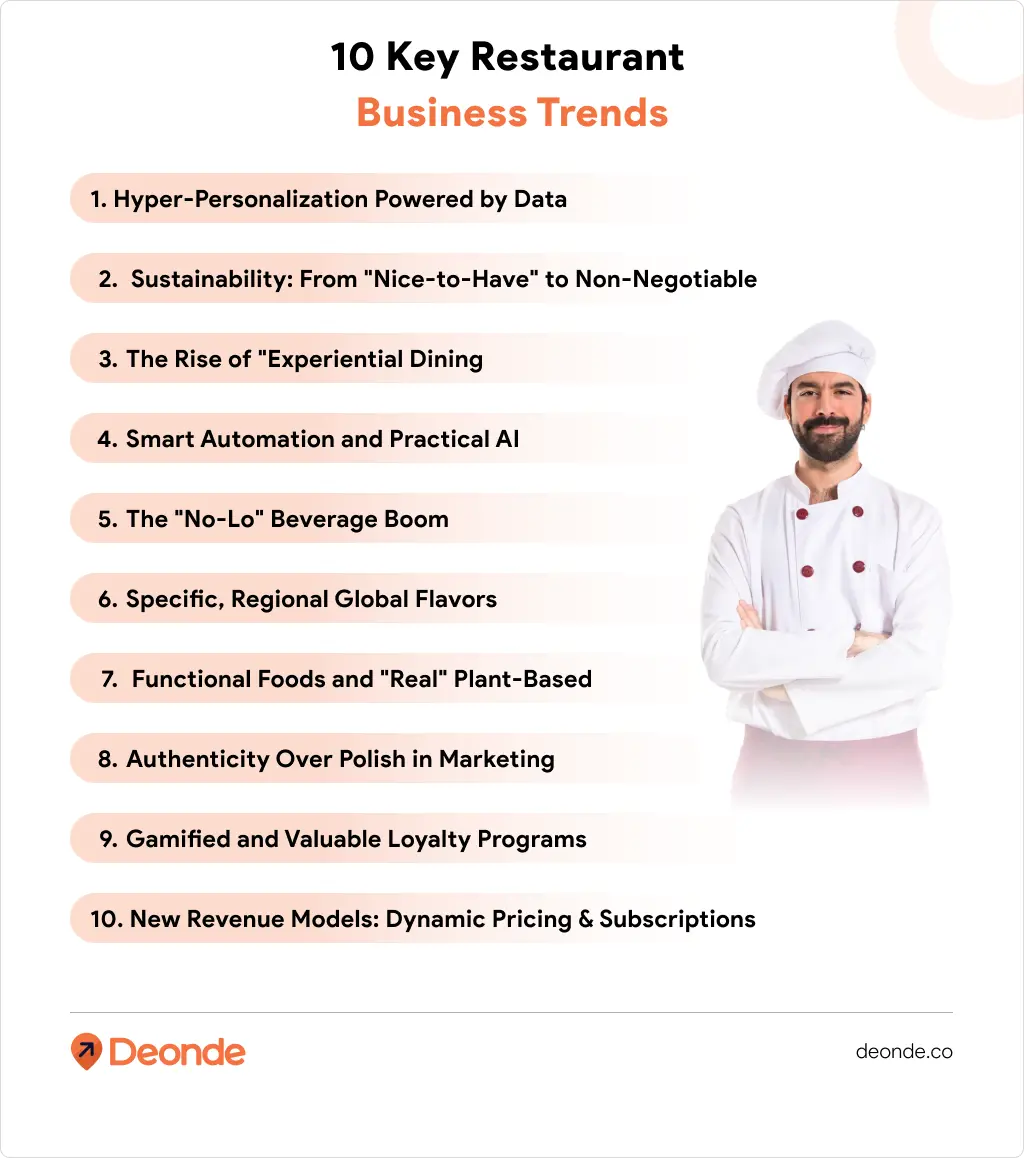
10 Key Restaurant Business Trends in the Industry
These are the 10 most important restaurant business trends that are currently shaping how restaurants operate, attract customers, and stay competitive in a rapidly changing market.
1. Hyper-Personalization Powered by Data
Restaurants are using customer data from POS and digital systems to personalize menus, offers, and dining experiences in real time.
Gone are the days when knowing a regular customer’s name was enough. Today, personalization is driven by data. Modern POS systems and integrated tech stacks are allowing restaurants to build detailed profiles of their diners.
This isn’t just about sending a birthday email. It’s about knowing a customer’s dietary restrictions, their favorite wine, their preferred seating area, and their average spend.
Restaurants are using this data to tailor digital menus in real-time, suggest add-ons they actually want, and send highly targeted offers. The goal is to make every guest feel like the experience was curated specifically for them.
2. Sustainability: From “Nice-to-Have” to Non-Negotiable
Sustainability has become a core expectation, with diners favoring restaurants that reduce waste, source responsibly, and operate transparently.
Sustainability has moved past being a buzzword on a menu to a core customer expectation, particularly among younger demographics. Diners are increasingly voting with their wallets for establishments that demonstrate responsibility.
This trend goes beyond just ditching plastic straws. It involves transparent sourcing of ingredients, active efforts to reduce food waste in the kitchen (sometimes using AI to track it), and energy-efficient operations. Restaurants that can authentically tell their sustainability story are finding it a powerful differentiator.
3. The Rise of “Experiential Dining”
Restaurants are focusing on immersive experiences that turn dining into an entertainment experience, not just a meal.
If customers can order excellent food to their couch in 30 minutes, why should they get dressed and leave the house? The answer must be: The Experience.
The industry is seeing a massive shift toward dining as entertainment. This doesn’t necessarily mean dinner theater; it means creating an immersive atmosphere that cannot be replicated at home. This could be open-fire cooking where guests watch the action, highly Instagrammable decor and plating, or unique thematic elements. The restaurant needs to be a destination, not just a refueling stop.
4. Smart Automation and Practical AI
AI is helping restaurants manage inventory, staffing, and workflows more efficiently while reducing operational pressure on staff.
The initial fear of robots replacing chefs has faded into a more practical reality: AI is here to handle the tasks humans hate doing.
We are seeing rapid adoption of AI in back-of-house operations. This includes predictive ordering to manage inventory better, AI-driven scheduling tools that optimize labor costs based on forecasted foot traffic, and automated kitchen display systems that streamline workflows. In the front-of-house, while human connection remains vital, AI chatbots are increasingly handling routine reservations and basic customer service queries, freeing up staff for face-to-face interaction.
5. The “No-Lo” Beverage Boom
Demand for no- and low-alcohol drinks is rising as customers seek premium social beverages without alcohol
Perhaps one of the highest-margin trends currently exploding is the “No-Lo” (No and Low alcohol) beverage sector.
A significant portion of the market, especially Gen Z and Millennials, are drinking less alcohol but still want the social ritual of a sophisticated drink. Restaurants are responding with complex, handcrafted mocktail menus that utilize premium ingredients, botanicals, and fermentation techniques. These aren’t just juices; they are high-end beverages that command cocktails-adjacent prices, boosting the average check significantly without relying on liquor sales.
6. Specific, Regional Global Flavors
Diners now prefer authentic, region-specific cuisines over broad or generic food labels.
Diners’ palates are becoming more educated and adventurous. Generic descriptors like “Asian” or “Mexican” are no longer enough. The trend is shifting toward hyper-regional specificity.
We are seeing a surge in interest for specific cuisines, such as regional Korean street food, diverse flavors from West Africa, and specific regional Mexican dishes beyond tacos. Customers are craving authenticity and the story behind specific spices and cooking techniques from narrower geographical areas.
7. Functional Foods and “Real” Plant-Based
Plant-based dining is shifting toward whole foods and functional ingredients that support health and wellness.
While the initial hype wave of hyper-realistic “fake meats” has plateaued, the demand for plant-based dining is stronger than ever—but it has evolved.
The focus has shifted away from ultra-processed meat analogues toward whole-food plant-based dishes. Chefs are getting creative with vegetables, legumes, and especially mushrooms as the center of the plate. Furthermore, diners are looking for “functional foods”—ingredients perceived to offer health benefits beyond basic nutrition, such as foods that aid gut health or improve focus.
8. Authenticity Over Polish in Marketing (Short-Form Video)
Short, real, behind-the-scenes videos now outperform polished ads in restaurant marketing.
In the realm of marketing, highly polished, studio-produced food commercials are losing effectiveness. The current king is authentic, short-form video content on platforms like TikTok and Instagram Reels.
Customers want to see the behind-the-scenes reality: the controlled chaos of the kitchen, the personality of the chef, and the steam rising off a dish shot on an iPhone. User-Generated Content (UGC)—customers posting their own videos of your food—is the most valuable marketing currency available today.
9. Gamified and Valuable Loyalty Programs
Modern loyalty programs use digital tools and rewards to keep customers engaged and returning more often.
The old “buy 10, get one free” punch card is practically obsolete. Modern loyalty programs need to be digital, integrated, and, crucially, engaging.
Successful restaurants are “gamifying” loyalty. This means offering tiered rewards, unlocking exclusive menu items for top-tier members, or providing instant gratification perks rather than making customers wait months for a payoff. The goal is to move a customer from a casual visitor to a brand advocate through continuous, interactive engagement.
10. New Revenue Models: Dynamic Pricing & Subscriptions
Restaurants are adopting dynamic pricing and subscription models to create stable, recurring revenue streams.
Restaurants are beginning to experiment with pricing models borrowed from other industries. Dynamic pricing, where prices fluctuate based on demand (similar to airlines or ride-sharing), is being explored for peak dining times. Additionally, subscription models for coffee, meals, or exclusive perks are gaining traction as a way to generate predictable, recurring revenue and foster long-term customer loyalty.
Conclusion
Restaurant business trends matter because they show how customer expectations, technology, and operations are evolving faster than traditional models can keep up.
From personalization and sustainability to AI, marketing, and new revenue models, these 10 restaurant business trends highlight what restaurants must adapt to in order to stay competitive.
Rather than following every trend blindly, successful restaurants will focus on the strategies that align with their brand, audience, and long-term goals.

Frequently Asked Questions (FAQs)
1. Do small and mid-sized restaurants need to follow these trends?
Yes, even small and mid-sized restaurants benefit from following trends, as many strategies like digital ordering, personalization, and loyalty programs are scalable and cost-effective.
2. Which restaurant trend has the biggest impact on profitability?
Trends such as automation, data-driven personalization, and new revenue models often have the most direct impact on reducing costs and increasing repeat customers.
3. How can restaurant owners decide which trends are right for their business?
Owners should evaluate trends based on their target audience, budget, location, and operational capacity rather than following every trend blindly.
4.Do restaurant trends change every year?
Some trends evolve yearly, while others remain relevant for several years, making continuous observation more important than frequent drastic changes.
5. Can ignoring industry trends affect a restaurant’s long-term growth?
Yes, consistently ignoring market shifts can lead to declining relevance, reduced customer interest, and difficulty competing with modern restaurant brands.